Post-purchase feedback should be easy. Someone just bought. You ask a question. You get “All good.” Then refunds show up, support repeats the same fixes, and repeat purchases don’t move. The problem usually isn’t customers. It’s timing.
Right after checkout, people can explain what pushed them to buy and what almost stopped them. After delivery and first use, they can tell you where reality didn’t match expectations. A few weeks later, they can tell you whether it actually earned a spot in their routine, and what would bring them back.
This article turns that into a simple system. You’ll get what to ask on Day 1, Day 7, and Day 30, what each question is meant to reveal, and how to use the answers to reduce churn signals, spot product issues early, and improve repeat-buy drivers.
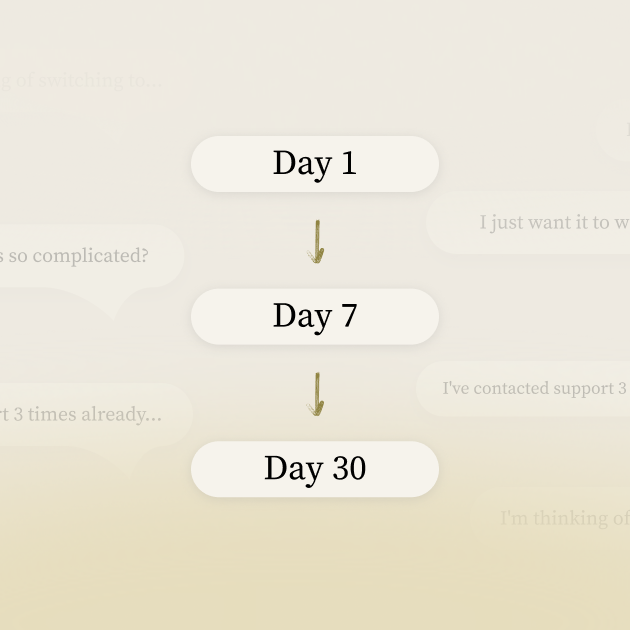
Quick scan: Day 1 vs Day 7 vs Day 30
Here’s the easiest way to scan the whole system before diving into the questions:
Now let’s move on to the details and the exact questions to ask your customer at each point.
What to Ask on Day 1 After a Purchase
Day 1 is when the “why” is still clean. The purchase is done, but nothing has happened yet, so answers tend to reflect real intent and expectations, not shipping delays, first-use friction, or second thoughts.
Done Day 1 well, this is how you achieve enterprise-grade customer insights without running a heavy survey.
Question 1: What was the main reason you bought today?
Best use case: Clarify the true conversion driver (offer vs. trust vs. urgency vs. need).
What it reveals: The “job” they hired you for.
How to use the answer: Treat this as your segmentation switch.
- If the buyer’s reason is outcome-based (solve a problem, feel a benefit), your first post-purchase message should be “how to get the first win fast.”
- If it’s trust-based (reviews, guarantees, legitimacy), reinforce proof and reduce anxiety (shipping clarity, returns clarity, what happens next).
- If it’s urgency/price-driven, make sure the next messages re-anchor value so the purchase doesn’t become “I only bought because it was on sale.”
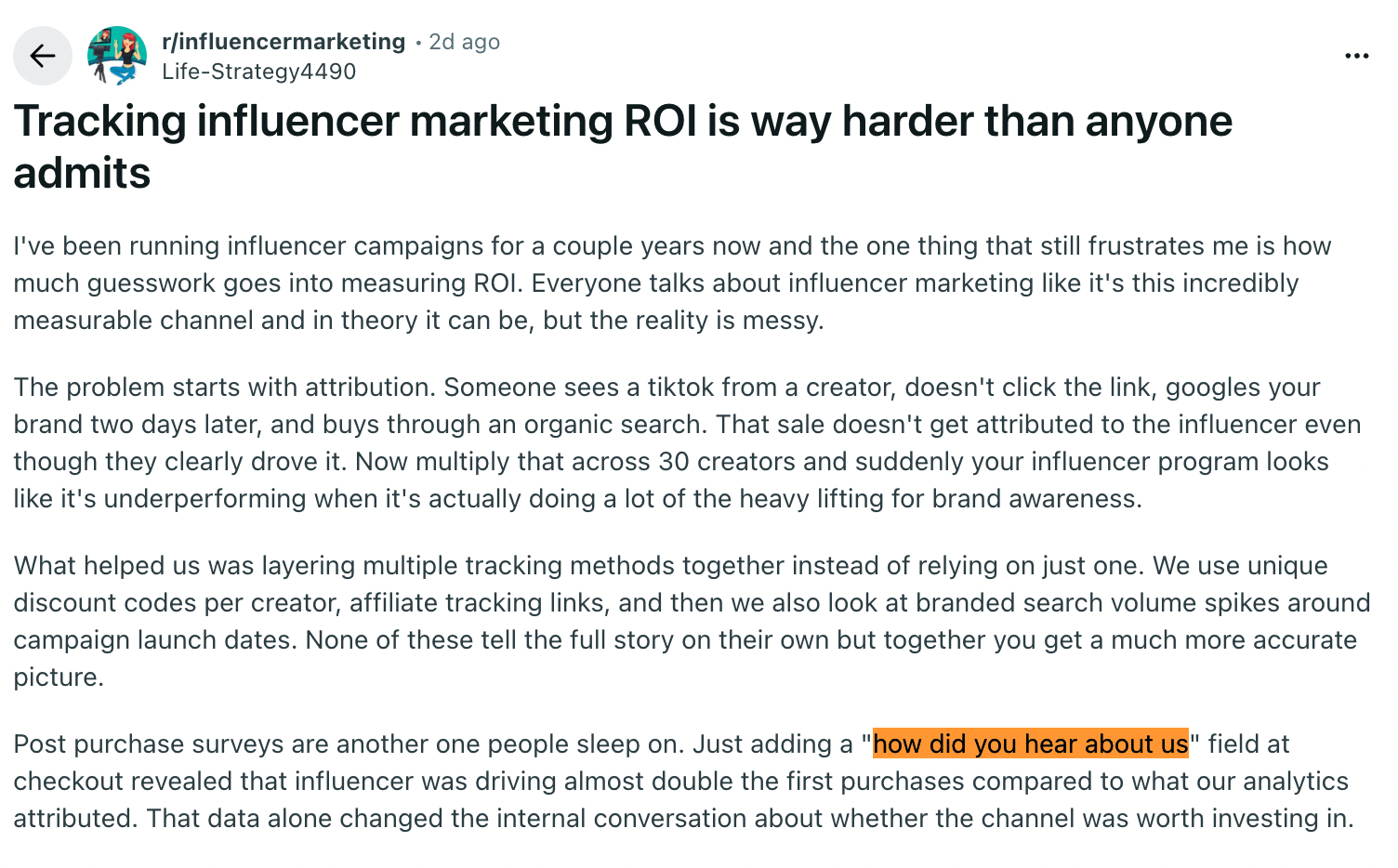
Question 2: How did you first hear about us? (open text)
Best use case: Catch where customers really come.
A very recent comment in an influencer marketing thread explains why this question matters: adding a simple “how did you hear about us” revealed influencer-led first purchases were nearly double what analytics showed.
What it reveals: Discovery paths your tracking misses.
How to use the answer: If your dashboard can’t see the real path, you need the customer’s version of events. Collect it on Day 1, then bucket responses weekly (creator name, community, friend, TikTok, etc.). Use that list to rebalance spend and build repeatable plays (specific creators/newsletters/communities).
Question 3: What almost stopped you from buying?
Best use case: Reduce checkout/product page drop-off.
What it reveals: The last-mile friction (price, trust, shipping, info gap).
How to use the answer: This is your fastest route to CRO priorities because it comes from people who did convert but still had doubts. It’s also a shortcut to deep customer understanding of hesitation you can actually fix.
Tag answers into a few friction categories (shipping uncertainty, returns anxiety, price/value, missing info, trust) and fix only the top one or two that repeat. Then re-check if the theme frequency drops.
Question 4: What did you expect this product to help you do?
Best use case: Catch expectation mismatch before refunds.
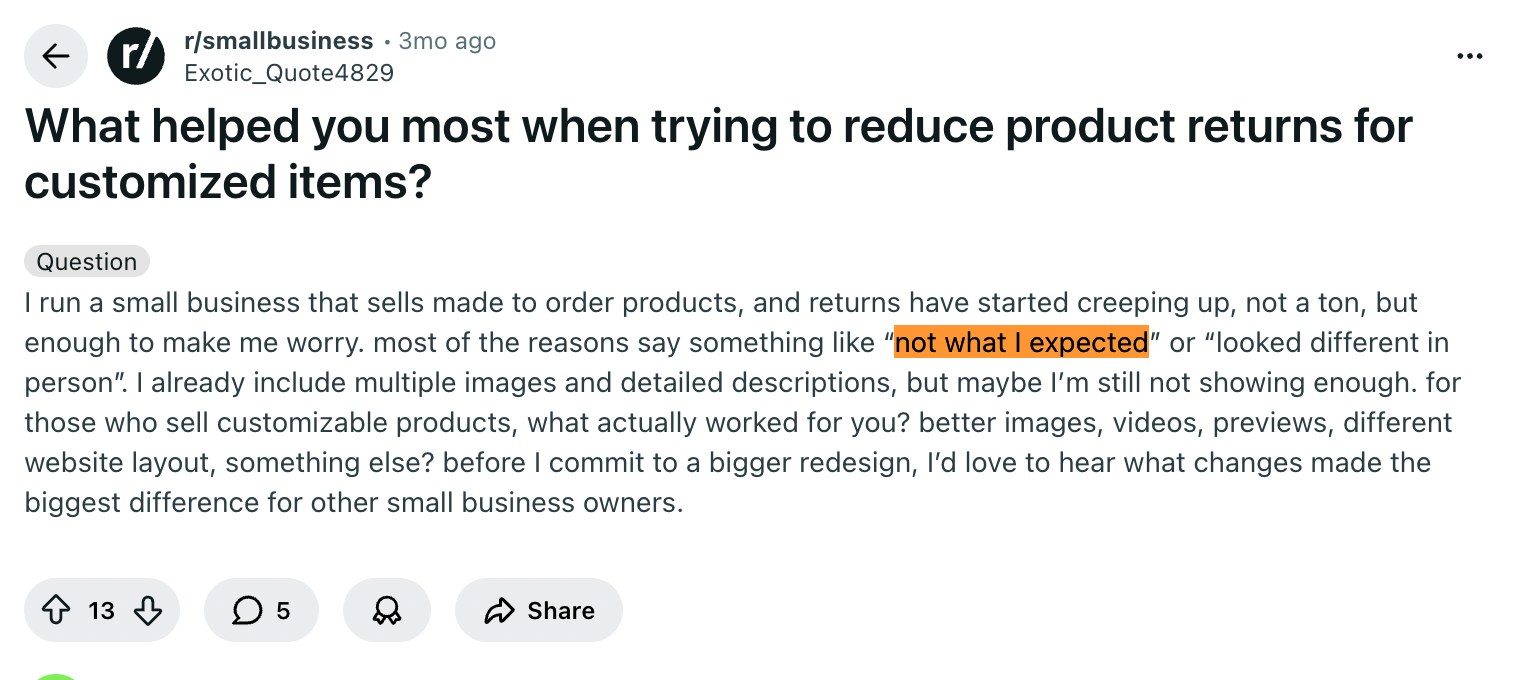
Expectation mismatch is a repeated theme in business discussions. In a recent business thread, a seller said return reasons were often “not what I expected” or “looked different in person.” If you know the buyer’s expected outcome on Day 1, you can prevent the mismatch from forming (or correct it early).
What it reveals: Their success criteria.
How to use the answer: Improve product page language + onboarding inserts.
- Remove implied promises that don’t match what you deliver.
- Send a first-win path based on the expected outcome.
- If expectations are unrealistic, send a gentle clarification earlier.
Question 5: Was anything confusing during checkout? (Yes/No → “What?”)
Best use case: Fast UX check.
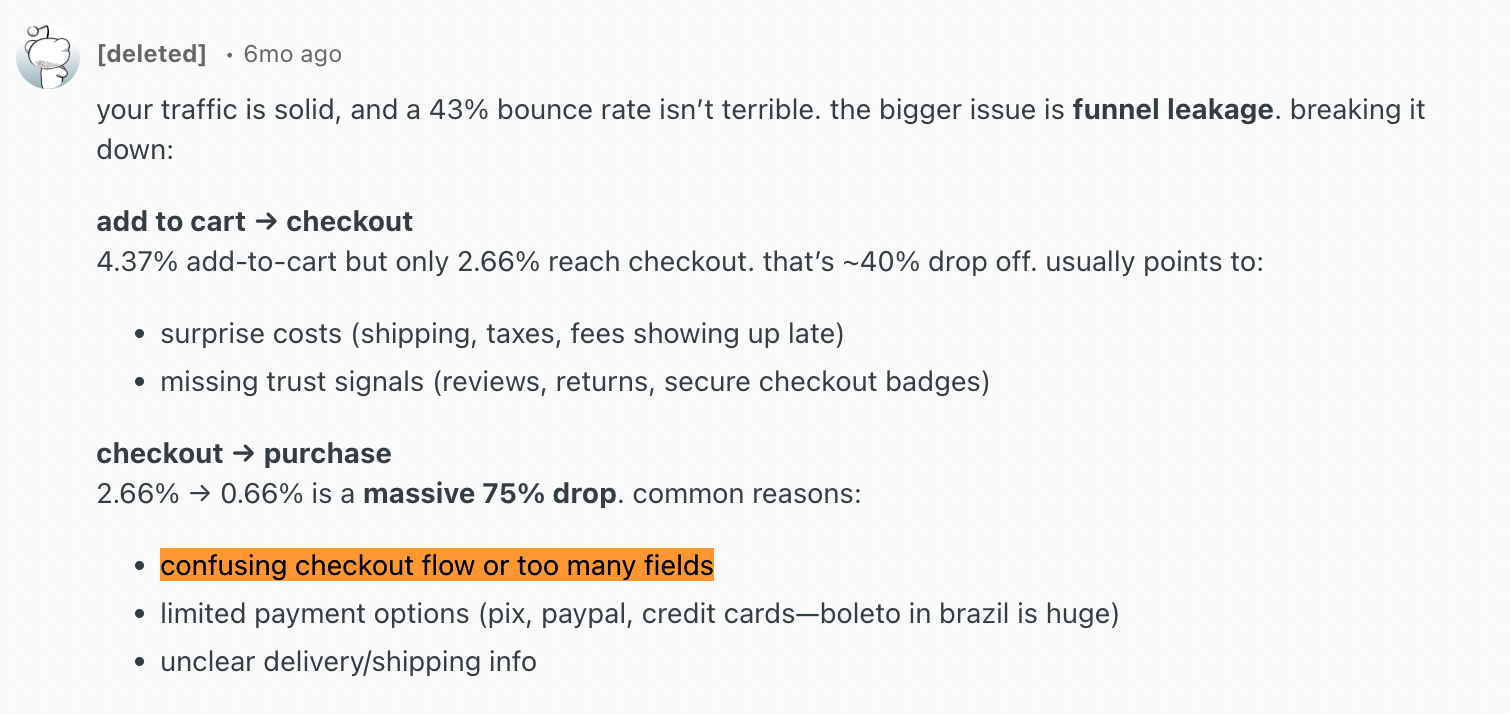
Low conversion-rate threads constantly point to checkout friction. One recent e-commerce reply lists “confusing checkout flow or too many fields” as a common cause. This question is how you catch that friction in plain language, especially issues analytics won’t label as “confusing.”
What it reveals: Friction you may not see in analytics.
How to use the answer:
Treat this as a bug-report stream and clarity detector. If you hear the same confusion repeatedly (discount code anxiety, shipping cost surprise, payment uncertainty, upsell confusion), fix it once in the interface and confirm the complaint rate drops. Don’t expand the scope unless a theme is recurring.
Also, keep the collection lightweight. A lot of people ignore surveys by default, especially if they feel like extra work with no payoff, so Day 1 needs to be minimal and optional.
What to Ask on Day 7 After a Purchase
Day 7 is when the purchase stops being a decision and starts being an experience. The package has arrived, or they’ve tried the tool at least once, and any small friction is now real, not theoretical.
That’s why this is the best moment to catch delivery issues, setup blockers, and early disappointment before they turn into returns, complaints, or silent churn.
Question 1: Did your order arrive when you expected? If not, what happened?
Best use case: Spot churn risk caused by shipping and tracking issues early.
What it reveals: Whether disappointment started before first use, and what exactly caused it (late delivery, no updates, broken tracking, damage).
How to use the answer:
- If many people say “late” or “no updates,” make delivery expectations clearer on your site and in confirmation emails.
- If tracking issues repeat, fix the messaging (where to track, when updates appear) and give support a simple, fast response.
- If packages arrive damaged, treat it as a packaging/handling problem and adjust protection.
Question 2: What stood out when you opened the package?
Best use case: Understand the unboxing moment (delight or doubt).
What it reveals: First impression signals: premium vs cheap, clear vs confusing, cared-for vs generic.
How to use the answer:
- If people say it felt cheap/confusing, improve packaging, labeling, or what’s included in the box.
- If people love something (look, scent, packaging detail), highlight that on your product page and in ads.
- If people say “I didn’t know what to do first,” add a simple “Start here” insert or first-step email.
Question 3: What was the hardest part of getting started?
Best use case: Catch setup friction before it turns into returns or complaints.
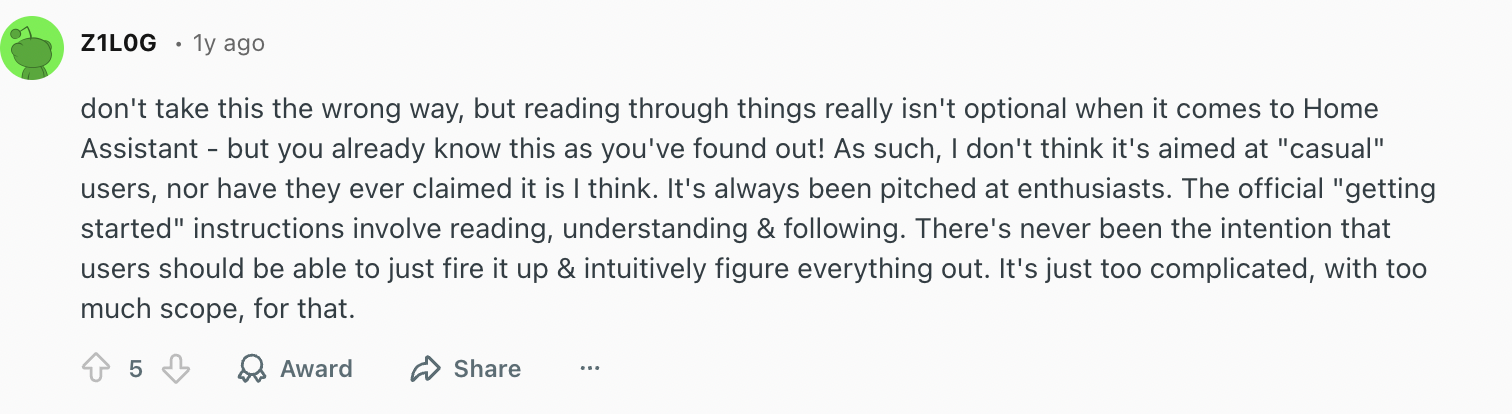
In one of the threads about setup/instructions, someone put it simply: getting started means “reading, understanding & following.” If that part is hard, people often blame the product.
What it reveals: Where they got stuck (instructions, assembly, sizing/fit, pairing, first use, missing “step one”).
How to use the answer:
- Pick the most common stuck point and fix it with one simple thing: a quick-start card, a short video, or a clearer first email.
- If a lot of people struggle with the same step, rewrite that step in plain language and show a photo/example.
Question 4: After the first use, did it match what you expected? (Yes/No → what was different?)
Best use case: Catch expectation mismatch here if you haven’t done it on Day 1
What it reveals: The gap between promise and reality (quality, size, ease, performance).
How to use the answer:
- If people expected something different, update your product page to be clearer (photos, sizing, what’s included, what results to expect).
- If people say “No,” send a helpful follow-up: a quick tip, setup help, or a support option, whatever makes sense for your product.
- Use repeated “No because…” reasons to prevent future mismatches
Question 5: If you could change one thing about the product or experience, what would it be?
Best use case: Get one specific improvement without overwhelming people.
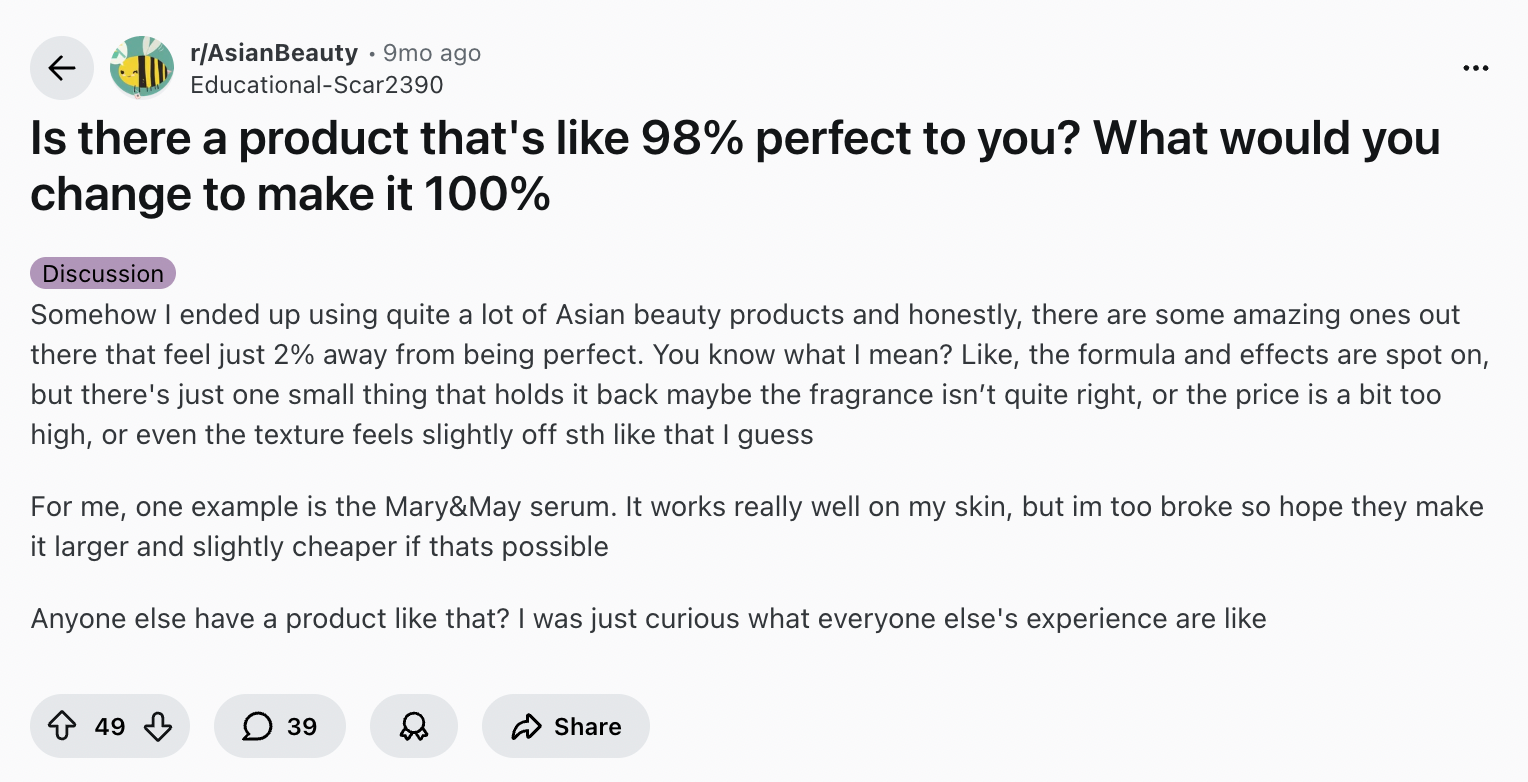
A recent discussion framed it as what’s “98% perfect” and what would make it “100%.” That’s the mindset you want.
What it reveals: The single biggest lever that would make the experience better.
How to use the answer:
- Group answers into simple buckets: product, delivery, instructions, packaging, support.
- Choose the top repeated one and fix it first, then check if that complaint shows up less next week.
- If the one change is actually a misunderstanding, fix the explanation (your copy or onboarding), not the product.
What to Ask on Day 30 After a Purchase
By Day 30, the product has either slipped into someone’s routine or quietly faded into the background.
This is the point where feedback stops being about first impressions and starts showing what actually drives a second purchase, and what makes people move on.
Question 1: Would you buy this again with your own money? Why or why not?
Best use case: Get a clean read on repeat intent.
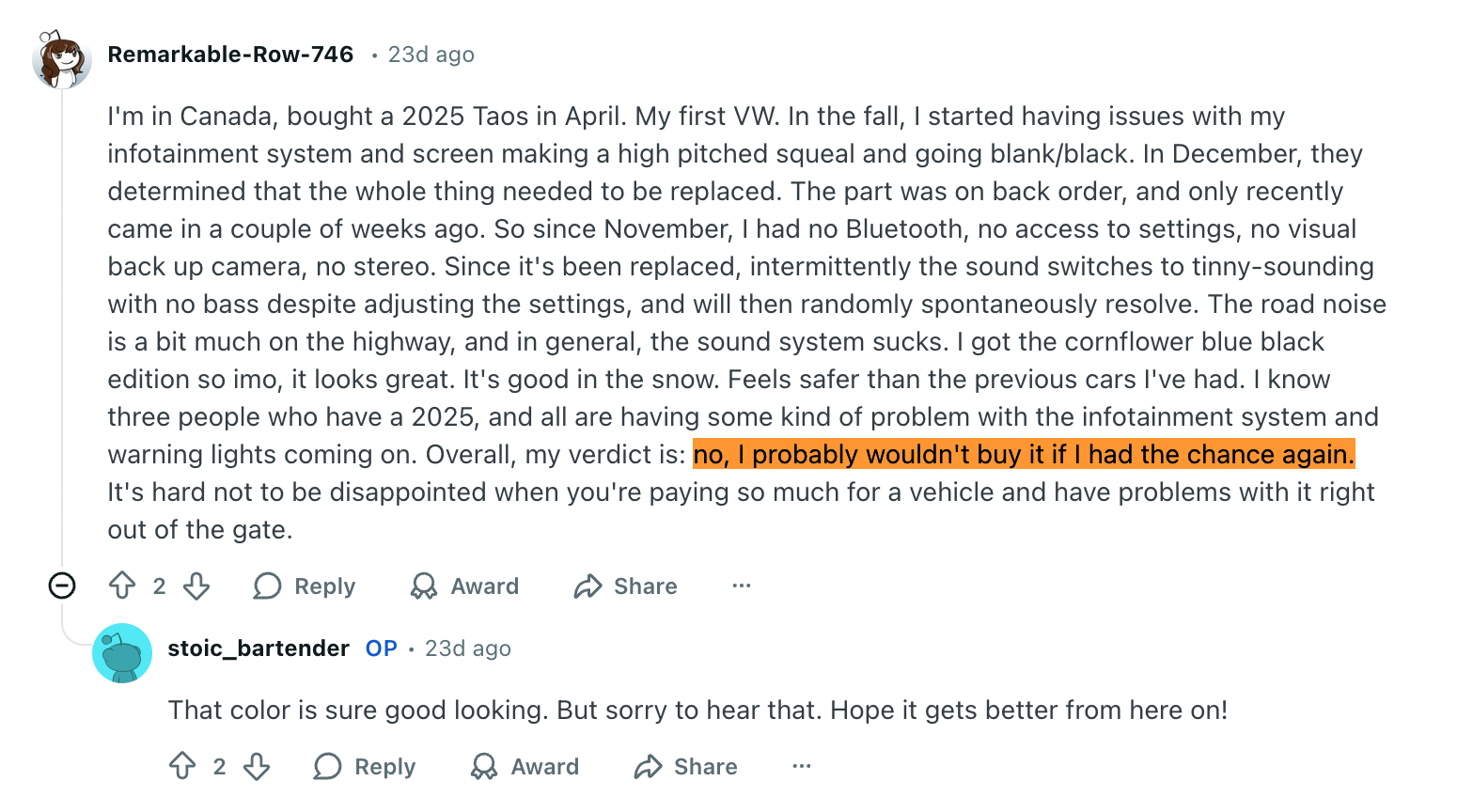
A recent “would you buy again” thread shows how fast people decide once a problem repeats: “No, I probably wouldn’t buy it if I had the chance again… problems with it right out of the gate.”
What it reveals: The real reason they’ll return (or disappear): trust, results, convenience, or a recurring annoyance.
How to use the answer:
- If many say “yes,” ask what made it a yes, then repeat that message in emails and on the product page.
- If many say “no,” write down the top 1–2 reasons and fix those first (don’t try to fix everything).
- If answers split, create two follow-ups: one for happy buyers (referral/UGC), one for “almost satisfied” buyers (help + reassurance).
Question 2: What result have you noticed so far?
Best use case: Learn what success actually means to real buyers after living with the product.
What it reveals: The outcome they care about most (and the words they use to describe it).
How to use the answer:
- Turn the most common result into your main post-purchase message (and even your headline on the product page).
- If results are vague, your onboarding may be missing a clear “how to get the best outcome” step.
- If results are negative, look for patterns (same complaint repeated) and fix that before pushing promos.
Question 3: What’s the one thing that would make this experience better?
Best use case: Get one actionable improvement without overwhelming them.
What it reveals: The single biggest friction point still remaining (product, delivery, instructions, support, etc.).
How to use the answer:
- Pick the most repeated “one thing” and improve it first.
- If the “one thing” is confusion, rewrite your instructions/onboarding (simple beats fancy).
- If the “one thing” is trust (returns, durability, sizing), make those details clearer where people decide to buy.
Question 4: Have you recommended it to anyone? If not, what stopped you?
Best use case: Find the “silent dealbreaker” that blocks word-of-mouth.
What it reveals: The one hesitation that stops them from putting their name on it (quality doubt, reliability, embarrassment, hassle, fear it won’t work for others).
How to use the answer:
- If people say, “I haven’t recommended because…”, fix that exact reason in your messaging or product experience.
- If they have recommended, ask who they recommended it to and mirror that wording on your product page (“perfect for…”).
- Use the biggest “stops me” reason as your next reassurance email topic.
Question 5: How disappointed would you be if you couldn’t use this anymore?
Best use case: Measure real attachment and true product value after a month of use.
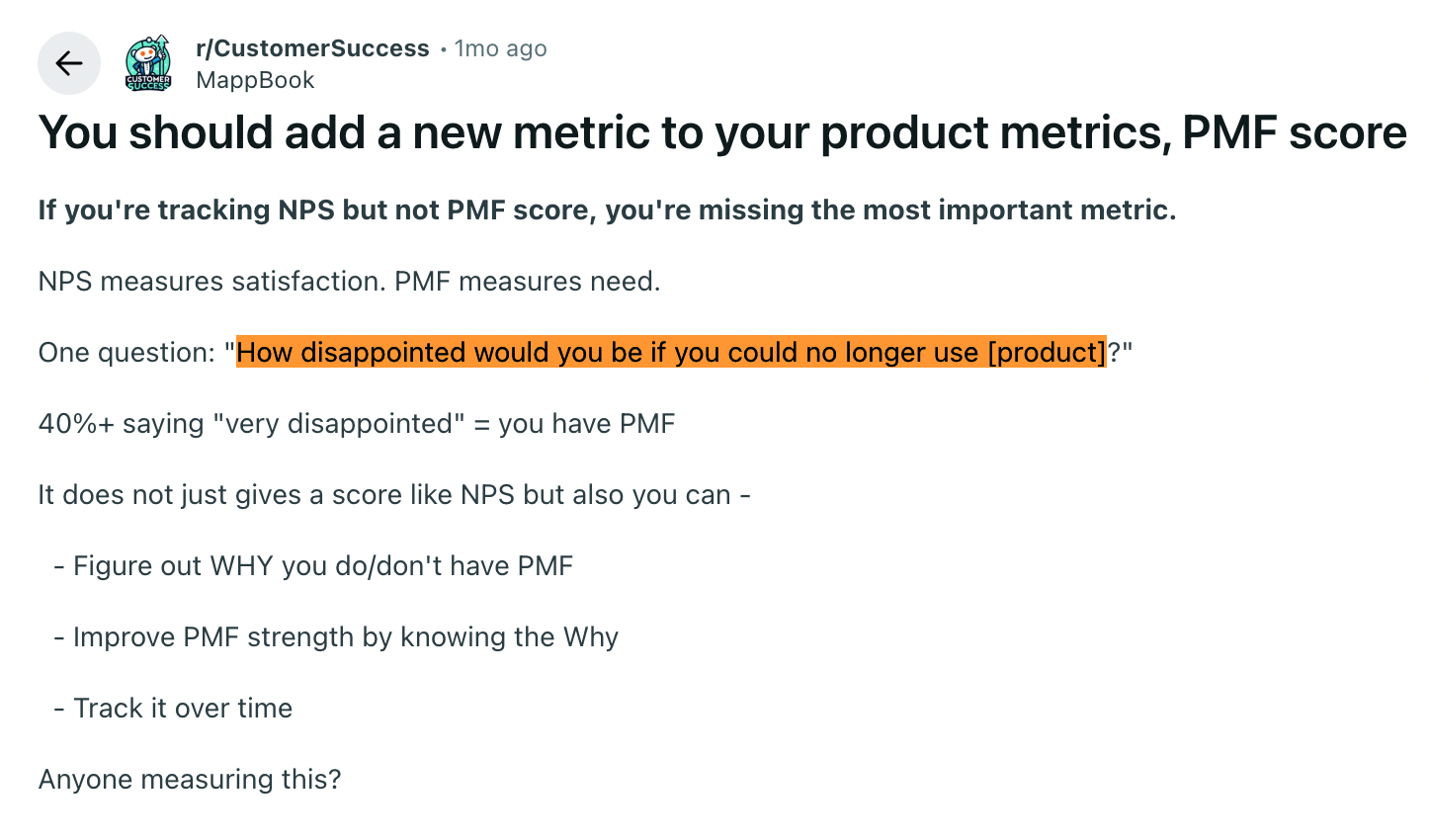
A recent discussion framed this as a strong indicator of real need: “How disappointed would you be if you could no longer use [product]?” with “40%+ saying ‘very disappointed’” as a meaningful threshold.
What it reveals: Whether the product became part of their routine, or stayed a nice-to-have.
How to use the answer:
- If many say “very disappointed,” lean into retention: subscriptions, refills, bundles, or a second purchase that fits naturally.
- If many say “not very,” don’t push harder; teach them how to get a better result (or clarify who it’s for).
- Track this over time. If it improves, your product + onboarding is getting stronger.
How to Collect Real-Time Post-Purchase Feedback (Without Annoying Customers)
Post-purchase feedback becomes annoying the moment it feels like a survey. The trick is to make it feel like a quick check-in that respects the customer’s time.
Depth still matters, but it shouldn’t be forced. A clean way to get both response rate and detail is a two-layer system: ask one sharp question, then offer an optional “tell me more” path for anyone who has something real to say.
This is also where AI interviewers help. Surveys are great for quick signals, but when you need the why behind the answer, an interview-style follow-up is what gets you there. The problem is time. Teams don’t have the bandwidth to schedule and run interviews every week, especially post-purchase.
An AI interviewer like Frank can handle those deeper follow-ups automatically, so you can keep the main flow light while still collecting real explanations.
- Best use case: When you need interview-level clarity (why they bought, why they struggled, why they didn’t reorder), but you can’t realistically run manual interviews.
- What it changes: Instead of one-off feedback snippets, it keeps a continuous loop of conversations going. Customers can explain what happened in their own words, and follow-ups can happen naturally. Over time, this becomes a living “Customer Brain” you can rely on
- Output: Clear themes and sourced customer quotes you can use for decisions and messaging, plus patterns that build up over weeks (what drives delight, what causes churn risk, what triggers repeat purchase).
The point isn’t to replace your judgment. It’s to make the customer truth easier to get, and harder to argue with.
Make Post-Purchase Feedback Boringly Effective
It’s kind of funny how the most expensive answers usually hide inside the smallest questions. Ask the wrong thing, and you’ll get polite filler. Ask the right thing at the right moment, and customers hand you your best headline, your biggest objection, and the exact reason they didn’t come back.
Also: “All good” is rarely a compliment. It’s just what people say when you make it hard to be specific. Keep the questions light, make depth optional, and when you want the why behind the answers without turning it into a scheduling project, an AI interviewer like Frank can carry those follow-ups for you.
Test before you invest
You can directly publish this — I’ve included headings, examples, benefits, challenges, and a strong conclusion.

FAQ
How many questions should a post-purchase survey have?
One is ideal. Two is still fine. More than that usually lowers completion and pushes people into generic answers.
Should I ask on the thank-you page or email/SMS?
Use the thank-you page for Day 1 questions because it’s low friction right after purchase. Use email/SMS for Day 7 and Day 30, because those depend on delivery and time to try the product.
What if customers give generic answers?
Make the question more specific. “What almost stopped you?” gets better answers than “Any feedback?” Also, add an optional follow-up only when someone signals a real issue or a strong opinion.
How do I tag and use responses without making a mess?
Keep tags small and simple. Use a handful of buckets (intent, objection, shipping, setup, expectation mismatch). Review weekly, pick the top one or two patterns, and act on those. If you’re not acting, simplify.
What’s the best timing if shipping takes 10–14 days?
Don’t tie Day 7 to the calendar. Tie it to delivery + first use. Send the Day 7 questions 1–2 days after delivery. Send Day 30 questions 2–4 weeks after delivery, depending on how fast people usually get results.
