
You know the frameworks. RICE. MoSCoW. Impact-Effort. You've used them all.
But every planning cycle, the same thing happens. Three stakeholders walk in with three different "top priorities." A sales rep quotes one customer. Engineering pushes back on effort estimates. And the loudest voice wins.
The problem is your inputs. And no amount of AI tool marketing will fix that unless you address the source of the data first.
This article shows how to use AI to make prioritisation faster, more defensible, and less political.
Key Takeaways
- AI won't replace your judgment. It cleans up the inputs on which your judgment depends.
- The real bottleneck isn't the framework - it's the quality of customer data feeding it.
- The best PMs use AI at two moments: before the meeting (to gather signals) and during synthesis (to find patterns).
- High-volume customer interviews, run quickly and consistently, turn roadmap debates from opinion-driven into evidence-driven.
Why Bad Customer Data Makes Every Framework Useless
Prioritisation looks like a data problem. It's actually a data quality problem.
Most PMs base their RICE (Reach, Impact, Confidence, and Effort) scores on 1–2 customer calls per month. That's not a customer signal - that's an anecdote. When Sales pushes a feature because "three customers asked for it," you have no way to push back with evidence. Traditional methods rely on intuition, static scoring models, or competing stakeholder demands - and the result is roadmaps that look busy but lack focus.
You're Prioritising Based on 2 Customer Calls a Month
Ask r/ProductManagement whether AI can replace a PM, and you’ll hit the same wall. In one widely shared thread, PMs argue the hard parts of the job. Strategy, stakeholder navigation, and judgment under incomplete information aren’t things a model replaces. That’s fair.
But it also sidesteps the real problem: most PMs aren’t losing to AI, they’re losing to thin inputs. If your roadmap is built on 1-2 customer calls a month, you’re not exercising judgment; you’re guessing with confidence.

Scheduling is the silent killer. You set up 10 interviews. Seven don't show. The other three are with your most loyal customers - not the ones who churned or never activated.
By the Time Insights Arrive, The Sprint is Already Decided
By the time a research report lands, the sprint has already started. The backlog debate already happened. You're using last quarter's data to justify this quarter's roadmap.
As Reforge noted: "I can whip out a spec in like 12 minutes now... But it is all the little micro decisions - things we call product sense, taste, prioritisation. These things are actually harder now because the realm of possible solutions is even wider." Speed without a fresh signal creates more decisions, not better ones.
How to Actually Use AI for Feature Prioritisation
Replace Anecdotes With Real Customer Volume
AI is only as good as what you feed it. Before you use AI to score or rank features, make sure your customer data isn't just "the loudest voices in Slack."
Aim to gather input from at least 20–30 customers per prioritisation cycle. Not sure how many interviews you actually need?
Use a mix of churned users, power users, and recent sign-ups. Each group will tell you something different.
Use AI to Cluster 40 Conversations in Minutes, Not Weeks
Once you have raw customer input, use an AI tool (Claude, ChatGPT, or a purpose- built research tool) to cluster it by theme. Getting deeper insights from your interviews before you feed them into AI makes the output significantly more useful. A good prompt looks like:
Prompt example:
"Analyse these 40 customer interview transcripts. Group responses by theme. For each theme, note: frequency, sentiment intensity (1–5), and 3 representative quotes. Rank themes by how often they appear and how frustrated customers sound."
This turns 40 conversations into a structured insight map in minutes - not weeks.
Score Your Backlog Against Real Frustration Data, Not Gut Feel
Take the top 5–7 themes from your synthesis. Match them against your current backlog items. Ask AI to help you score RICE based on the frequency and sentiment data - not gut feel.
This gives you a defensible "Confidence" score. AI doesn't rely on subjective scoring from stakeholders. AI uses real business metrics such as customer churn, conversion rates, and revenue projections to assign values. Instead of "I think this matters," you can say "37 of 40 customers raised this, with a frustration score of 4.2."
Use AI to Find the Blind Spots in Your Top Priorities
Before locking the roadmap, use AI as a devil's advocate. Feed it your top 3 priorities and ask:
- What are the strongest arguments against each of these?
- What signals in this data might I have misread?
- Which of these solves a symptom vs. the root cause?
This is where experienced PMs separate themselves. AI doesn't replace the art of product management - it adds a powerful layer of intelligence that makes prioritisation faster, smarter, and more customer- informed.
Turn One Insight Set Into Messages That Land With Every Stakeholder
Use AI to translate your findings into audience-specific summaries. Engineering cares about effort and dependencies. Executives care about revenue and retention impact. Sales cares about close rates.
One set of insights, multiple clear messages. PMs spend a huge amount of time translating the same core information for different audiences. AI can take one source document and generate multiple targeted versions. This cuts the meeting prep that usually eats an entire afternoon.
How Frank Turns Customer Conversations Into Prioritisation Evidence
Frank AI Researcher is an AI customer interviewer that conducts voice interviews (video and WhatsApp coming soon), analyzes responses using scientific research methodology, and delivers structured insights overnight with no scheduling required.
Every interview is analysed using proven scientific research methodology. Structured summaries land overnight - ready to feed directly into your prioritisation workflow.
How Frank AI Researcher Compares to Traditional Customer Research
When to Deploy Frank in the Customer Journey
Frank works best when it fires at exactly the right moment in the customer journey.
How Frank Works: From Research Goals to Structured Insight
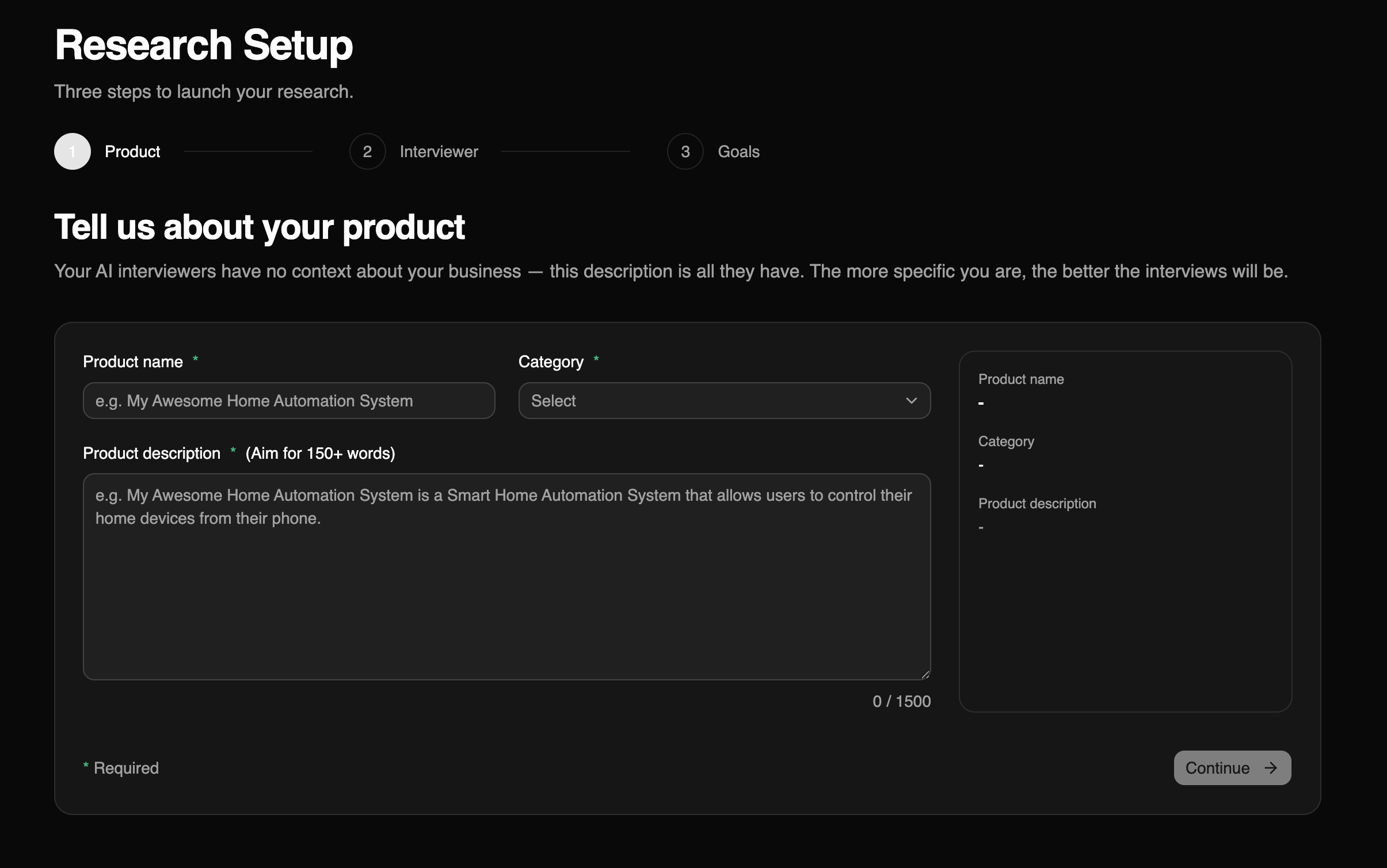
1. Set up your product - Give Frank the context it needs to ask the right questions — what your product does, who uses it, and the problem you're trying to prioritise around.
2. Set your research goal - Tell Frank what you need to understand (e.g., "Why do users churn after trial?"). Frank uses proven methodology to structure the interview questions.
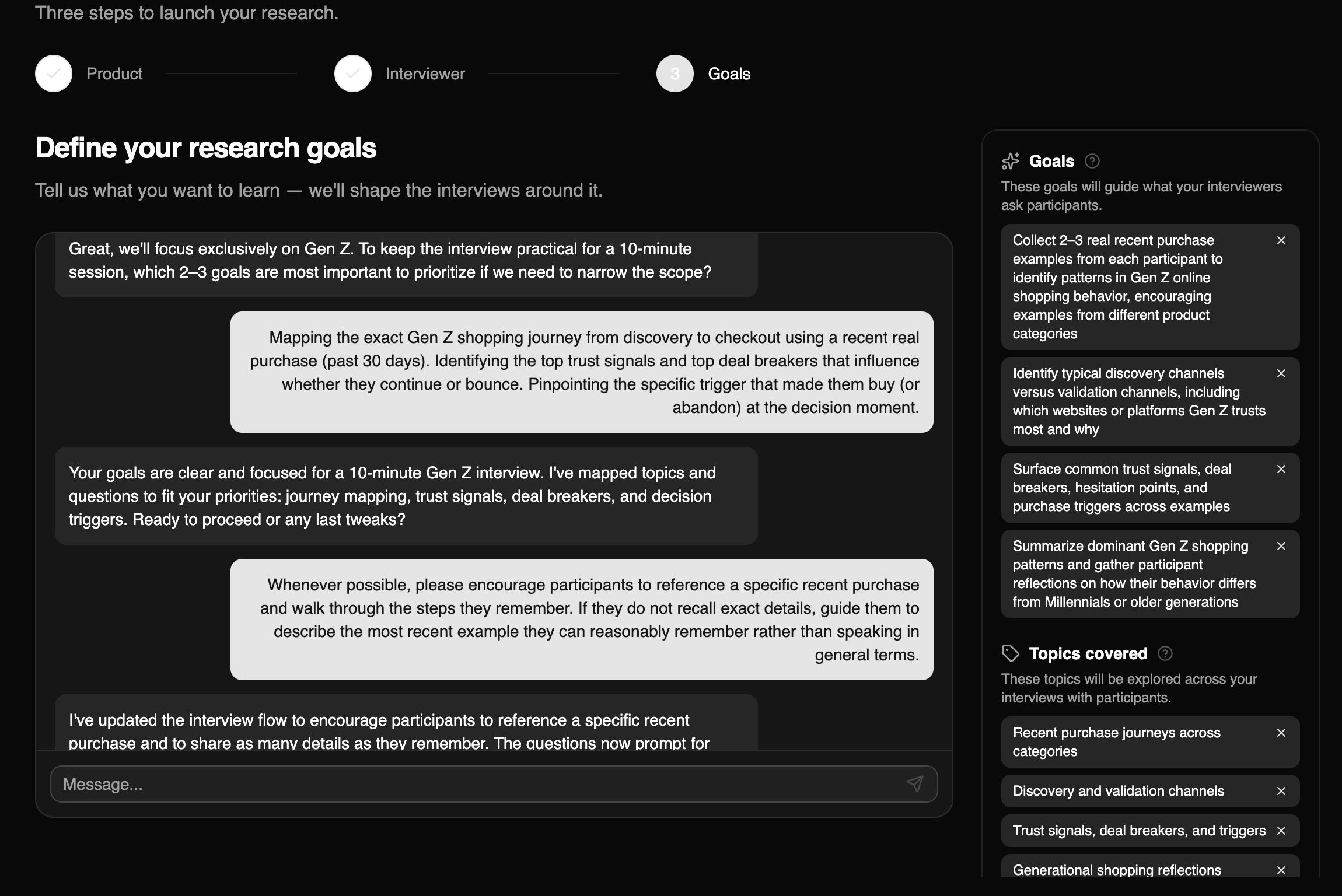
3. Send the interview to your customers - Frank generates an interview link, which you can send to your customers. They respond when it's convenient. No scheduling.

Frank conducts the conversation
Adaptive, natural dialogue. Frank uses adaptive follow-up questions based on the participant's responses - probing contradictions, missing details, or unclear answers so you get interview- quality depth, not survey- quality noise.
Receive structured insights overnight
Themes, sentiment scores, and direct quotes - all organised and ready to map to your backlog.
Verify any claim
Every insight links back to the raw transcript and recording. When a stakeholder pushes back, you show the evidence - not just the summary.
What Actually Changes in the Meeting
Here's the moment the feedback asked for. Not a framework. Not a theory. The actual shift.
Same meeting. Same stakeholders. Same CPO. Different outcome.
Notice what changed?
The CPO didn't suddenly become data-driven. The sales rep didn't stop advocating for their customer. What changed is that the PM had something nobody else in the room had: a specific, verifiable signal from the exact users who left.
That's not a synthesis tool. That's not a better prompt. That's 40 real conversations that happened overnight - while the PM was doing everything else.
This is the shift Lenny Rachitsky described: AI gives PMs a strong first draft for roadmaps. But the real unlock isn't the draft - it's walking into the room with evidence that's more specific and more recent than anything a stakeholder can counter with.
Where to Start Before Your Next Planning Cycle
You can’t remove politics from prioritisation. You can make an opinion a weaker argument than evidence.
Before your next planning cycle, pick one decision on the table and run 20–40 interviews against it — churned users, inactive users, recent activators. Bring the themes, frustration scores, and quotes into the room. That’s the shift. Not next quarter.This week

FAQ
Will AI just tell me what I want to hear when I prioritise?
Only if you let it. The key is feeding AI real customer data, not your internal assumptions. When you give it 40 raw interview transcripts, it surfaces patterns across all of them, not just the ones that confirm your bias. That's why the input quality matters more than the AI tool you choose.
We already do surveys. Why isn't that enough?
Surveys tell you what customers say. Interviews tell you why they say it. A survey might show that 60% of churned users cited "missing features." An AI interviewer asks which features, why they mattered, and what they switched to instead. That's the insight that actually changes your roadmap.
How do I convince my CPO to trust AI-generated insights?
Don't ask them to trust the AI, ask them to trust the customers. Tools like Frank link every insight back to the raw transcript and recording, so you're not presenting a black-box summary. You're presenting 40 customer voices, organised into a clear picture. That's evidence, not opinion.
We don't have a research team. Is Frank still useful?
Frank is designed for companies with and without a research team. You don't need to be a researcher to use it. You say what you need to understand, Frank handles the interview structure, conducts the conversations, and delivers structured summaries.
How many interviews do I actually need for a reliable signal?
For most prioritisation decisions, 20-40 interviews are enough to identify the top 3–5 themes with confidence