.png)
Customer research used to be a long game of calendar tetris. You’d spend weeks recruiting, scheduling, and apologizing for technical glitches, all to get twenty minutes of feedback that’s already three weeks stale. By the time you had the insights, the product had moved on.
It was exhausting. But it’s 2026, and the game has changed.
AI interviewers are no longer just fancy surveys. They are sharp, adaptive agents that live where your customers do: on voice, video, or chat. They catch users in the moment, ask the clever follow-up questions you’d ask yourself, and hand you the "why" on a silver platter.
This isn't about automated interrogation; it’s about scale. If you're ready to stop chasing people and start hearing them, these are the best AI customer interviewers actually worth your time. Let's get into it.
Key Takeaways
- Frank is best for always-on customer interviews while the moment is still fresh, with practical outputs like transcripts, summaries, themes, sentiment, recordings, and video insights.
- Outset is strong for enterprise teams that want to run AI-moderated interviews at scale across voice, video, and text.
- Listen Labs works well for bigger consumer, product, and brand research projects, especially when teams want a more complete research workflow.
- Conveo is a strong choice for video-based qualitative research, where facial reactions, tone, and richer human signals matter.
- Glaut is best for market research teams that want the depth of interviews but the scale of surveys.
- Voicepanel is useful when teams need fast feedback on products, prototypes, brands, or ideas without turning the whole thing into a three-month research project.
- Userology is a good fit for UX and product teams that want AI-moderated interviews, usability tests, and prototype feedback.
- Great Question makes sense when AI interviews are only one part of the job, and the team also needs participant management, surveys, research ops, and a repository.
How We Ranked These AI Customer Interview Tools
To make this list in 2026, a tool had to prove it was not just a static questionnaire with better branding. We looked at five pillars to separate the helpers from the hype:
- Interview depth: Can the tool ask follow-up questions, handle open-ended answers, and get closer to the real “why” behind customer behavior?
- Speed and scale: Can it help teams run more interviews than a human research calendar can realistically handle, across time zones, markets, or languages?
- Real customer use cases: Does it support practical research needs like churn interviews, product feedback, onboarding research, concept testing, usability testing, and customer objection research?
- Output quality: Does it turn conversations into usable outputs like transcripts, recordings, summaries, themes, highlights, sentiment, reports, or searchable insights?
- Ease of adoption: Can founders, marketers, product managers, and customer success teams use it without needing a full research department, or is it mainly built for mature research teams?
Quick Comparison Table
Before we break down each tool properly, here’s the quick comparison view:
Now that the quick scan is done, let’s get into the details: what each tool actually does, who it fits best, where it falls short, and how the pricing works.
The 8 Best AI Customer Interview Tools in 2026
1. Frank
Who is this tool best for?
Frank is best for startup founders, marketing leads, and product managers at ecommerce and SaaS companies who need real customer insights but don't have a dedicated research team or the budget for one.

It is especially useful for teams that want to learn from customers:
- before launching a product, feature, or campaign
- after churn or cancellation
- after signup
- after a demo request
- after a purchase
- after onboarding
- after support resolution
- after a failed activation moment
Frank is the best place to start because it solves one of the oldest customer research problems: by the time you finally talk to the customer, the moment is already gone.
Someone cancels. Someone buys. Someone gets stuck. Someone finishes onboarding. Someone almost converts but does not. That is usually when the best answers live, before they fade into “I don’t remember, I think it was fine.”
It is an always-on AI customer interviewer that talks to real customers through voice today, with video and WhatsApp chat coming soon. Instead of relying on static surveys or waiting for scheduled research calls, Frank can run natural, adaptive conversations right after key customer actions and deliver structured insights overnight.
That is what makes it feel like the future of customer interviews in practice: less chasing, fewer no-shows, and more useful answers while the experience is still fresh.
Core features
- Always-on AI customer interviews
- Natural, adaptive conversations through voice, video, or WhatsApp chat
- Support for 30+ languages for global customer research
- 24/7 availability with no manual scheduling or no-shows
- Ability to conduct 100+ interviews simultaneously
- Science-driven interview structure that helps teams ask better questions, avoid shallow “yes/no” research, and probe beyond surface-level answers with adaptive follow-ups.
- Automated summaries delivered overnight
- Transparent verification through recordings, transcripts, and chat logs
Limitations
- Frank is less suited for advanced concept testing where teams need to show multiple concepts, guide participants through each one, or run Figma prototype tests.
- It does not currently support video interviews.
- Participant payments are not handled inside the platform.
- It is less useful for teams starting completely from zero without an existing audience, customer list, or panel to interview.
Pricing
Free
- Usage: 60 voice minutes/month, around 4 interviews, with a 10-minute max interview length.
- Includes: Sentiment and thematic analysis, video reels, and unlimited anonymous viewers.
Starter
- Usage: $49/month, billed yearly at $590. Includes 120 voice minutes, around 8 interviews, and 50 chat conversations.
- Includes: Full analytics and a 20-minute max interview length.
Growth
- Usage: $166/month, billed yearly at $1,990. Includes 450 voice minutes and around 30 interviews.
- Includes: 30-day credit rollover and a 20-minute max interview length.
Business
- Usage: $312/month, billed yearly at $3,750. Includes 950 voice minutes and around 63 interviews.
- Includes: Everything in Growth, plus a 30-minute max interview length.
2. Outset
Who is this tool best for?
Outset is best for enterprise UX research, product research, consumer insights, and strategy teams that need to run many AI-moderated interviews at once.

It is a good fit for teams that already have:
- formal research programs
- recurring studies
- larger participant samples
- multilingual research needs
- stakeholders who expect structured reporting
Outset is one of the more established names in AI-moderated research. It is built for teams that want to run serious interview volume without manually moderating every conversation themselves.
The platform focuses on AI-moderated interviews across video, voice, and text. Its AI moderation dynamically probes based on audio and visual cues, which matters because the real answer is often not sitting neatly in the first sentence.
The platform supports qualitative-style studies like usability testing, brand research, segmentation, and jobs-to-be-done research, as well as quantitative-style studies like concept and creative testing. Outset also supports dynamic probing and can conduct hundreds of AI-moderated interviews at once in any language.
Core features
- AI-moderated interviews.
- Text, voice, video, and voice-to-voice responses.
- Dynamic probing.
- Multilingual research.
- Customizable moderator setup.
- Qualitative research workflows.
- Quantitative-style testing workflows.
- Support for usability testing, brand research, segmentation, concept testing, and creative testing.
Limitations
- It may feel too heavy for small teams that just want quick customer interviews.
- Outset excels at scale and consistency; for sensitive or highly exploratory topics, a human moderator may still be better.
- The setup may be better suited to formal research teams than founder-led discovery.
- It is less focused on always-on interviews tied to real customer actions like churn, support resolution, or onboarding.
Pricing
- Outset uses custom pricing.
- Its pricing page says plans are built around research needs, team needs, support, and add-ons.
3. Listen Labs
Who is this tool best for?
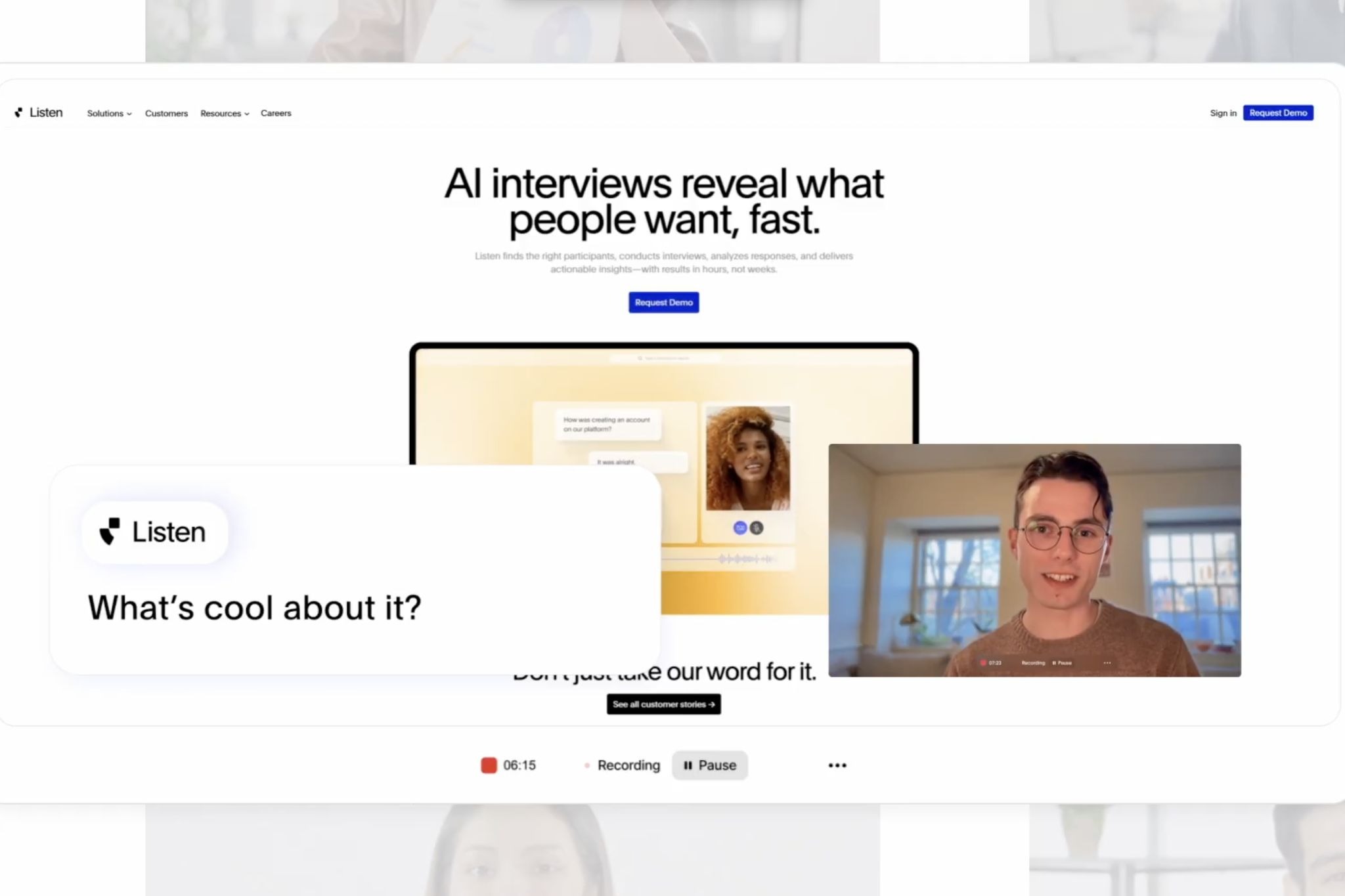
Listen Labs is best for consumer insights teams, product teams, marketing teams, brand researchers, and UX teams that want a more complete AI research workflow.
It works especially well for:
- brand research
- usability testing
- concept testing
- segmentation
- customer journey research
- large consumer studies
- teams replacing traditional surveys or focus groups
Listen Labs is positioned as an end-to-end AI research platform for teams that want to replace or speed up surveys, focus groups, and in-depth interviews.
Customers use Listen’s AI-moderated interviews for brand tracking, usability testing, multi-market segmentation, concept testing, and consumer journey mapping. That makes it especially relevant for bigger product, brand, and consumer research programs.
The community conversation around Listen Labs is mixed, which is useful to mention honestly. In one Reddit thread, a researcher said, “I’ve used ListenLabs, and someone on my team has used Userology. We’re just test-driving tools and will be working to try others and figure out which one to add to our tool set.” That quote captures where the market is right now: teams are interested, but still comparing and testing.
Core features
- AI-moderated interviews
- End-to-end research workflow
- Brand tracking
- Usability testing
- Multi-market segmentation
- Concept testing
- Consumer journey mapping
- Support for 100+ languages listed on the site
- Research reports and study outputs
Limitations
- It may be more platform than a small startup needs.
- Public pricing is not very transparent.
- It is better for structured research programs than lightweight customer-moment interviews.
- Teams that only need churn, onboarding, or post-purchase interviews may find other tools simpler and more directly aligned.
Pricing
- Listen Labs appears to use custom or demo-based pricing.
- Its official homepage does not list a simple public pricing table.
4. Conveo
Who is this tool best for?
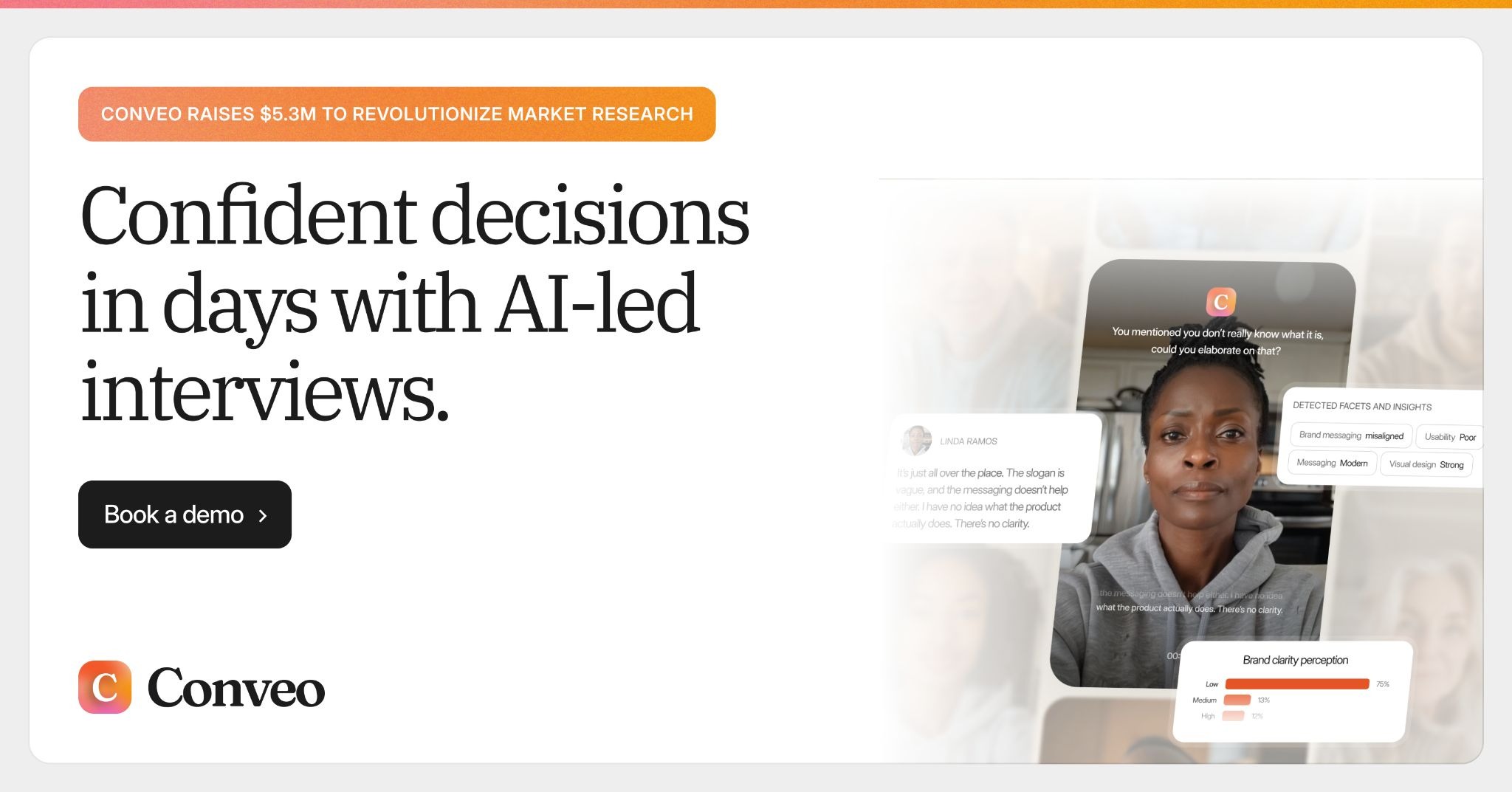
Conveo is best for qualitative research teams, consumer insights teams, agencies, and product teams that want richer video-based interviews.
It is especially relevant for:
- concept testing
- brand research
- product feedback
- consumer research
- video-based qualitative studies
- teams that care about tone, behavior, and visual context
Conveo is built around AI-led qualitative research, especially video interviews. Its positioning is focused on helping teams design studies, conduct interviews, and turn recorded conversations into structured research outputs.
That makes Conveo one of the more interesting tools for teams that care about richer qualitative context from video-based customer conversations. The value is not in guessing emotions or reading body language; it is in capturing detailed responses and turning them into usable research findings.
Conveo is also described by Greenbook as a platform that helps teams design, recruit, interview, analyze, and share qualitative studies.
Core features
- AI-led video interviews
- AI study design
- Recruitment support
- Video-based qualitative interviews
- Interview transcripts and structured summaries
- Research synthesis from recorded conversations
- Insight sharing
- Stakeholder-ready storytelling
Limitations
- It may be too advanced for teams that only need simple customer interviews.
- It is more focused on rich qualitative studies than always-on lifecycle research.
- Smaller teams may need to check whether the workflow is too research-heavy for their needs.
Pricing
- Conveo appears to use custom or demo-based pricing.
- Public pricing is not clearly listed on the main site.
5. Glaut
Who is this tool best for?
Glaut is best for market research firms, agencies, and insights teams that want to add qualitative depth to larger quantitative studies.

It is especially useful for:
- market research agencies
- quant + qual hybrid studies
- large-scale customer research
- multilingual studies
- survey-based research programs
- teams that already work with research methodology
Glaut is built very clearly for market research firms. It sits in the space between surveys and interviews: more depth than a static questionnaire, more scale than a traditional one-on-one qualitative study.
It uses AIMIs, or AI-moderated interviews, as a way to combine survey efficiency with one-to-one interview depth, with hundreds or thousands of respondents at the same time.
Greenbook describes Glaut as using voice-based, in-depth conversational interviews with dynamic, personalized follow-ups, and says it can be used end-to-end or integrated inside existing survey platforms.
This is probably not the cutest tool for a founder who wants to ask ten customers why they left. It is more like the serious market research friend who arrives with a spreadsheet and a methodology.
Core features
- AI-moderated voice interviews
- Dynamic follow-up questions
- Survey-scale qualitative feedback
- 50+ languages
- Fraud detection and data quality controls
- Integration with existing survey platforms
- Automatic analysis of unstructured interview data
Limitations
- It is less suited for small founder-led discovery.
- It may feel too research-agency-oriented for lightweight SaaS or eCommerce teams.
- It is not the most obvious fit for always-on interviews after churn, signup, or support resolution.
- Teams need some research maturity to get the most from it.
Pricing
- Glaut offers demo-based access.
- Greenbook lists pricing details as free trial, annual subscription, and one-time pricing options.
6. Voicepanel
Who is this tool best for?
Voicepanel is best for product teams, founders, marketers, and researchers who need fast feedback on something specific.

It is useful for:
- product feedback
- prototype reactions
- messaging tests
- brand feedback
- concept testing
- AI output evaluation
- pre-launch validation
Voicepanel is built for teams that need quick feedback from real people on products, prototypes, messaging, brands, or ideas. Teams can let AI conduct hundreds of feedback sessions to measure what real people think about a product, brand, or topic.
The platform is useful when the team needs a signal fast and does not want to turn every question into a giant research project. That makes it especially relevant for product teams, marketing teams, and founders to test decisions before launch.
Respondent’s Voicepanel partner page describes it as helping product teams collect feedback on products, prototypes, messaging, and decisions through AI-run sessions.
Core features
- AI-conducted feedback sessions
- Voice, video, and text feedback
- Built-in panel options
- In-product intercepts
- Link-based recruiting
- External panel connections
- Interactive reports
- Feedback on products, brands, prototypes, and topics
Limitations
- Better for feedback sessions than deep research programs
- Teams should check whether it supports their exact lifecycle-triggered interview use case
- It may not fix broken research habits on its own. If the audience is wrong, the timing is late, or the research goal is unclear, your customer interviews can still fail.
Pricing
- Voicepanel uses usage-based pricing for its built-in panel.
- Agent engagements are scoped by initiative.
- Enterprise agreements can support unlimited responses when teams recruit through owned lists, links, or partner panels.
7. Userology
Who is this tool best for?
Userology is best for UX researchers, product managers, designers, and startups that want AI-moderated research around digital products.

It is especially useful for:
- usability testing
- prototype testing
- design validation
- product feedback
- discovery interviews
- live product testing
- Figma prototype research
Userology is a strong fit when the interview is tied to a product experience. Think prototypes, live products, usability tasks, first-click tests, product flows, and design validation.
Userology positions itself as AI-moderated interviews that turn conversations into action. Capterra describes it as an AI-based user research and usability testing solution that uses conversational AI to automate interviews and usability tests, with an AI assistant that asks follow-up questions, onboards participants, detects silence, and handles technical issues.
Core features
- AI-moderated interviews
- AI-moderated usability tests
- Follow-up questions
- Participant onboarding
- Silence detection
- Technical issue handling
- Reports with transcripts, metrics, and insights
- UX testing toolkit, including concept tests, first-click tests, tree tests, card sorting, and prototype testing
Limitations
- It is more UX/product-testing focused than broad customer intelligence focused.
- It may be less ideal for churn interviews, win/loss research, or post-purchase interviews.
- Teams should still check participant quality and report depth before relying on it for major strategic decisions.
- It is not as focused on interviews triggered by customer journey events.
Pricing
- Userology lists pricing at $20 per session.
- It says there are no subscriptions and no seat limits.
- This makes it one of the clearer and more startup-friendly pricing models in the list.
8. Great Question
Who is this tool best for?
Great Question is best for UX research teams, product research teams, and companies that already think of research as an ongoing function.

It is especially useful for teams that need:
- participant CRM
- panel management
- research scheduling
- surveys
- interviews
- prototype testing
- AI analysis
- research repository workflows
Great Question is not just an AI interview tool. It is a broader research platform for teams that need participant management, research operations, surveys, prototype testing, interviews, AI analysis, and a repository in one place. That is why it also belongs in the conversation when teams are comparing the best Outset alternatives, especially if they need more than AI moderation alone.
That makes it very useful for teams where the interview itself is only one part of the research machine. If your research process includes recruiting, scheduling, storing insights, managing panels, running surveys, and sharing findings, Great Question starts to make more sense.
Every interview is automatically captured and processed, with full video, transcript, and highlights generated instantly.
Core features
- AI-moderated interviews
- Full video, transcript, and highlights
- Research repository
- Participant CRM
- Surveys
- Prototype testing
- AI analysis
- Panel management
- Self-serve and enterprise options
Limitations
- It may be too broad if the team only needs an AI interviewer.
- It is less focused on always-on customer interviews after real customer actions.
- The platform makes most sense when research ops are already part of the workflow.
- Smaller teams may not need the full participant CRM and repository layer.
Pricing
- Usage: Self-serve pricing starts at $129/month, with annual self-serve pricing listed at $1,290/year.
- Includes: Enterprise custom pricing is also available for larger teams.
Conclusion
AI customer interview tools are not here to make research colder. At their best, they make customer learning easier to keep up with.
The right tool depends on what your team actually needs. If you want always-on interviews close to real customer moments, Frank is the strongest fit. If you need enterprise-scale AI-moderated research, Outset and Listen Labs are worth looking at. If your work is more video-heavy, market-research-led, UX-focused, or research-ops-heavy, tools like Conveo, Glaut, Voicepanel, Userology, and Great Question each have their place.
The main thing is this: don’t choose the tool with the loudest AI promise. Choose the one that helps you ask better questions, reach the right customers, and turn the answers into decisions your team can actually use.

FAQ
Are AI customer interviews better than surveys?
They can be, especially when you need to understand the “why” behind customer behavior. Surveys are useful for quick, structured answers, but AI interviews can go deeper with follow-up questions.
Can AI replace human customer interviews?
Not completely. AI is great for speed, scale, and repeatable research, but human researchers are still better for sensitive topics, emotional nuance, vague discovery, and complex strategic research.
What is the best AI customer interview tool in 2026?
For always-on customer interviews close to real customer moments, Frank is the best fit. For enterprise research teams, Outset and Listen Labs are also strong options.
Which AI customer interview tool is best for startups?
Frank is a strong choice for startups because it helps teams run customer interviews without needing a full research team, manual scheduling, or expensive agency support.
Which tool is best for UX research?
Userology, Great Question, Outset, and Conveo are strong options for UX research. The best choice depends on whether you need usability testing, video interviews, participant management, or a full research workflow.
What should I look for in an AI customer interview tool?
Look at interview format, follow-up quality, language support, pricing, output quality, privacy, integrations, and whether the tool fits your actual customer research workflow.
What are the risks of AI-moderated interviews?
The main risks are shallow follow-ups, weak study design, over-trusting AI summaries, privacy concerns, and using AI for conversations that need human rapport. The best approach is to use AI for scale while keeping human judgment in the process.