.jpg)
You can see churn in the dashboard, but that does not mean you understand it. Customers cancel, go quiet, fail to activate, or decide not to renew, and all you are left with is a number and a few guesses.
For founders, that is the frustrating part. You are supposed to fix the problem fast, but the real reason behind churn is usually buried somewhere between product data, support noise, and shallow feedback forms.
This article covers how founders can use AI to understand customer churn more clearly, ask better questions, and uncover the real reasons customers leave before those insights go stale.
TL;DR
- Churn metrics can show when customers leave, but not always why they leave.
- Founders can use AI to connect product behavior, customer feedback, and churn patterns much faster.
- The best AI workflows focus on specific churn moments, like cancellations, failed activation, or non-renewal.
- AI is especially useful for asking better follow-up questions and getting past surface-level answers.
- Customer insight is strongest when it is collected close to the churn event.
- AI interviewers like Frank help founders run those churn conversations automatically and turn them into structured insights overnight.
Why Understanding Churn is a Founder’s Hardest Task
Getting to the bottom of churn means understanding what was going through a customer's head the moment they decided to leave. For most founders, that process is slow, manual, and deeply frustrating.
1. The "no-show" loop and wasted founder time
By the time someone clicks "cancel," they've already checked out. Asking them to book a 20-minute call feels like asking for a favor they no longer want to give. Most don't show up. And even when someone does respond later, the insight is usually weaker. Too much time has passed, and the frustration has cooled into something vague and polite.
2. The "surface-level" survey gap
Exit surveys rarely get to the truth. A customer might check "Too expensive," but that's almost never the whole story. Usually, it's code for "I couldn't figure out the integration" or "It didn't solve my problem fast enough." The form records the answer and moves on. You're none the wiser.
3. In a startup, this work usually belongs to no one
Everyone agrees that founders should talk to customers more. The reality is that in a 20–50-person company, churn research belongs to no one. It sits somewhere between product, growth, support, and founder instinct, and it keeps getting pushed behind launches, hiring, and everything else that feels more urgent.
To actually stop the leak, you can't rely on manual scheduling or static forms that miss the "why." You need a way to have better conversations at scale, without adding more to your plate.
How to Use AI to Understand Customer Churn
You don't need a larger research team; you need an AI-driven workflow that captures context before it fades. Here's a practical four-step approach.
Step 1: Automate the friction trigger
The biggest mistake founders make is waiting for a weekly or monthly churn report. By then, the customer has already moved on to a competitor.
Connect your billing system to an AI outreach that fires the moment a subscription is canceled or downgraded, typically via a Stripe webhook or a Zapier trigger, so no custom code is required. The goal is to reach the customer while the frustration that led to the click is still fresh, not three days later when they've already signed up with a competitor.
Step 2: Use adaptive interviews instead of forms
A form can't ask "Why?" If a user selects "Too expensive," it records the answer and ends. An AI interviewer can probe: "Is it the total price, or do you feel like you weren't getting enough value from a specific feature?"
Customers also tend to be more candid with an AI than with a founder. There's no social pressure to be nice, no relationship to protect. They're more likely to say the uncomfortable things, a pattern well-documented in UX research on reducing interviewer bias. That makes the answers more useful.
Step 3: Look for patterns, not individual complaints
Once you have 50 or 100 conversations, don't read them one by one. Use AI to perform a thematic analysis. Feed the interview transcripts into an AI to categorize the churn into buckets like:
- Activation Gap: Users who never reached their "Aha!" moment.
- Feature Friction: Specific UI/UX issues that caused a drop-off.
- Competitor Pull: Users leaving for a specific feature you don’t have yet.
This shifts you from reacting to individual complaints to spotting the patterns that should actually drive your next sprint.
Step 4: Connect insights to your roadmap
The final step is using AI to prioritize your fixes. Ask the AI to cross-reference these churn reasons with the potential impact on revenue.
Founder Tip: Ask the AI: "Based on these 50 churn interviews, which 3 product changes would have the highest impact on retaining our highest-paying tier?" This turns raw feedback into a prioritized "to-do" list, ensuring you aren't just shipping features, but specifically building the things that stop the leak.
Done well, this helps teams understand customers better than competitors, because they are learning from churn faster and acting on it sooner.
While you can piece this workflow together using four different tools and a lot of manual prompting, there is a way to automate the entire cycle from the first interview to the final overnight insight report, in one go. This is exactly why we built Frank.
Using Frank to Understand Customer Churn
Frank is an always-on AI researcher that founders use to run churn research without building the whole system themselves.
The manual workflow described in the previous section, triggering outreach, probing for the "why," and synthesizing data, is exactly what Frank was built to automate.
Frank works best when integrated into the trigger moments that define your customer’s exit. For founders focused on retention, these are the three most critical moments:
*Sentiment Churn is what happens when a customer keeps paying but quietly checks out, no complaint, no ticket, just a slow drift toward not renewing. It's the hardest kind to catch because nothing in your dashboard flags it until the subscription actually ends.
What Happens After the Trigger
The value of Frank is not just that it talks to customers. It helps founders run the same AI churn workflow from the previous section without having to manage it manually. That matters for teams looking for the best ways to understand churn without stitching together multiple tools, prompts, and follow-up workflows by hand.
1. Frank automates the friction trigger
Frank reaches out right after key churn-related events, such as a cancellation, a downgrade, a renewal milestone, or a tricky support interaction. That means you're getting the real reason while the frustration is still fresh, not a vague answer two weeks later.
2. Science-driven adaptive voice interviews instead of forms
Most AI interviewers follow a rigid, linear script. Frank adapts in real-time during voice conversations. which helps teams move beyond rigid forms and generic post-purchase feedback questions that rarely uncover the full story.
If a churned customer says, "The product was too complex," Frank uses proven research frameworks to probe deeper, asking follow-up questions to uncover whether the complexity was a UI bottleneck, a lack of documentation, or a missing integration.
3. Overnight synthesis & theme mapping
Frank can run 100+ interviews simultaneously, 24/7. While you sleep, it processes every conversation and delivers structured summaries in the morning, organized by friction, unmet needs, and motivation. You can update your roadmap before the next sprint starts.
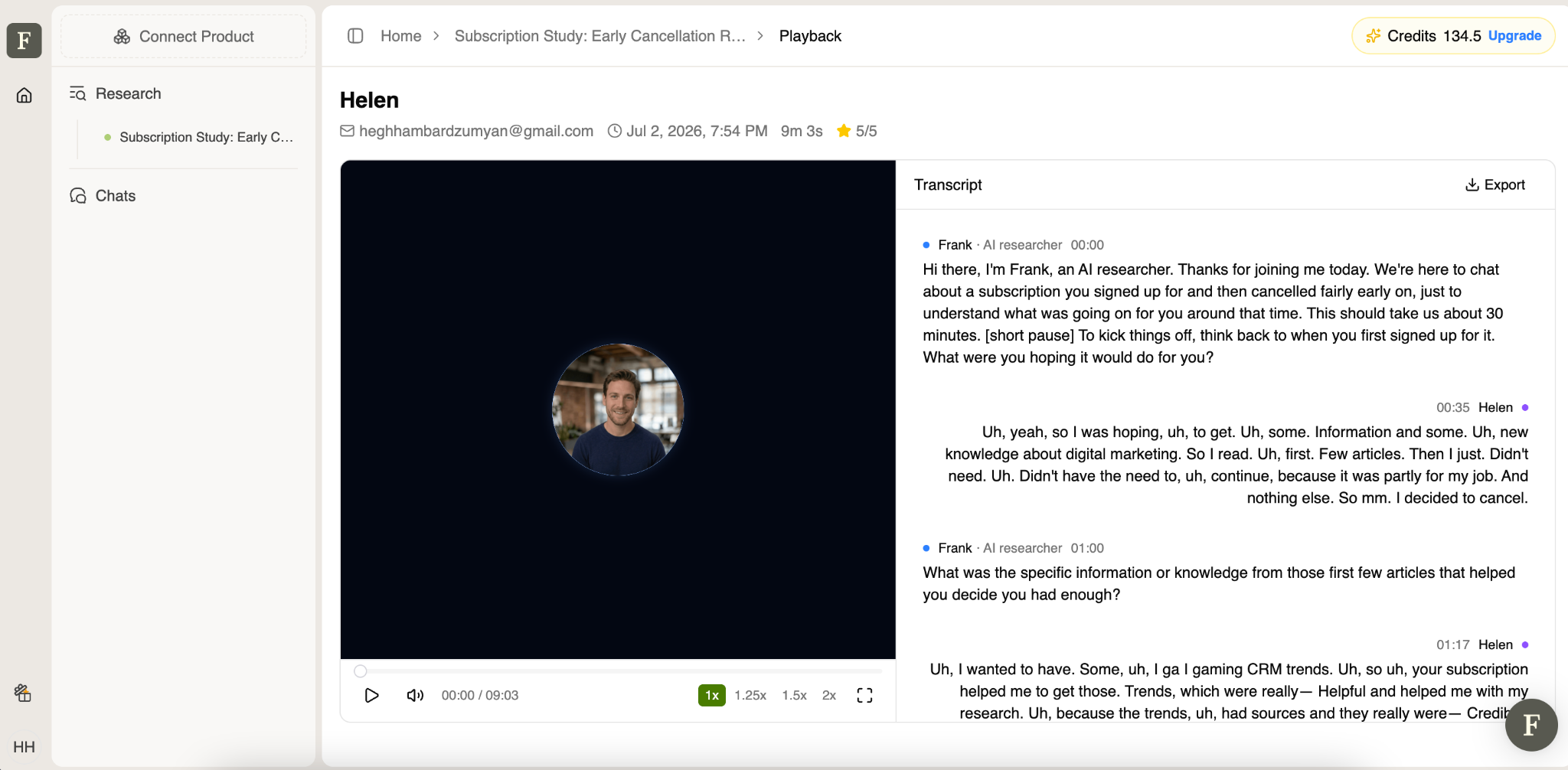
4. Traceable transparency
Every insight in your summary links back to the original voice recording and transcript. If something seems surprising, you can click through and hear the customer say it in their own words. No guessing whether the AI made it up.
Conclusion
Your time is better spent building than chasing people who already clicked cancel. Churn doesn't have to be a recurring mystery.
The shift is simple: be there to listen at the exact moment a customer hits a wall. Let AI handle the interviewing and synthesis, so you know why customers leave instead of guessing.
Frank runs that research for you, day and night, and hands you the raw, honest reasons you need to build a product people don't want to leave.
Start your first Frank Interview today.

FAQ
Will my customers actually talk to an AI?
Yes, and often more honestly. AI interviews feel low-pressure. Without politeness bias, users feel safer giving the raw, uncomfortable truths they might hide from a founder.
What's the difference between churn analysis and churn research?
Churn analysis usually looks at the numbers: who left, when, and from which plan. Churn research looks at the reasons behind those numbers, the friction, unmet expectations, or missing features that led someone to leave in the first place.
How soon after a cancellation should you reach out to a customer?
The sooner, the better. The clearer and more useful the feedback tends to be, since the frustration or reasoning behind the decision is still top of mind.
Is churn research only useful for canceled customers?
Not necessarily. Some of the most valuable insights come from users who almost churned but stayed, or who show early warning signs like reduced usage.
What if I only have a few churned users a week?
Tools like Frank is built for any scale, especially for startups and mid-size companies. Whether it’s 2 people or 200, the always-on nature ensures you catch every insights-rich moment the second a cancellation occurs, before the trail goes cold.
What if my customers don't speak English?
Platforms like Frank is globally scalable and supports 30+ languages. It can conduct an interview in Spanish or German and deliver the summarized insights to your dashboard in English by the next morning.