Hot take: your exit survey data is probably not telling you much.
Not because people are lying. They're not (mostly). They just pick the fastest answer and close the tab. "Price" gets clicked more than any other option and means approximately nothing. You've maybe even tested pricing already. But, churn didn't move.
The real reason someone left lives somewhere in the days before they canceled. That story exists. It's just not something people are going to type into a cancellation form at the exact moment they're most done with you.
This article is about how to actually get to it, what makes churned customers talk, and how to make it run without a research team or a single scheduled call.
TL;DR
- The short answer: reach out within 7–14 days of cancellation, use a conversational format with follow-up built in, and ask them to walk you through what happened, not why they left.
- Churned customers aren't unwilling to talk; they're unwilling to fill out a form.
- The real reason someone left lives in the week before they canceled, not the moment they clicked the button.
- Timing and format are what determine whether you get the truth or a tidy exit line.
- There's a practical system for catching this consistently. No research team, no scheduling required.
Why Churned Customers Go Silent (and What's Actually Happening)
The default assumption when a customer cancels and goes quiet is that they've moved on and don't want to engage. That assumption is almost always wrong, and it's costing you answers you could actually use.
25 out of 26 dissatisfied customers never complain. They leave without a word, without a ticket, without a complaint. According to Esteban Kolsky, former Gartner analyst and founder of ThinkJar, the true enemy isn't negative feedback; it's indifference. The silence in your dashboard is a very polite form of giving up on you.
Customers don't voice dissatisfaction because of high complaining costs, low perceived likelihood of success, and not knowing where to direct feedback. A recent study in the Advanced Research Journal found that this silence costs organizations an estimated 15% of annual revenue in preventable churn.
Why Exit Surveys Structurally Fail
What you're getting back from a cancellation form is not a reason and is not a story. Just the fastest, least confrontational thing someone could click on their way out the door.
By the time a customer hits cancel, the specific moment things went wrong has already been compressed into something they can live with. Tidy. Plausible. And wrong enough to send you fixing the wrong thing.
Three reasons this keeps happening:
- They don’t ask for a story. "Didn't meet my needs" is not a reason. It's a label.
- They arrive after the decision is already made. The real call happened two weeks ago. Very helpful. Thanks.
- There's no follow-up. Someone picks "too expensive." Nothing happens next. A pricing experiment gets greenlit.
What Teams Get Wrong
The form fails. But so does the assumption that the customer is done with you.
The teams that close that gap shouldn’t run smarter surveys. They should ask differently and earlier. When it comes to what actually works for getting churned customers to open up, the answer almost never starts with a form.
The Real Cost of Not Knowing Why They Churn
You can't fix what you can't name. Vague churn reasons produce vague fixes and usually, the wrong ones.
The two most common wrong calls are discounting the price when the real issue was onboarding confusion, and redesigning the UX when the problem was an expectation set during the sales process. Both happen constantly.
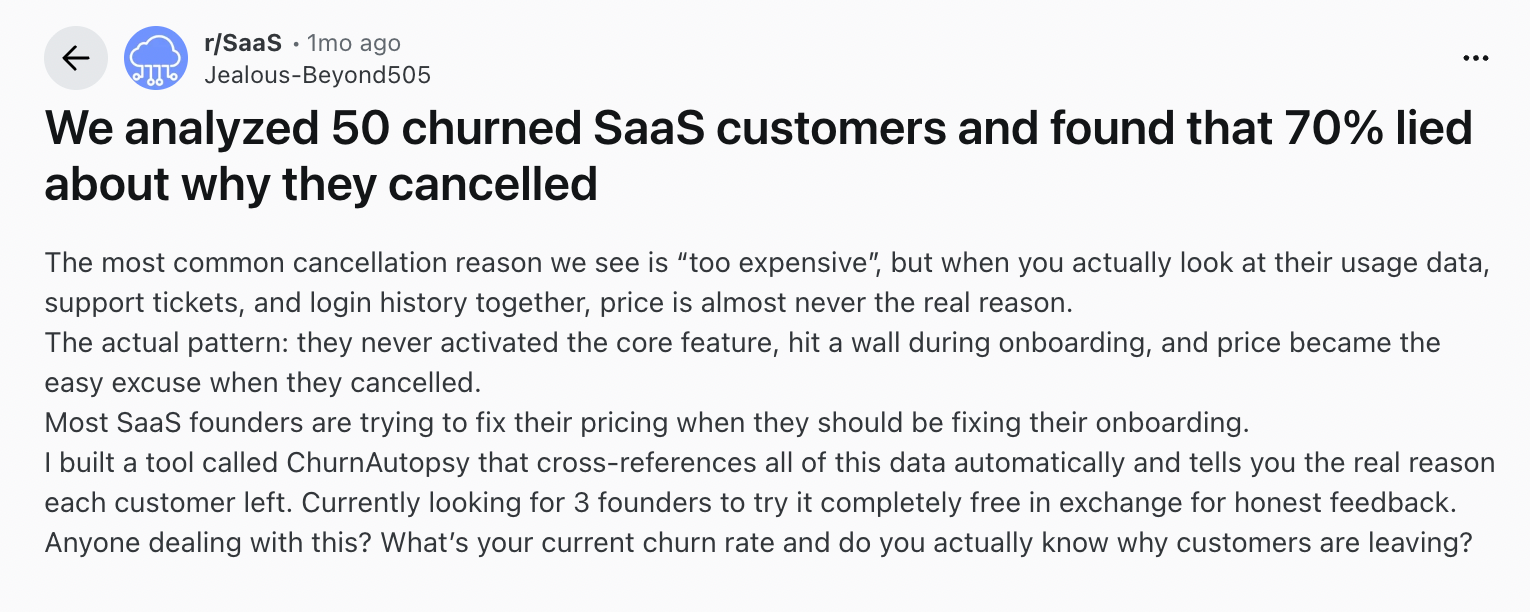
In a discussion on r/SaaS, one founder reviewed dozens of cancellations and found the selected reasons weren't the real ones:
"They never activated the core feature, hit a wall during onboarding, and price became the easy excuse when they cancelled."
Another founder in r/SaaS kept seeing "too expensive" in exit surveys, reached out directly, and got a different answer:
"They replied same day and said honestly they'd just stopped finding it useful. Never mentioned price once."
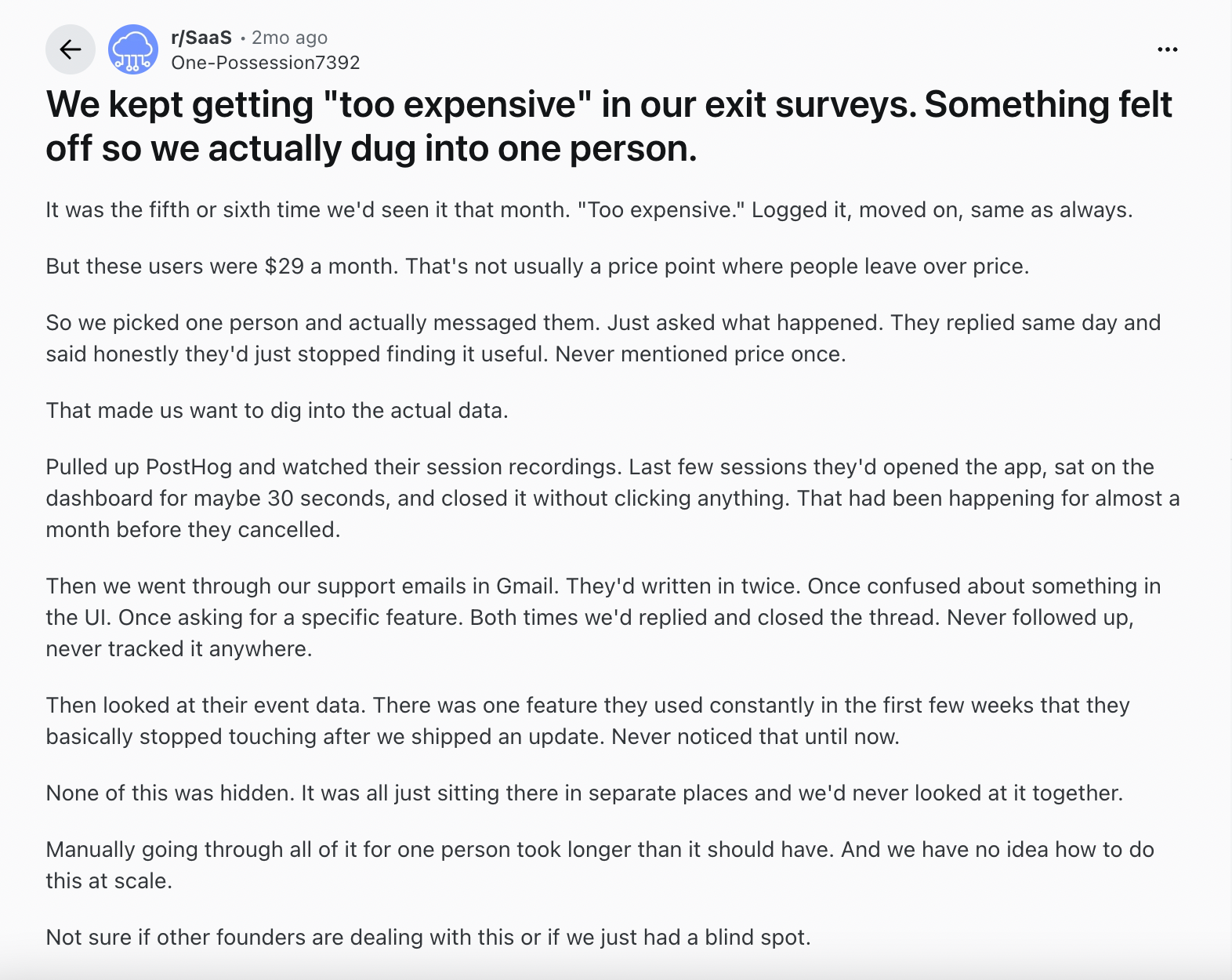
A pricing problem requires changing what you charge. A value problem requires changing what customers achieve. On a cancellation form, those two look identical. Exit survey data attributes 40% of churn to price, and deeper interviews reveal that only 12% of those cases are actually about cost.
One lost customer is a data point. Twenty with the same unspoken reason is a pattern that's been costing you every month. The way founders are using AI for churn to get real answers is starting to look very different from how it worked even two years ago, and the gap between teams who've made that shift is widening.
So what actually surfaces the real reason?
What It Takes to Actually Get Churned Customers Talking
Three things stand between you and the real reason someone left: timing, format, and the questions you ask. Get one wrong, and you're back to "didn't meet my needs."
- The window is short. Within 7–14 days of cancellation, the experience is still vivid. After that, memory flattens, and the story compresses into a label the customer can live with. Your outreach needs to be fast, not eventual.
- Format determines whether you get the real answer. What works: short, conversational, low-effort for the customer, with follow-up built in. What doesn't: multi-step forms, cold email threads, anything that requires the customer to do work.
- Ask them to walk you through what happened, not why they left. "Why did you leave?" invites a label. "Walk me through the last few weeks before you canceled," invites a story.
- The decision chain you're trying to reconstruct: Expectation → first disappointment → what they tried → final straw → what they chose instead
Five right questions to ask follow that chain exactly:
- What were you hoping this would help you do?
- When did it first start feeling less useful or harder than expected?
- What did you try before deciding to leave?
- What was the moment you made the final call?
- What did you switch to, and why that?
Volume is what turns a story into a pattern. And the number of interviews you need before findings become actionable is smaller than most teams assume: five per segment to spot a theme, 8–10 before making a significant change. Segment by plan, tenure, use case, or churn type: silent (customers who stop using the product without complaining) versus reactive (customers who reach out before or during cancellation) because different segments have different stories.
The framework is simple. The hard part is executing it fast enough and at enough volume for the findings to mean something. That's where most teams actually get stuck. Not on the questions. On the calendar.
And that's exactly the problem an AI Interviewer such as Frank was built to solve.
What Churn Conversations Look Like When You Actually Run Them
Most teams skip churn interviews because a list of 100 churned users becomes 100 calendar invites. Calendar invites become no-shows. No-shows become "let's reschedule." By the time the tenth call happens, the first ten people have already rewritten the story into something cleaner and less true.
How Frank Times Its Outreach After Cancellation
Frank is an AI customer interviewer by Prelaunch. Drop a churn interview link into your cancellation flow, and Frank reaches out to each user the moment cancellation is confirmed via voice interviews (WhatsApp chat and video coming soon) with no scheduling involved on either side.
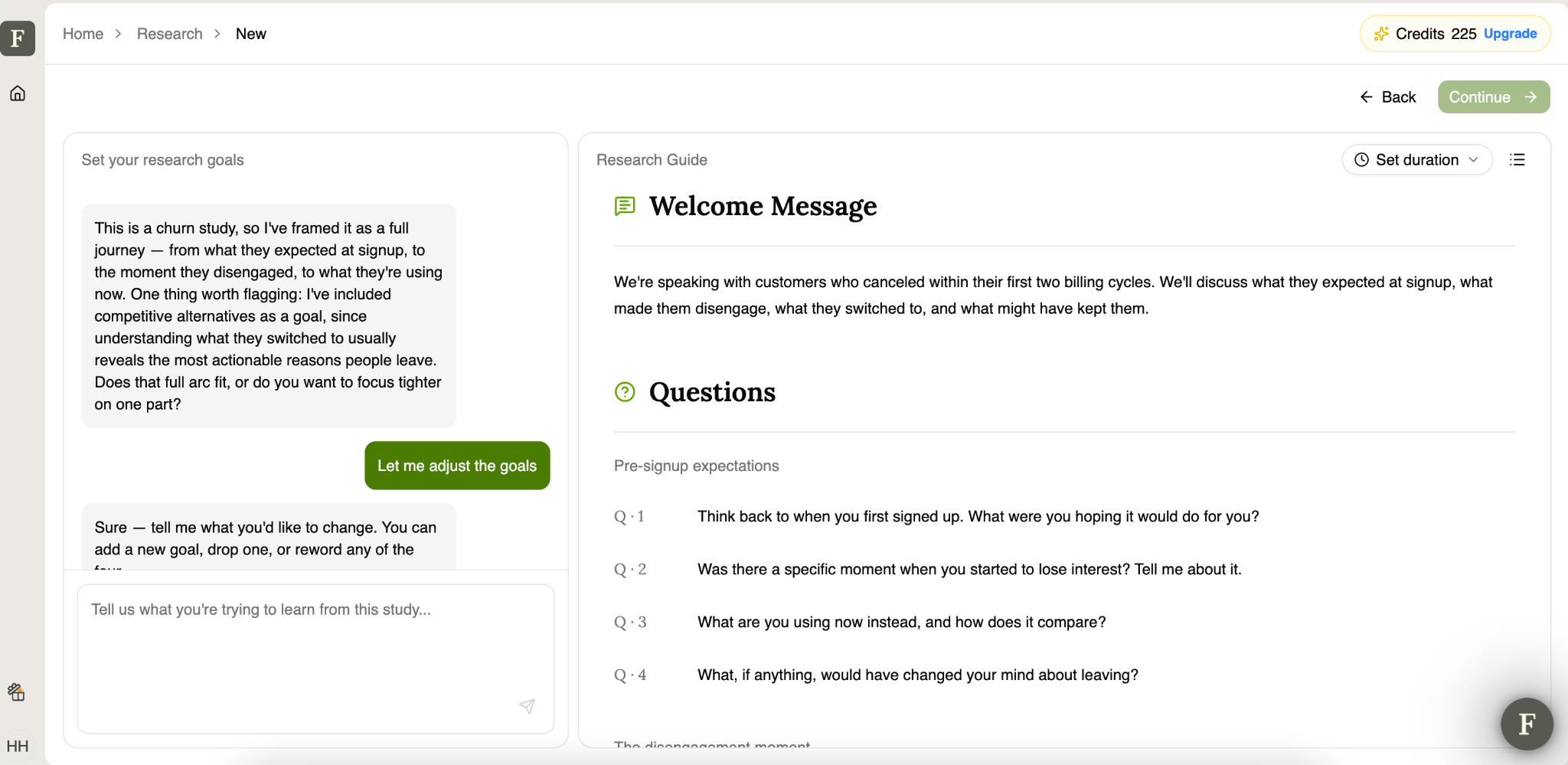
A real conversation that starts when the customer is ready and goes wherever the answer goes. This matters more than it sounds. The format is what gets people talking, and the timing is what gets them talking honestly. Catch someone in the first few days after canceling, and the frustration is still specific, still fresh, still actionable. Wait three weeks, and you get "it just wasn't the right fit." (It was never about the fit. You just asked too late.)
How Frank Conducts Churn Interviews
A cancellation form gives you one of five options. Frank gives you a conversation in 30+ languages, any time zone, no moderator needed. If someone says, "I wasn't sure it was working," Frank asks what they were trying to do when that happened. Turns out people are also pretty honest when there's no human on the other end judging their answer.
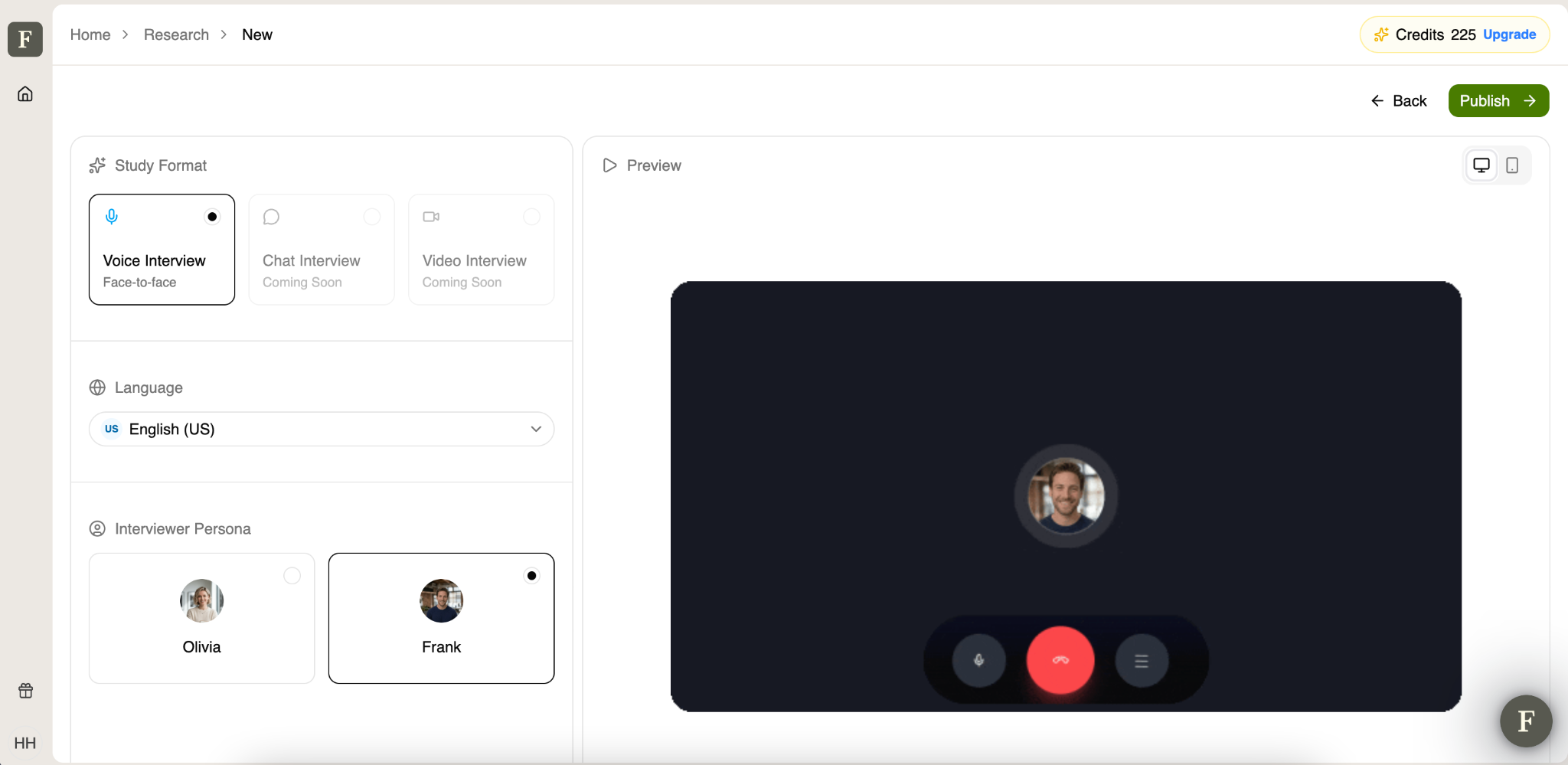
What Frank's Churn Summaries Deliver
Frank transcribes and summarizes every interview, then finds what's repeating across all of them. Every insight links back to the exact moment in the transcript it came from. Not a spreadsheet. A ranked list of what actually sent people out the door.
The ranked list is only useful if it changes what you build next. Treat the top pattern the same way you'd treat a bug report from your biggest customer: it goes into the next sprint, not the next quarterly review. If a single theme shows up across 8–10 interviews in a segment, that's no longer a research finding, it's a roadmap item, and someone should own turning it into a fix before the next cohort hits the same wall.
Conclusion
Your churned customers already know why they left. Most teams never find out, because a cancellation form was never going to surface the real reasons.
The fix isn't a bigger research program. It's a faster trigger: conversations that fire at the moment of cancellation, follow the answer wherever it leads, and surface a pattern before anyone has had time to schedule a single call.
Churn is only a mystery if you're asking too late, in the wrong format, at too low a volume to tell a story from a signal.
See how Frank captures churn conversations at the moment they happen.

FAQ
Why don't churned customers respond to exit surveys?
Mostly format and timing. A short conversational outreach that catches them while the experience is still fresh gets a completely different response.
Is price ever actually the real churn reason?
Sometimes. More often, it's the cleanest exit line available. Price tends to show up as the stated reason when the real cause is unclear value, onboarding friction, or an expectation that was never going to be met.
What's the difference between an AI interview and a standard exit survey?
A survey records the answer someone is willing to give. An AI interview follows up when that answer is vague, asks what happened next, and reconstructs the actual decision chain.
How long does it take to set up a churn interview on Frank?
It takes minutes. You define what you want to understand, Frank suggests an interview outline based on thousands of past interviews, and you drop the link into your cancellation flow. The interviews run automatically from there: no moderator, no manual follow-up, no project management overhead.
Will people actually talk to an AI interviewer?
More than you'd expect. People tend to be more direct with AI than with a human on the other end; there's no social pressure to be polite or give a "good" answer.