Product managers are told to stay close to customers, but continuous discovery often collapses under the weight of everything else. Sprint pressure wins. Stakeholder requests pile up. Interviews get postponed. Feedback comes in too late or too vaguely to help with the decision in front of the team.
That is where AI is becoming useful in discovery workflows. It helps product teams reduce the manual work, keep feedback loops active, and learn closer to the moment when customer behavior actually happens. AI interviews are one part of that, but they work best inside a broader AI-supported discovery process.
This article looks at how product managers use AI to make customer discovery more continuous, practical, and easier to sustain.
TL;DR
- Continuous customer discovery usually breaks down because PMs lack time, structure, and repeatable workflows.
- AI can help product teams detect important customer moments, organize messy feedback, compare patterns faster, and run follow-up discovery more consistently.
- AI interviews are especially useful when the team needs the reason behind signup, churn, drop-off, or renewal behavior.
- The strongest workflow uses AI broadly first, then uses AI interviews to add depth where the signal matters most.
- The right AI interview tool fits naturally into that workflow by helping teams run ongoing customer interviews and review structured, verifiable findings.
Why Continuous Customer Discovery Is Hard to Sustain
Continuous customer discovery is the practice of building small, regular customer conversations into the product workflow so that learning happens alongside building, not only before a launch or after something breaks.
It sounds like a good habit. In reality, it is one of the first things to break when product work gets busy.
1.Weekly discovery is hard to protect
Product teams may believe in regular customer contact, but that does not mean they can defend it every week. Discovery competes with sprint delivery, roadmap changes, bugs, launches, and internal requests. It usually loses to the more urgent thing.
In practice, discovery happens in bursts instead of continuously. Teams talk to customers before a launch, after churn goes up, or when a decision already feels risky.
2.The operational work around discovery is heavier than it looks
The interview is only one part of the work. PMs still need to find the right users, recruit them, schedule them, write prompts, handle drop-off, review outputs, and turn a handful of conversations into something the team can actually use.
That overhead is what makes discovery hard to sustain, especially for PMs without dedicated research support.
3.Small samples create hesitation
A few interviews may reveal something interesting, but product managers still need to know whether that issue is broad, segment-specific, or just noise. Without enough volume or structure, teams hesitate to act.
That slows prioritization. The insight might be real, but confidence stays low.
4.Most research methods force speed-depth tradeoffs
Surveys are faster, but often too shallow. Human interviews go deeper, but they take time to run and even more time to analyze.
Nielsen Norman Group’s recent guidance makes this point clearly: AI-moderated interviews can help teams collect structured feedback at scale.
This is exactly where AI becomes useful. Not because it removes the need for product judgment, but because it helps product teams reduce the operational burden, organize discovery inputs faster, and decide where deeper customer conversations are worth running.
How to Use AI for a Continuous Discovery Workflow
Product managers do not need AI to “do discovery for them.” They need it to make discovery easier to maintain. A practical workflow usually looks like this.
1.Use AI to identify the right customer moment
Start with a moment that already matters to the product team.
Examples:
- after signup
- after a demo request
- after onboarding drop-off
- after cancellation
- after a support interaction
- at renewal
AI can help surface where friction, hesitation, or behavior changes are showing up by sorting through product signals, support themes, open-text feedback, or CRM notes faster than a team could manually. Maze’s PM research guide supports this kind of lightweight, continuous learning rhythm by encouraging product teams to stay close to current user behavior instead of relying only on occasional large studies.
That gives the PM a clear point of investigation.
2.Define one learning goal per AI workflow
Each AI interview flow should answer one question well.
Examples:
- Why did this user sign up now?
- What blocked onboarding?
- What is the real reason behind the churn?
- What keeps long-term users loyal?
- What almost stopped conversion?
This keeps the workflow usable. Discovery gets weaker when one flow tries to cover acquisition, onboarding, pricing, retention, and support all at once.
3.Use AI to structure and compare feedback
Before introducing interviews, use AI to reduce the mess around incoming customer input.
That includes:
- clustering repeated feedback themes
- summarizing open-text comments
- comparing issues across segments
- spotting recurring friction points
- highlighting where behavior and stated feedback seem to match
Amplitude’s guidance leans in this direction too: use lighter, more continuous feedback systems instead of relying only on occasional heavyweight research efforts. That makes it easier for teams to keep learning active without creating a parallel research process nobody can maintain.
This is where AI helps product managers move from scattered customer signals to a more structured view of what deserves deeper investigation.
4.Use AI interviews when you need the “why”
Signals are useful, but they do not explain motivation on their own.
If onboarding completion drops, AI can help surface the pattern. But it still takes a conversation to understand whether the real issue was confusion, weak perceived value, missing setup guidance, internal approval friction, or something else entirely.
AI interviews become most useful when the team already knows which moment matters and now needs context, reasoning, and customer language. They are especially effective when the goal is to collect real-time feedback from customers while the experience is still fresh.
5.Verify patterns before acting
AI summaries help teams move faster, but they should not become the final layer of truth.
A stronger process looks like this:
- review the main themes
- compare them across trigger moments or segments
- check transcripts, recordings, or quotes for anything important
- separate repeated issues from isolated comments
The goal should be to build confidence around what is actually happening before product teams make feature prioritization decisions without enough evidence.
Using Frank in a Continuous Customer Discovery Workflow
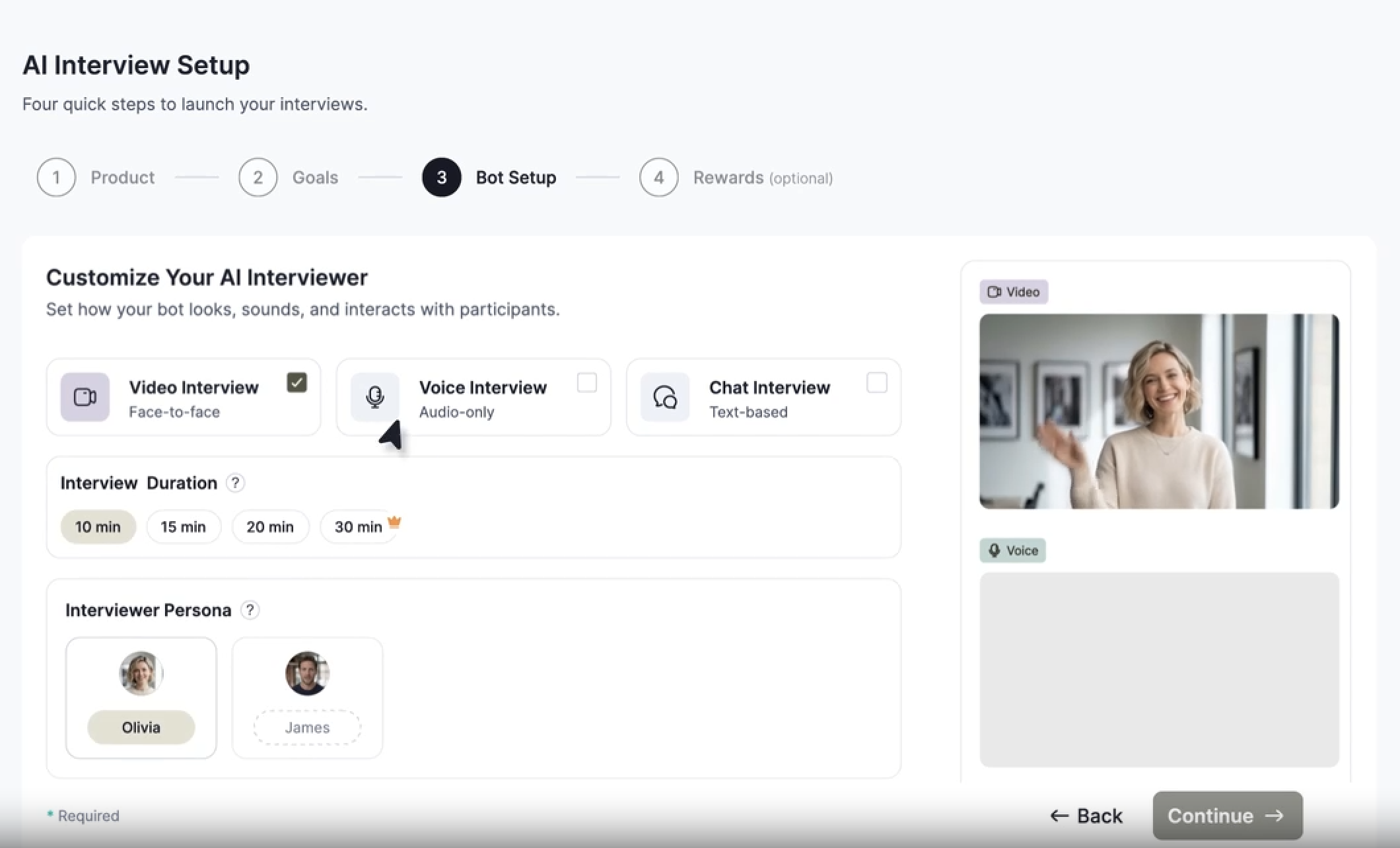
What is Frank AI Researcher? Frank is an AI interviewer that conducts voice-based customer conversations at key moments such as inquiry submissions, churn, or renewals. It follows up to get past surface-level answers and delivers structured summaries with transcripts and recordings for verification.
The workflow above shows how product managers use AI more broadly in continuous customer discovery. This is where Frank becomes especially useful.
Of the trigger moments covered in Step 1, three sit closest to acquisition intent, retention risk, and long-term value: inquiry form submissions, churn or cancellation, and renewal. These are the moments where knowing the signal is not enough; the team needs the reason behind it. Frank fits directly into that gap.
Right after an inquiry form
When someone submits a demo request or inquiry form, the team already has a signal of intent, but not much real context. A PM may want to understand what pushed the person to reach out, what job they want the product to do, what they are comparing it against, and what concerns they already have.
When a user churns or cancels
This is one of the most valuable discovery moments because it captures failure close to the point where it happened. The team can learn whether the issue was product fit, unclear value, onboarding friction, or whether pricing was the real problem or just the final reason given.
At renewal or subscription milestone
Renewal helps the team understand what is working strongly enough to keep customers around. It can reveal which parts of the product feel essential, what keeps users loyal, what almost caused churn, and what could put future renewals at risk.
Across all three moments, the pattern is the same: AI helps identify where discovery should happen, and AI interviews help explain why.
Use Case Triggers Most Relevant for Product Managers
For product managers building a continuous discovery workflow, the most useful trigger moments are the ones tied to clear intent, churn risk, and retention signals. AI helps surface these moments; AI interviews help explain them.
How Frank Handles the Customer Discovery Workflow
Once the trigger and research question are clear, Frank makes the interview layer much easier to sustain.
1.Start with one trigger and one learning goal
The workflow begins the same way strong discovery usually does: with one customer moment and one question.
For example:
- Why did this prospect request a demo now?
- What is the real reason behind the churn?
- What keeps this customer renewing?
This keeps the interview focused and makes the output easier to compare later.
2.Launch the interview close to the moment
Frank interviews customers through voice calls, while the experience is still recent enough to be described clearly.
That matters because discovery gets weaker when outreach happens too late. Customers forget specifics, simplify the story, or give an answer that sounds neat but hides the real issue.
3.Go beyond the first answer
The first answer is often too broad to be useful on its own.
If a customer says onboarding was confusing, the team still needs to know which part was confusing. If they say the product felt expensive, the team still needs to know whether the issue was actual pricing, weak perceived value, or a mismatch in expectations.
Frank follows up until the team gets the reason behind the surface-level answer.
4.Review the findings in a usable format
After the interviews, the output is organized into structured summaries.
That gives the team something easier to review than scattered notes or one-line survey responses. It also makes it easier to compare repeated themes and spot patterns worth acting on.
5.Check the original conversations when needed
The summaries are not the only layer. Transcripts, chat notes, recordings, and reels stay available.
That helps with verification, especially when a pattern looks important enough to influence roadmap decisions, onboarding changes, or retention work.
This is what makes Frank feel like the natural next step in the workflow: AI helps PMs identify where discovery should happen, and Frank helps run the deeper conversations without turning that process into more manual overhead.
Conclusion
Continuous customer discovery usually breaks down for the same reason many good product habits do: the team believes in it, but the process is too heavy to keep running.
AI helps when it makes that process easier to sustain. It can help PMs spot important customer moments, organize feedback faster, and decide where deeper investigation is worth the effort. AI interviews add the next layer by helping teams understand the reasons behind signup, churn, renewal, and other key behaviors.
That is what makes discovery more continuous in practice and more useful for real product decisions. And when product teams want to turn those moments into real conversations without adding more manual overhead, Frank is a practical place to start.

FAQ
Can AI replace customer interviews for product managers?
No. It helps with repeatable discovery work, but human interviews still matter for strategic, sensitive, or unclear topics.
What kinds of product questions work best for AI interviews?
Questions tied to a specific customer moment work best, like signup, onboarding friction, churn, or renewal.
Are AI interview summaries enough to make product decisions?
No. Use summaries to spot patterns, then check transcripts, recordings, or quotes before acting.
Why use AI interviews instead of surveys?
Surveys are faster for broad input. AI interviews are better when the team needs the reason behind the answer.
Will customers actually talk honestly to an AI interviewer?
Often, yes, and sometimes more honestly. When customers talk to a team member, social pressure softens the conversation. They avoid uncomfortable topics or frame criticism gently to spare the interviewer's feelings. That dynamic disappears with an AI interviewer. There is no relationship to protect, which makes it easier for customers to say what they actually think, especially on sensitive topics like pricing, churn reasons, or unmet expectations.
When should product teams trigger AI interviews?
As close as possible to the event they want to understand, such as signup, cancellation, support resolution, or renewal.
How is AI customer research different from surveys?
Surveys are useful for collecting broad input quickly, but they return answers to the questions you already thought to ask. AI interviews follow the conversation. When a customer gives a surface-level answer, the AI follows up until the real reason emerges.
.jpg)