If you've run a focus group and walked away wondering what you actually paid for, you're not alone. The frustration is real - and it's structural. This article breaks down why focus groups fail most businesses, and gives you an honest comparison of the alternatives that actually work, including what each method costs, how long it takes, and who it's right for.
Traditional focus groups are slow (6–8 weeks), expensive ($10,000–$30,000+ per study), and structurally unreliable, because group settings produce socially filtered answers, not honest ones. For most 10–500-person companies, AI-moderated 1:1 interviews (like Frank) solve the cost and speed problem while keeping the depth of a private conversation.
Surveys are best for validating a hypothesis you already have. 1:1 human interviews are the gold standard for high-stakes depth if you have the time and discipline to run them well. Reddit and social listening are the cheapest way to learn customer language before you talk to anyone. Online focus groups only make sense when the group dynamic itself is the point.
Why Focus Groups Fall Short
The original logic was sound. Get 8–12 real customers in a room, watch them react to your product or message, and let the group dynamics surface insights a survey never could. Rich, qualitative, human data. The kind of thing that shapes real decisions.
For large consumer packaged goods companies in the 1970s and 80s, it worked reasonably well. The problem is that most businesses today aren't large CPG companies. And the format hasn't changed.
Each alternative in this article was chosen because it directly addresses one or more of the failure modes listed below. If your research method doesn't fix at least one of these, you haven't actually changed anything.
The cost is prohibitive for most businesses
A single traditional focus group study costs between $10,000 and $30,000 when you account for venue, moderator fees, participant incentives, recording, transcription, and analysis. Run multiple groups across demographics or geographies, and you're past $100,000 before you have a single usable finding.
For a 20-person company, that's a major budget event. Not a research practice. It forces teams to run two or three studies a year instead of the continuous feedback loop their decisions actually need.
Benchmark: Drive Research cites $10,000–$30,000 per study. One messaging campaign - a single project - consumed $100,000 according to Christopher S. Wilson's documented conference anecdote.
The timeline kills decision-making
Traditional focus groups take 6–8 weeks from brief to debrief: venue booking, moderator scheduling, participant recruitment, multi-session execution, transcription, synthesis, report. Most businesses are making product, pricing, and marketing decisions on cycles measured in days or weeks - not months.
The data is structurally unreliable
This is the problem that doesn't get talked about enough. Focus groups don't just return slow data. They return systematically distorted data.
In a group setting, people self-censor. They avoid responses that conflict with the dominant voice in the room. They tell you what they think the researcher or the room wants to hear. Academic research labels this social desirability bias, and it's most severe in in-person group settings. It diminishes as anonymity increases.
The consequence is significant. Harvard Business School professor Gerald Zaltman found that the correlation between stated intent and actual behavior is usually low and negative. He estimated that 80% of new products vetted through focus groups fail within six months. The data felt good. The real-world result didn't.
Groupthink compounds the problem. Dominant personalities take over, set the tone, and push quieter participants toward agreement. The people most likely to have the most nuanced, genuine view are most likely to stay silent.
Professional respondents game the system
This one is rarely discussed in mainstream research content. Focus group participant pools fill up with people who participate for income. They've learned how focus groups work. They know what researchers want to hear. They're optimized to complete the session and collect the incentive.
This isn't a fringe issue. It's a documented structural failure of the format. When your participant pool is infiltrated by people performing research responses rather than giving them, your data is compromised before the first question is asked.
Comparison Table: Focus Group Alternatives
A quick-scan summary before the deep dives
The Best Alternatives to Focus Groups
Every alternative below was evaluated on four criteria. The same four failure modes focus groups consistently produce:
- Cost accessibility - can a 10–30 person business use this without a major budget event?
- Speed to insight - does this fit a decision cycle measured in days or weeks, not months?
- Data depth and reliability - does this produce honest answers, not socially filtered ones?
- Scalability for small teams - can a lean team run this without dedicated research staff?
The goal is to show you the real tradeoffs so you can match the method to your actual situation.
Frank - AI-Moderated Customer Interviews
Best for: Founders, product teams, and marketers at 10–500-person companies who need honest customer insight without agency overhead, scheduling chaos, or a 6-week wait.
What it is: An AI-moderated interview platform that runs one-on-one, adaptive customer interviews at scale, in place of a human moderator and a room full of participants.
How it works / Key characteristics: You define the research objective - for example, why customers churn or what's blocking activation. Frank interviews hundreds of customers simultaneously, follows up on interesting answers in real time, and delivers structured summaries with transcript and recording links for verification. Because interviews are private and one-on-one, there's no group pressure, no social desirability filter, and no dominant voice shaping the room.
Key characteristics:
- Adaptive follow-ups that probe the reasons and decision drivers behind an answer
- Runs hundreds to 1,000+ interviews simultaneously
- Supports 30+ languages
- SOC 2 & GDPR compliant
- Transparent verification via transcripts and recordings
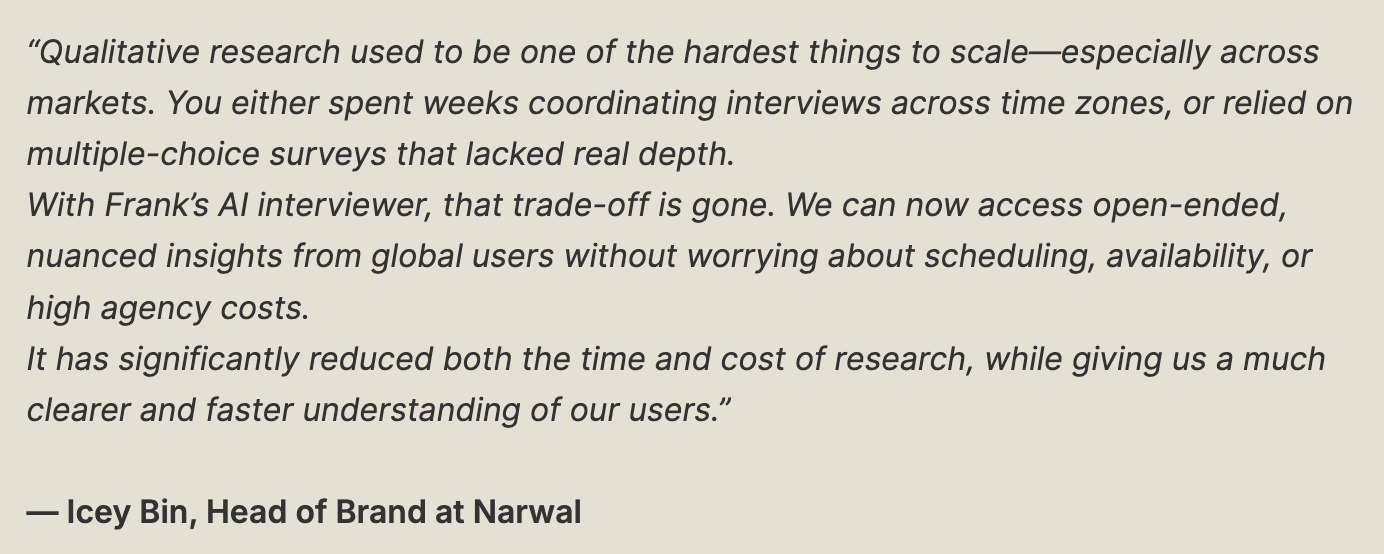
As Head of Brand at Narwal mentiones “Qualitative research used to be one of the hardest things. With Frank's AI Researcher, the trade-off is gone. We can now access global users without worrying about scheduling, availability, or high agency costs.” Focus groups give you filtered consensus, but Frank gives you honest in-the-moment context from hundreds of your actual customers for a fraction of that cost.
Typical cost: Free tier available; Starter plan from $49/month.
Typical timeline: Typically overnight to three days, depending on how many customers respond.
Key limitations: Frank works with your existing customer base (soon to have recruited interviewees). It's not a panel recruitment tool. If you have no customers to contact yet, you'll need a different approach for participant sourcing.
Online Surveys - Typeform, SurveyMonkey, Tally
Best for: Teams that have already done qualitative research and need to validate a specific hypothesis at scale, or track a metric like NPS over time.
What it is: A structured, quantitative questionnaire distributed digitally to collect responses at scale.
How it works / Key characteristics: Respondents answer fixed, pre-written questions with no follow-up or adaptive probing. Surveys are fast, cheap, and easy to run for what they're built for: validating a hypothesis you've already developed through qualitative research, or tracking a known metric over time. Never use surveys as a first-pass discovery tool when you're trying to understand motivations. They can't answer why customers are churning, why a feature isn't being adopted, or what's driving a purchase decision.
Typical cost: Typeform and SurveyMonkey start free with paid tiers from ~$25–$99/month. Tally is free for most use cases.
Typical timeline: Same day.
Key limitations: Static and can't follow up on an answer. The most common misuse is running a survey as a first-pass discovery tool when the goal is understanding motivations - that's a job for a conversation, not a checkbox.
1:1 Customer Interviews - User Interviews, Respondent
Best for: Teams making high-stakes decisions who need maximum depth and are willing to invest the time to get it right.
What it is: A live, one-on-one conversation between a researcher and a customer, without the group setting.
How it works / Key characteristics: When done well, 1:1 in-depth interviews are the gold standard for qualitative insight. Private conversations produce candor no group setting can replicate — no dominant personality, no social filtering, just a real person walking through their experience. Recruitment typically runs through platforms like User Interviews or Respondent, followed by structured scripts, recorded sessions, and rigorous synthesis. As Basel Fakhoury, CEO of User Interviews, mentioned in a TechCrunch article, “Participant recruiting is the most painful part of user experience research by a mile.”
Typical cost: $1,500–$5,000+ per study, covering recruiting and facilitation.
Typical timeline: 1–3 weeks.
Key limitations: Hard to sustain as a continuous practice. Most teams can manage 5–10 interviews per research cycle before scheduling, no-shows, note-taking, and synthesis cause the process to collapse under its own weight. Pair with AI-moderated alternatives when you need the depth but not the logistics.
Reddit and Social Listening
Best for: Teams in early discovery mode who want to understand the language their customers use before they run a single interview.
What it is: Mining organic, unprompted customer conversation on Reddit and similar public forums for pain points and language.
How it works / Key characteristics: Real people complain, vent, wish for alternatives, and describe their frustrations in natural language, with no moderator, no incentive to please, and no group pressure. The data exists whether you look for it or not.
Tools like f5bot let you systematically mine subreddits for pain points, feature requests, and competitor complaints in your category - the exact language customers use when nobody's watching, which belongs in your copy, onboarding, and pricing page.
Typical cost: Has a free plan with up to business-grade pricing up to $215 of charge. Reddit itself is free to search manually.
Typical timeline: Same day.
Key limitations: Reddit skews 18–34 and tech-comfortable. It's not a match for every audience. You can't follow up, probe, or validate. It's a discovery tool, excellent for figuring out what questions to ask next, not a substitute for direct conversation.
Online Focus Groups
Best for: Teams that specifically need group interaction — co-creation sessions, stakeholder observation, or early-stage ambiguous exploration where the dynamic between participants is the point.
What it is: A virtual version of the traditional focus group, run over video instead of in person.
How it works / Key characteristics: Faster and cheaper to organize than in-person groups, but they inherit most of the same structural problems. Social desirability bias, dominant personality effects, groupthink, because participants are still in a group.
They work for co-creation sessions where participants build on each other's ideas, stakeholder observation where clients or executives watch real customers talk, and early-stage ambiguous exploration where the goal is generative rather than evaluative. If you're running one hoping for honest individual opinions, it won't deliver that.
Typical cost: $3,000-$10,000 per study, depending on recruitment scope and moderator fees.
Typical timeline: 2-4 weeks.
Key limitations: Not a reliable substitute for honest individual opinion. Only worth choosing when the group dynamic itself is the point.
Match the method to the question. No single research method wins every use case. The right tool depends on what you're trying to learn, what you can afford, and how quickly you need to act. Most businesses researching this topic are asking the same type of question: why are customers doing what they're doing?
Those are qualitative questions - they need conversations, not checkboxes. AI-moderated interviews remove the two biggest barriers, cost and logistics, that used to make continuous conversation impractical for 10–500-person companies.
That doesn't mean surveys, Reddit, or 1:1 interviews have no role. It means you can now build a research practice that matches the pace your business actually moves at.
If you want to see what AI-moderated interviewing looks like in practice, try Frank for free. No scheduling. No agency. Results the next morning.

FAQ
What's the cheapest alternative to a focus group?
Reddit and social listening cost nothing beyond your time, and Frank has a free tier for AI-moderated interviews. Both are far below the $10,000–$30,000 typical cost of a traditional focus group study.
What's the fastest way to get customer insight?
Surveys and Reddit/social listening return same-day results. AI-moderated interviews like Frank typically return structured findings overnight to a few days. Traditional or online focus groups take 2–8 weeks.
Can AI actually replace focus groups?
For most of what businesses actually need from a focus group — honest, individual customer input — yes. AI-moderated interviews remove the group filtering and cost barriers while keeping the depth of a real conversation. For use cases where the group dynamic itself is the point, like co-creation sessions or stakeholder observation, a group format (online focus group) is still the better fit.
How many customers do I need to talk to for reliable qualitative research?
There's no single-source number that fits every product or audience, so treat this as a starting hypothesis rather than a rule: many qualitative researchers use roughly 5–10 conversations per customer segment as a rough saturation guideline — the point where new interviews stop surfacing new themes. Complex products or highly varied audiences may need more; a narrow, homogeneous segment may need fewer. Test this against your own research by tracking when new interviews stop producing new insights.
What should I use to figure out why customers are churning?
An AI-moderated interview tool like Frank, targeted at recently churned customers, is built for exactly this — it asks why in a private setting and follows up on the answer. A survey can tell you that churn happened, not why.
What should I use to validate a hypothesis I already have?
Online surveys (Typeform, Tally, SurveyMonkey) are built for this: fast, cheap, and structured for testing a specific, already-formed hypothesis or tracking a metric like NPS over time.
What should I use to research a brand new market or persona from scratch?
Start with Reddit to mine the language and pain points people already use unprompted, then move into AI-moderated interviews to go deeper on the reasons behind what you found.
Is there ever still a good reason to run a focus group?
Yes, in a narrow set of cases: co-creation sessions where participants build on each other's ideas, stakeholder observation where executives want to watch customers react live, and high-stakes strategic questions where 1:1 human interviews with expert facilitation are worth the added time and cost. Outside of those, the group format works against you.