"Customer research platform." Okay, prove it.
That’s a bold claim, honestly. Because a lot of customer research platforms aren't really doing what the name says.
Some just organize research you already ran. That’s useful, but not new. Some watch clicks on a live site. Some interview people pulled from an outside panel, people who've never touched your product. All real, all useful. Just not quite understanding your own customers, even though it usually gets called insights too.
We tried eight tools built for that specific job: running user interviews, testing usability and prototypes, catching feedback in the moment inside your product, and storing and making sense of research you've already collected.
This is for founders, PMs, and growth teams who want something actionable, ideally before your next standup turns into a guessing contest.
TL;DR
- Frank — interviews users across the full lifecycle, gets you a specific reason, not a flagged event.
- Listen Labs — recruits an external panel, not your own customers. Custom pricing, demo-gated.
- UserTesting - large recruited consumer panel plus video-based usability sessions, built for enterprise-scale unmoderated testing.
- Maze — prototype and usability testing product teams run themselves, with panel recruitment and an AI moderator on higher tiers.
- Sprig — in-product surveys, session replays, and AI-powered real-time analysis triggered at specific moments in the user journey.
- Hotjar — heatmaps, session recordings, and on-site surveys/polls, now sold as three separate Contentsquare products.
- Dovetail — AI-powered repository that tags, synthesizes, and cross-references research from any source; no built-in recruitment.
- Condens — a repository, not an interviewer; organizes research you've already collected.
How We Ranked Best Customer Research Platforms
The first question is which job a tool is actually built for, is actually built for. A repository, a heatmap tool, and an interview platform solve different problems and shouldn't be scored against each other. So we sorted the eight tools into four categories, then ranked within each using the same core criteria, adjusted for what that category is meant to deliver.
- Category fit. Interview platforms run new conversations with users. Usability and prototype tools put a design in front of people and record what happens. Continuous feedback tools sit inside a live product and catch reactions as they occur. Repositories organize research already collected.
- Depth past the first answer. A tool scores higher here when it follows up on a vague reason instead of stopping at the first response. This is measurable: a controlled study published in the International Journal of Human-Computer Studies tested Ladderbot, a text-based conversational agent for laddering interviews, against standard survey-based laddering with 256 participants, found people gave about twice as many answers, and much longer ones, than in a normal interview. "The pricing" tells you nothing. "The pricing changed the week I was deciding whether to keep a third seat" tells you everything. For tools that don't run interviews like heatmaps, repositories, enterprise survey suites, we substitute signal quality: how much of what's surfaced is a real, actionable pattern versus noise you still have to dig through by hand.
- Speed to insight. Faster turnaround from interview to usable summary scores higher. A working paper by economists Felix Chopra and Ingar Haaland ("Conducting Qualitative Interviews with AI," CESifo Working Paper No. 10666) had an AI run hundreds of interviews and found it produced rich, high-quality answers for a fraction of the time and cost of doing it by hand. Same-day or overnight beats waiting several days.
- Fit without a dedicated research team. A tool scores higher if a single PM or founder can set it up and run it solo, which is largely how founders use AI for product discovery now, without a research-ops layer, a moderator, or a services team.
- Pricing transparency. A public price, checked against the company's own pricing page, beats "contact us for a quote." Custom pricing isn't automatically a bad thing; we just say so plainly whenever it's the case.
Each tool is evaluated on depth past the first answer (or signal quality, for tools that don't do interviews), speed to insight, solo-founder fit, pricing transparency, and, most importantly, how well its core product matches the research job it's actually designed to solve.
Best Customer Research Platforms at a Glance
Best Customer Research Platforms in 2026: Deep Dives
1. AI Customer Interviews
Frank
Best for: Frank is the strongest choice for SaaS, product, and growth teams that want to continuously interview their own customers across the full customer journey, from onboarding and adoption to upgrades, renewals, churn, and everything in between.
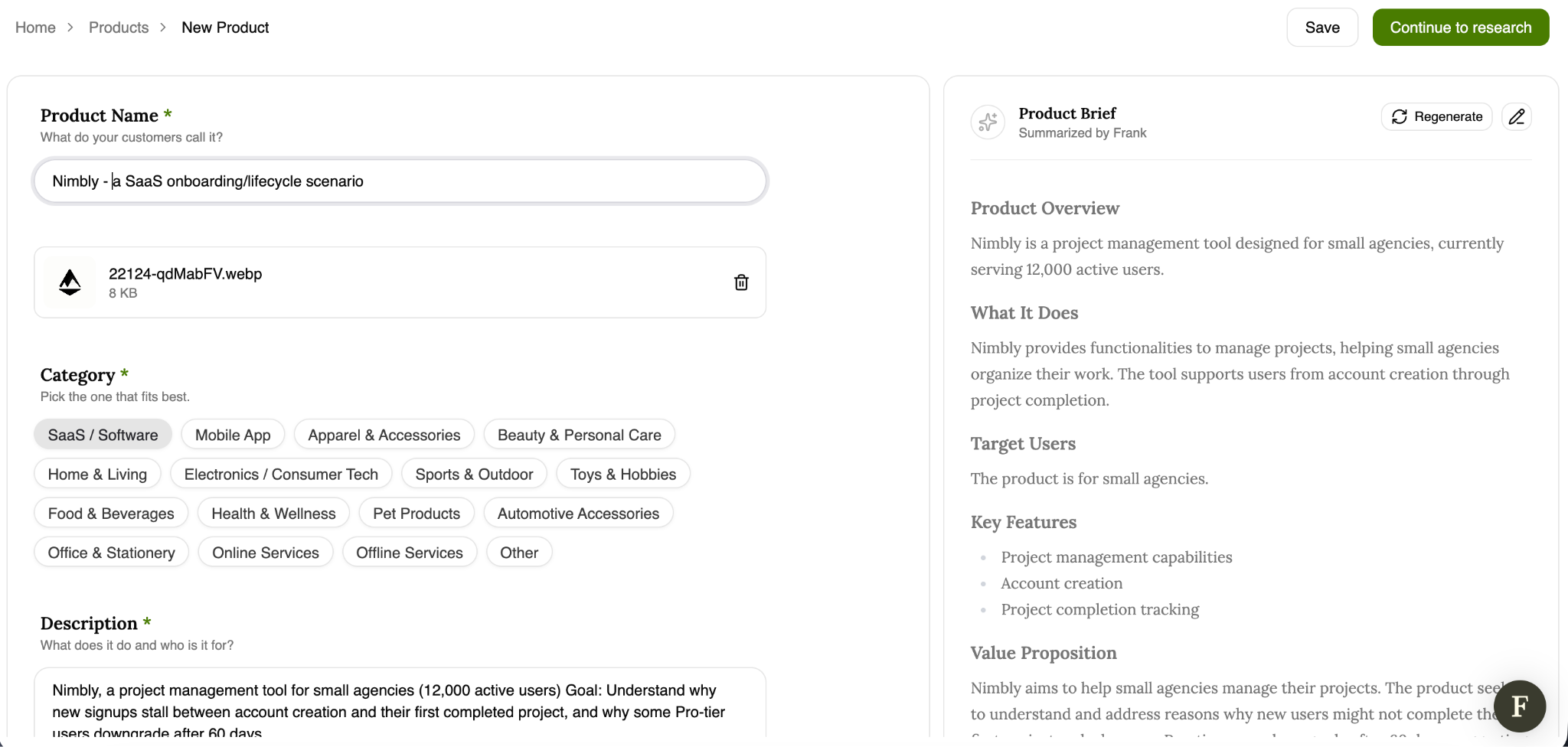
Frank is the strongest choice here for teams that want to continuously interview their own customers throughout the full customer journey. While many research tools focus on a single moment or study, Frank runs AI-moderated conversations across the lifecycle, from onboarding and adoption to upgrades, renewals, churn, and other key moments.
An onboarding drop-off, a feature nobody's adopting, an upgrade someone's stalling on, a cancellation, each gets the same treatment: an adaptive AI conversation triggered by the moment itself, not a quarterly research cycle someone has to remember to schedule. That's played out at real scale already: Frank has run more than 3,000 interviews across more than 600 research projects, in over 30 languages, with the platform able to run 100+ interviews at once, any time of day, one working answer to how to run churn interviews at scale.
Frank also embeds directly into a company's website, app, or checkout flow through a website widget, so a customer can complete the full voice interview without ever leaving the page they're already on. That matters for the moments research needs to happen exactly where a customer is: a cancellation flow, an in-app feedback prompt, a post-purchase page, instead of routing them to a separate hosted link and losing people to drop-off along the way.
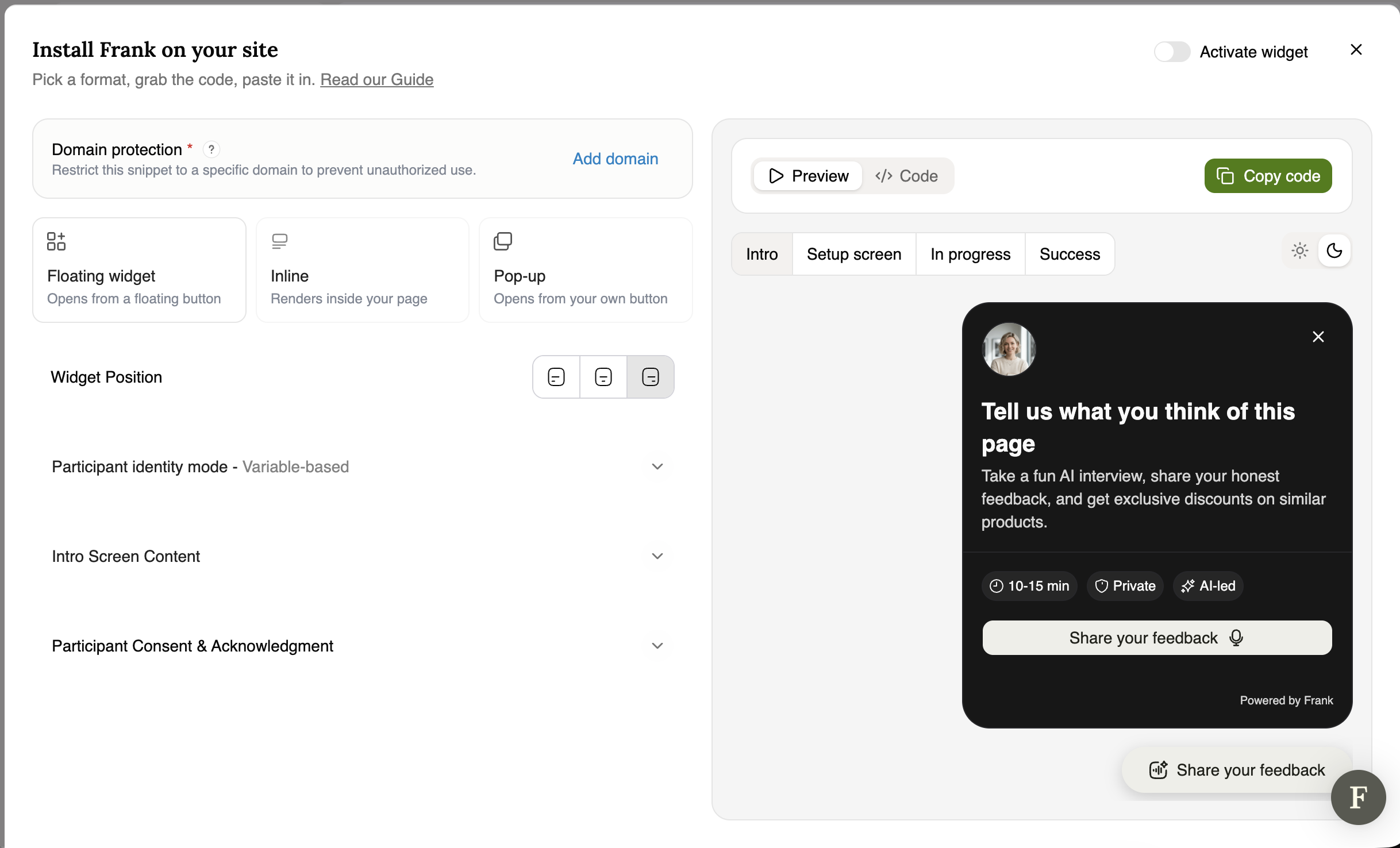
Interviews run by voice, with every conversation coming back overnight as a clear summary of themes, sentiment, and the specific reasons behind people’s decisions, rather than a raw transcript someone still has to read through. Research suggests that people may open up more when talking to AI than they would in a live interview, which can lead to deeper answers than a rehearsed response to a human moderator. Interviews can run for 5, 10, 15, 20, or 30 minutes, depending on what you choose.
Where it stops: Frank is built for customer interviews, not concept or prototype testing. Teams validating a new feature idea before it exists need a dedicated concept-testing tool instead.
Pricing: Free (~4 interviews/month); Starter $49/month (~8 interviews, 50 chat conversations); Growth $166/month (~30 interviews); Business $312/month (~63 interviews). All paid tiers billed annually.
Listen Labs
Best for: enterprise teams that need to recruit a large external panel, not just interview the customers they already have.
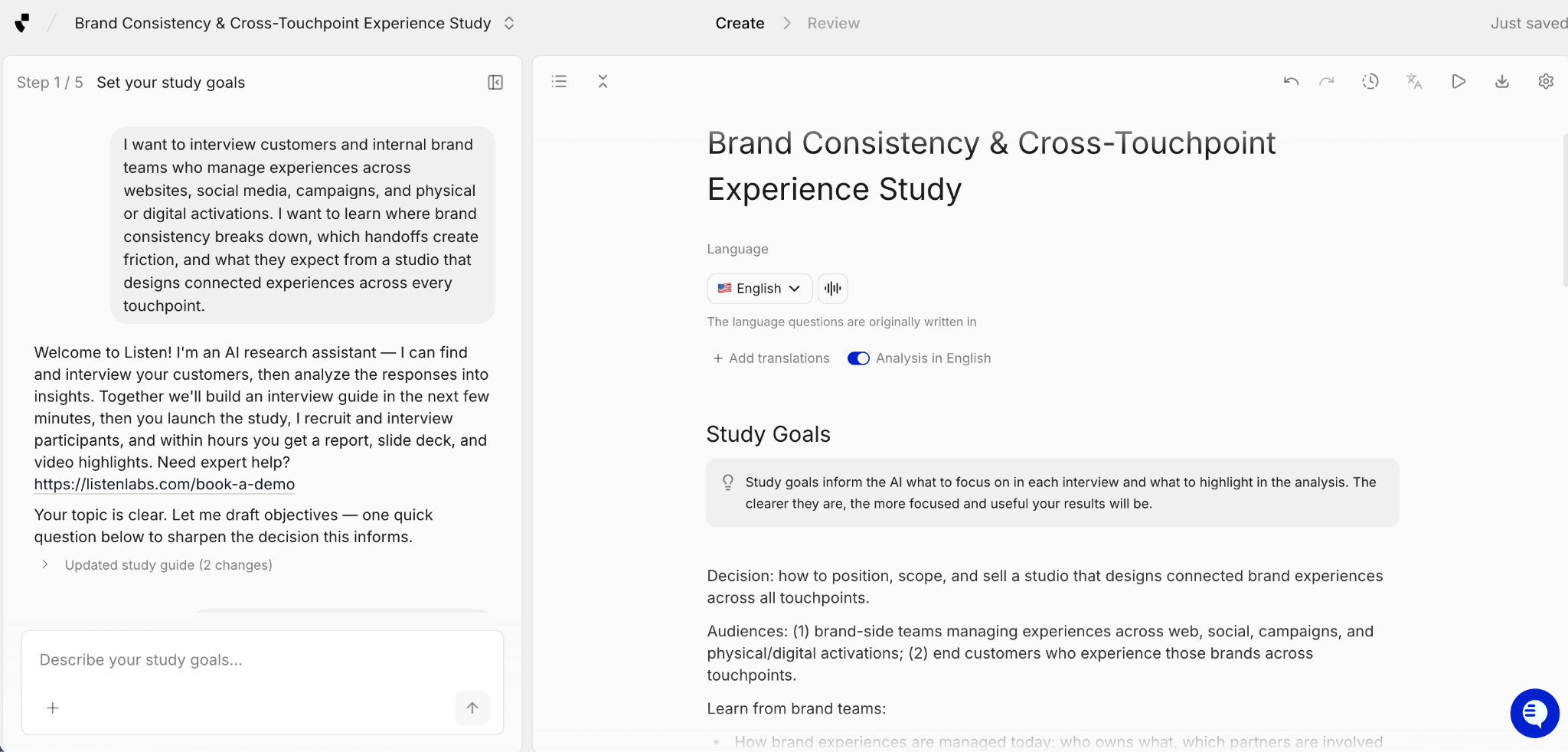
Listen Labs sources participants from its own verified respondent network rather than a company's existing user base, which makes it the right category fit when the research question is about a broader market or population that a company's own customer list can't answer, new product concepts, unfamiliar segments, or markets a team hasn't entered yet.
Interviews run through Listen Labs' own recruitment and moderation infrastructure at enterprise scale, with support across a wide range of languages and regions, and the platform positions itself around compressing traditional multi-week research cycles into a much shorter window.
Where it stops: Listen Labs uses custom pricing; access runs through a demo and a sales quote, structured as a managed engagement with an annual base fee rather than a self-serve plan a team can sign up for directly.
Pricing: Custom.
2. User Testing & Product Research
Tools in this category put a prototype, flow, or live product in front of real or recruited people and record what happens, usually before or around a launch rather than continuously.
UserTesting
Best for: enterprise product teams that need to run consumer usability studies at scale against a large, pre-built participant panel.
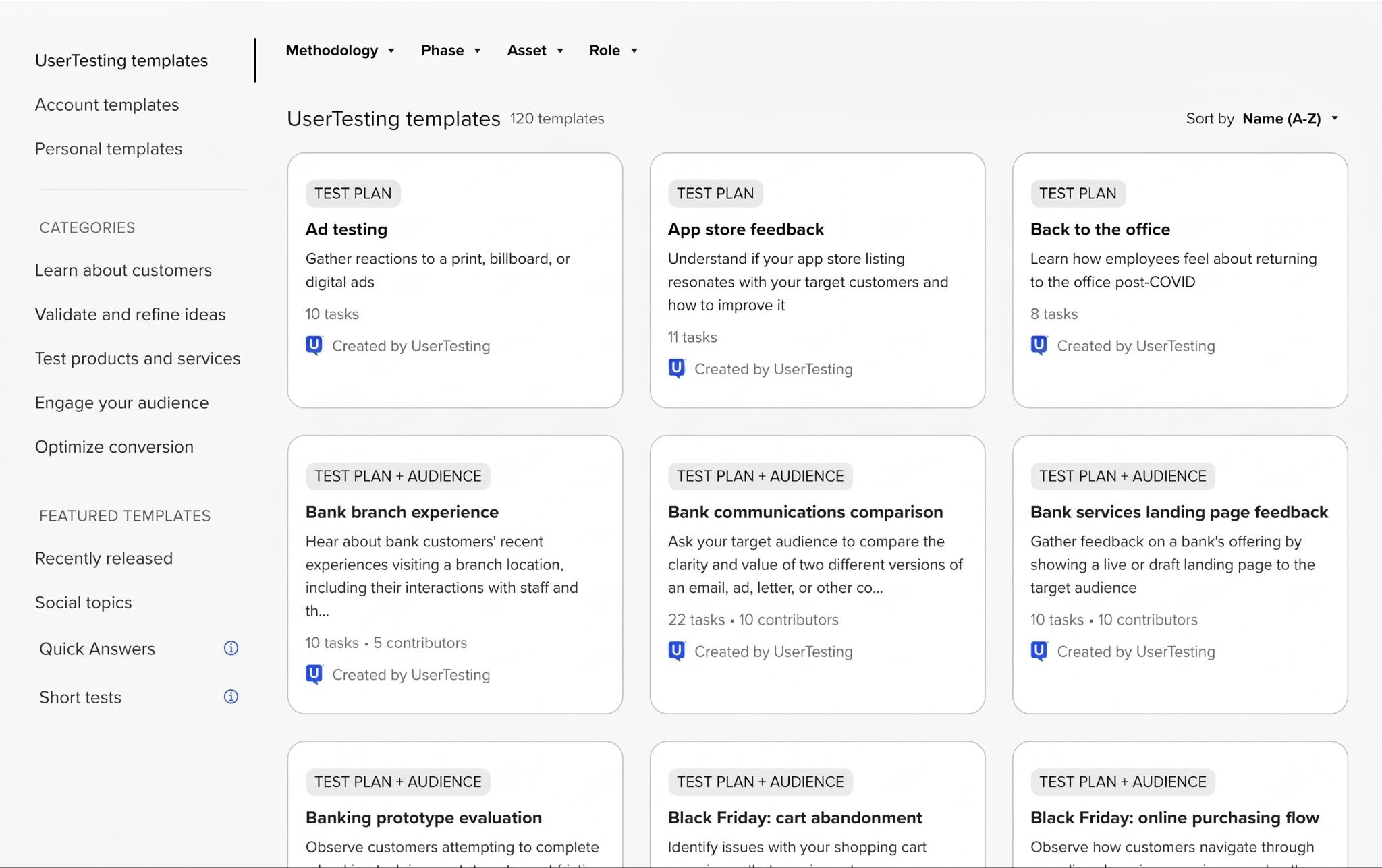
UserTesting is a human insight platform built around video-based user sessions, surveys, and prototype testing, sourced primarily from its own consumer participant panel rather than a company's own users. Founded in 2007, and following its acquisition of User Interviews in January 2026, the combined panel now runs to more than 6 million people. That scale and maturity is the platform's real strength: teams get access to a deep, pre-vetted pool of consumer testers without having to recruit anyone themselves, plus AI-assisted analysis (automatic transcription, sentiment tagging, theme detection) that reduces manual review time on high-volume unmoderated studies.
Where it stops: UserTesting's live session and moderated-interview tooling is less developed than its unmoderated core, so teams running mostly moderated conversations often need a supplementary tool.
Pricing: Custom only; no self-serve plans.
Maze
Best for: product, design, and research teams that want to run their own prototype and usability tests without a research-ops layer, and need recruitment built into the same platform.
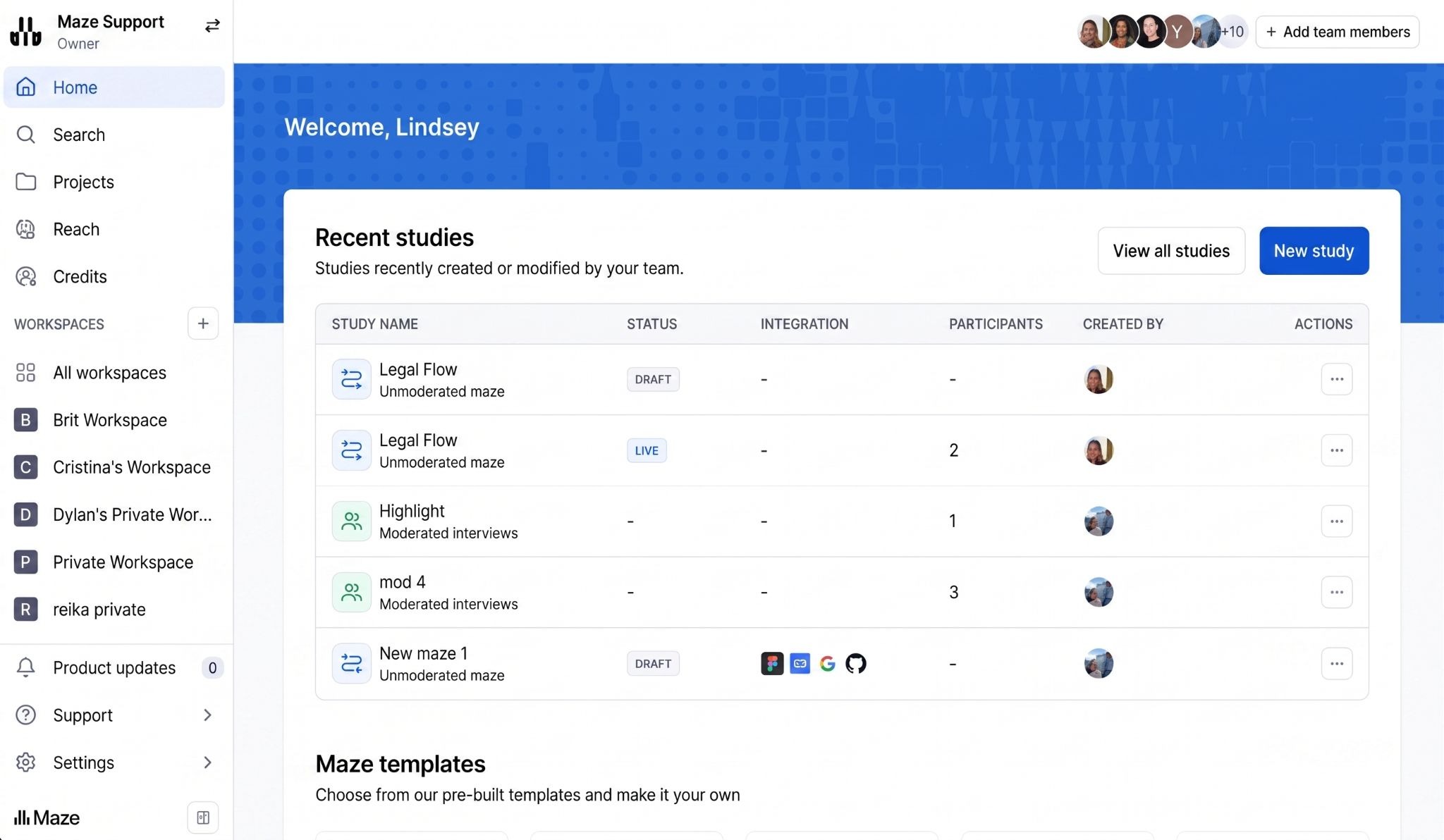
Maze is a self-serve product research platform for prototype testing, usability studies, surveys, path testing, and information architecture studies, positioned as a "continuous product discovery" tool for teams that want repeatable research without a heavyweight ops stack. Maze pairs an inexpensive subscription with pay-per-use panel credits, so a team can start small and only pay for the participants it actually recruits.
Maze also offers an AI Moderator for moderated-style interview flows, along with AI-assisted analysis across session recordings and survey responses, but that capability is reserved for the Business or Organization tier rather than the entry-level plans.
Where it stops: Maze is also built around discrete studies rather than the always-on, lifecycle-triggered interview cadence a tool like Frank runs.
Pricing: Free plan; Starter from $99/month; Organization/Enterprise custom, with the AI Moderator gated to higher tiers and panel credits billed separately.
3. Continuous / In-Product Customer Feedback
Tools in this category live inside a product or website and catch feedback and behavior as it happens, rather than running a dedicated study.
Sprig
Best for: product teams that want to catch feedback at a specific moment in the user journey, inside the product itself, and turn it into themes without manual analysis.
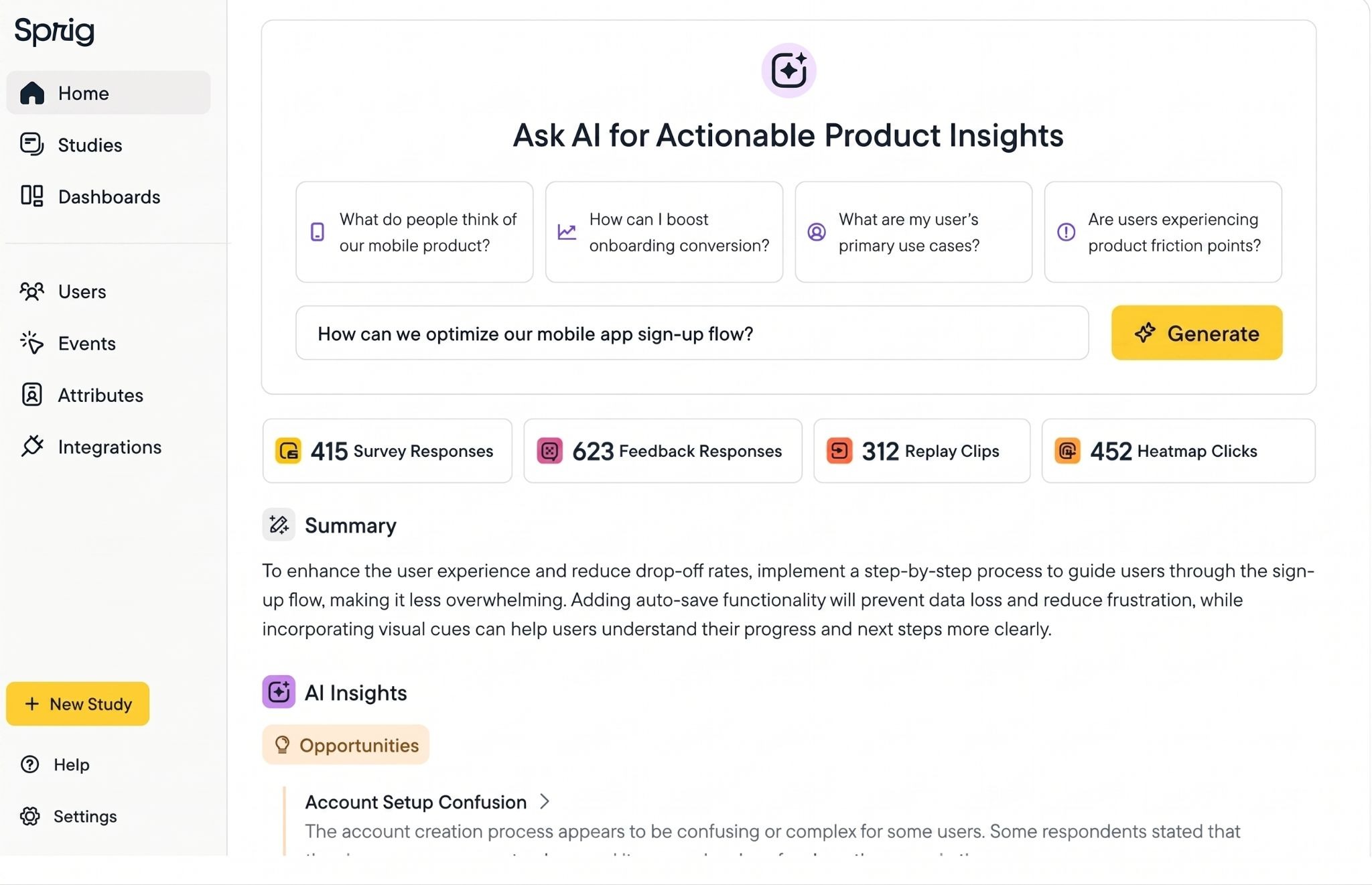
Sprig is an in-product research platform combining targeted surveys, session replays, heatmaps, and real-time AI analysis, all triggered by precise moments in the user journey rather than a scheduled study. A survey can fire the instant someone hits a paywall, abandons a flow, or completes onboarding, and AI agents handle the design, deployment, and synthesis of the resulting data, surfacing themes and product recommendations as responses come in.
Where it stops: Sprig captures a reaction at a moment, not a "why" conversation; it isn't built to push past a vague answer the way a laddering interview does, and it has no way to trigger a deep, multi-turn conversation with a churned or at-risk user after they've already left.
Pricing: Free; Starter $175/month; Enterprise custom.
Hotjar
Best for: teams that want lightweight, on-site feedback (polls, surveys, feedback widgets) sitting next to behavioral heatmaps and session recordings, without standing up a dedicated research program.

Hotjar combines behavior analytics with a lightweight way to collect real-time feedback from customers: heatmaps, session recordings, conversion funnel tracking, on-page surveys, polls, and feedback widgets, plus a recruited-interview feature. It’s a tool that is easy to add to a site and gives a fast visual read on where users are struggling. Following its 2025 merger into Contentsquare, the product line was renamed and split: Experience Analytics covers heatmaps and recordings, Voice of Customer covers surveys and feedback, and a separate Product Analytics line handles deeper behavioral reporting.
Where it stops: that merger unbundled what used to be one subscription into three separately billed products, and industry reviewers put the effective cost of running both analytics and surveys well above the old single-product price.
Pricing: Free tier available per product; Experience Analytics from $49/month; Voice of Customer from $99/month; Product Analytics custom.
4. Research Repositories & Analysis
Tools in this category don't collect new research themselves. They organize, tag, and synthesize research a team has already run somewhere else.
Dovetail
Best for: teams running continuous research across multiple product areas that need one searchable, centralized place to store, tag, and synthesize everything they've already collected.
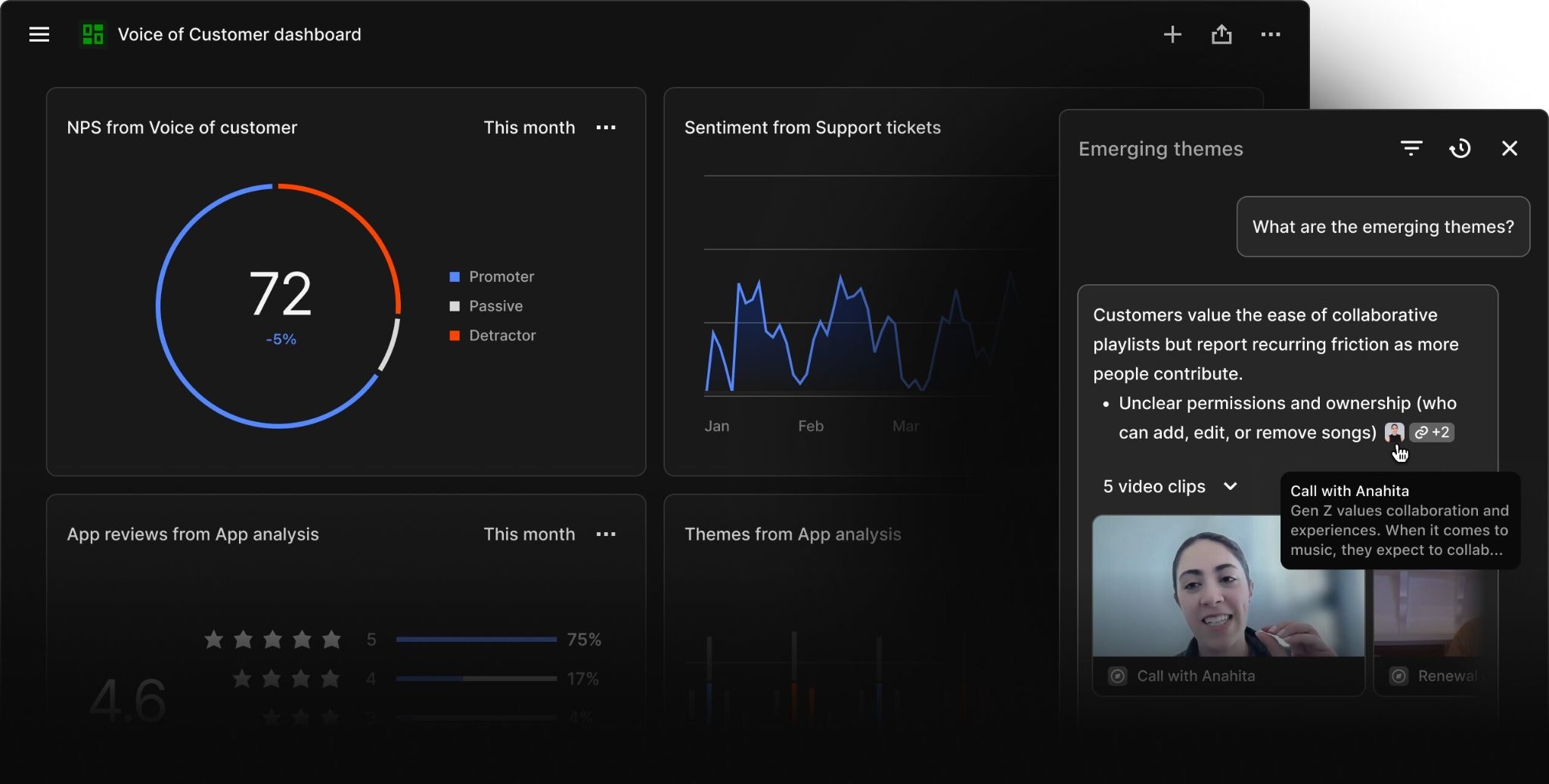
Dovetail is a research repository and AI-powered analysis platform, not an end-to-end research tool: teams bring their own transcripts, recordings, survey responses, and field notes, and Dovetail's AI handles theme detection, sentiment scoring, highlight extraction, and pattern recognition across studies. Its video highlight and clip-sharing tools are considered ahead of most alternatives for teams that need stakeholders to watch a moment rather than read a summary. Its real advantage over a raw folder of files is showing exactly where your customer insights get lost and how to fix it, by turning a data backlog into something searchable and cross-referenced across every study a team has ever run.
Where it stops: Dovetail has no participant recruitment or built-in data collection, so a company's total research cost always includes Dovetail plus whatever tool sources the interviews, surveys, or usability sessions in the first place.
Pricing: Free plan; Enterprise custom, with buyer-reported median annual contracts around $21,600.
Condens
Best for: teams that need to organize and analyze research they've already collected, not run new interviews.
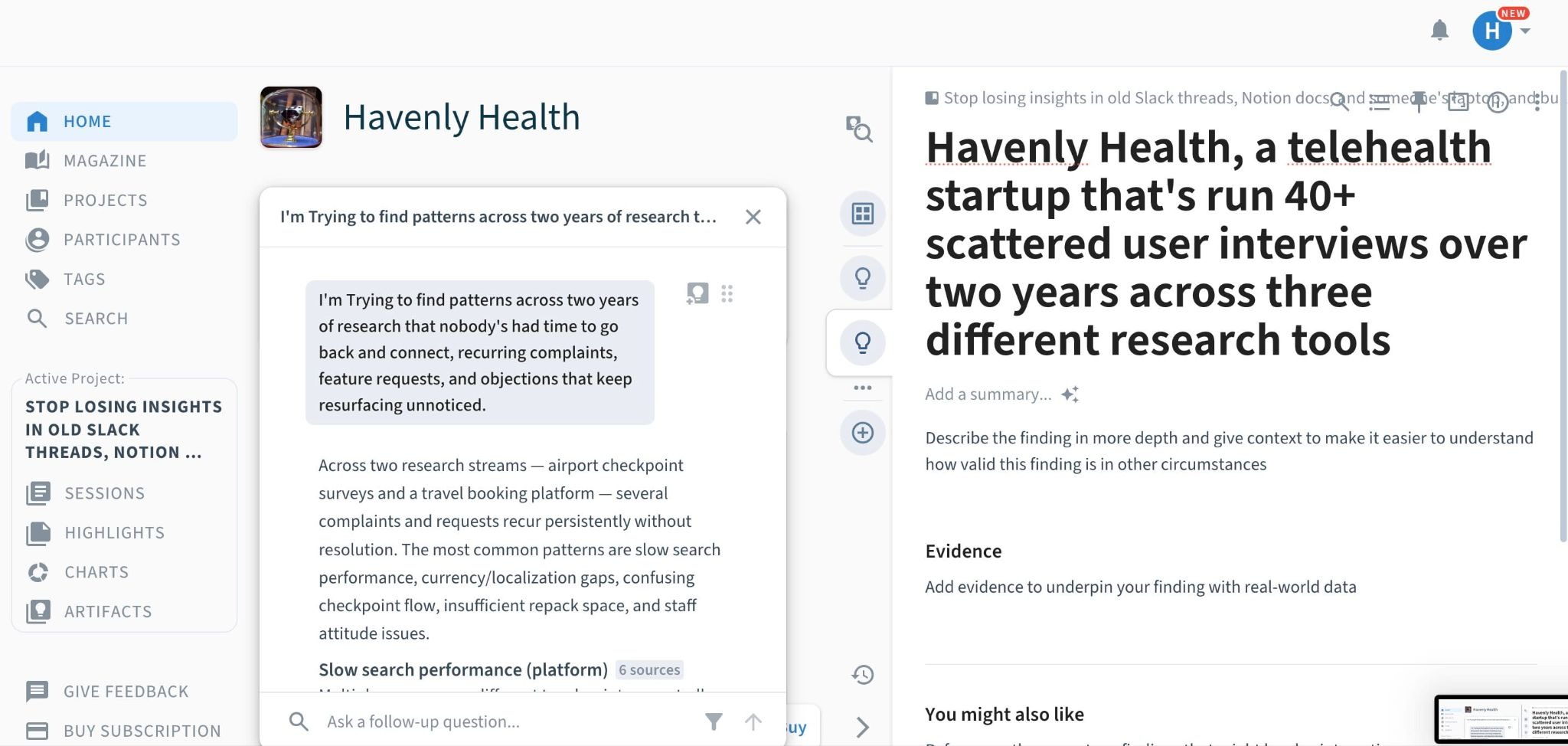
Condens is a repository. Recordings and transcripts get imported, tagged, and synthesized into a searchable, shareable body of research, with AI-assisted tagging and a clip-highlighting workflow built specifically for video analysis.
That's a different job from what an interview platform does: Condens organizes research a team already has sitting in various folders and drives, which is usually why customer insights get lost in the first place, rather than going out and collecting new research on its own. For teams that already run interviews through another tool and just need somewhere clean to store and make sense of the output, that's the whole point.
Where it stops: Condens doesn't recruit, interview, or moderate; it needs a separate tool upstream to actually produce the recordings and transcripts it organizes.
Pricing: Lite ~€15/user/month; Business ~€500/month flat (5+ users); Enterprise custom.
Which Customer Research Platform Fits Your Research Need
Conclusion
There's a real difference between organizing research you already have, watching where people click, recruiting strangers to play customer, and actually asking your own customers what's on their minds. All of it gets called "insights." Only some of it means talking to, or watching, anyone who's touched your product.
A dashboard can tell you something's wrong. A heatmap can tell you where. Neither tells you why, and why is the only part you can act on. Pick the tool that matches what you're trying to learn, and go have the conversation. Your customers already know the answer. You just have to ask.

FAQ
Which customer research platform should I use?
Use Frank to interview users across the full lifecycle, Listen Labs to recruit an outside panel, Maze or UserTesting to test a prototype or usability flow, Sprig or Hotjar for continuous in-product feedback, and Dovetail or Condens to organize research you've already collected.
Are AI-moderated interviews actually better than a traditional exit survey?
Yes, when the goal is understanding why rather than measuring what. Exit surveys are useful for collecting high-volume structured feedback, while AI-moderated interviews can ask follow-up questions and uncover more specific reasons.
What's the difference between a usability testing tool and a customer interview tool?
Usability tools like Maze and UserTesting record what people do with a design or flow, usually as a one-off study. Frank runs adaptive, moderated conversations with your own users, often triggered by a real event like a cancellation.
Do I need a separate tool to catch feedback continuously, or does an interview platform already cover that?
Different rhythms: Sprig and Hotjar catch a reaction the moment it happens, at high volume and low depth. Frank goes deep on fewer, triggered conversations. Many teams run both.
Which tool is cheapest to start with?
Frank and Sprig have usable free plans; Maze's free tier covers basic testing. UserTesting and Listen Labs are custom/enterprise pricing only, no self-serve option.
Do I need a dedicated research team to run any of these?
No, for Frank, Maze, Sprig, and Hotjar, a single PM or founder can run them solo. UserTesting, Dovetail, and Listen Labs suit larger, more structured programs.