
Marvin is an AI-powered customer research platform that helps teams organize, analyze, and share insights from customer interviews and other research data. Features include transcription, tagging, AI-powered analysis, and tools to turn research findings into shareable insights.
However, Marvin may not fit every team. Pricing structure, learning curve, insight organization, customization, and transcription or translation performance can all influence which research platform makes sense for a particular workflow.
In this guide, we compare the best Marvin alternatives in 2026 based on these factors. You’ll find options for teams looking for more transparent pricing, a simpler research workflow, stronger customization, participant recruitment, or different approaches to AI-powered customer research.
We’ll compare each alternative’s key features, pricing, strengths, limitations, and the teams it suits best, so you can see how the options differ before choosing a platform.
Why Look for a Marvin Alternative?
Four issues come up often enough, across independent reviews, to be worth naming directly.
1. Enterprise-style pricing with no month-to-month option. Every Marvin tier past the free plan is "contact sales," and paid plans require an annual commitment. A third-party source, Looppanel, mentioned that Essentials starts at $50/user/month and Standard at $100/user/month, both with a 5-user minimum. Marvin's live pricing page no longer publishes those figures, but the annual-only structure they describe still holds. If you want to test the tool for a quarter before committing, you can upload a very limited number of files (5 files/month) with only 2 seats.
2. A steep learning curve for non-researchers. Marvin is built with the depth research-ops teams expect. It provides tagging taxonomies, affinity boards, and a full Analysis Studio; however, a lot of the people now running customer research are PMs and founders, not trained researchers. Robert D., a Senior UX Researcher, put it plainly in a Capterra review: "The interface can be a little complex, but there is a lot of functionality." A Product Manager added that "the flows of moving between the main screen and projects are a bit confusing as they have a different side navigation."
3. Rigid insight display with limited board customization. Multiple reviewers flagged that Marvin pushes findings into one central insights view rather than keeping them project-specific. User and UX Researchers in Caotera mentioned: "The 'insights' function is a little clumsy ..." and “... is not possible to customize... as easily as it is on other tools like Miro."
4. Inconsistent transcription and translation accuracy on cross-market projects. Transcription can be hit-or-miss, with punctuation sometimes missing. For cross-market projects, the translation feature can sometimes be poor. For global teams, this can become a data-quality issue.

How We Ranked These Alternatives: Our Methodology
We didn't rank these tools on feature count. We lean on individual reviews and rank alternatives against the four drawbacks above.
- Pricing transparency and flexibility
Can you actually see what you'll pay before talking to sales? Is there a plan that doesn't require an annual lock-in?
- Learning curve
Can a PM or founder without research training use this without a week of onboarding?
- Insight and board customization
Can findings stay organized per-project, and can stakeholders see them in a format that fits how they actually work?
- Transcription and translation accuracy
How does the tool perform on multilingual or accented speech, based on independent reviews rather than vendor claims?
Where the public data was thin - which happened more than we'd like with a few of these tools - we say so instead of filling the gap with a guess.
Overview: Marvin Alternatives at a Glance
A quick-scan summary before the deep dives below. Frank's row is shaded — it's the pick we'd default to for the reader profile this article is written for, but not the only reasonable answer.
7 Best Marvin Alternatives in 2026
Frank
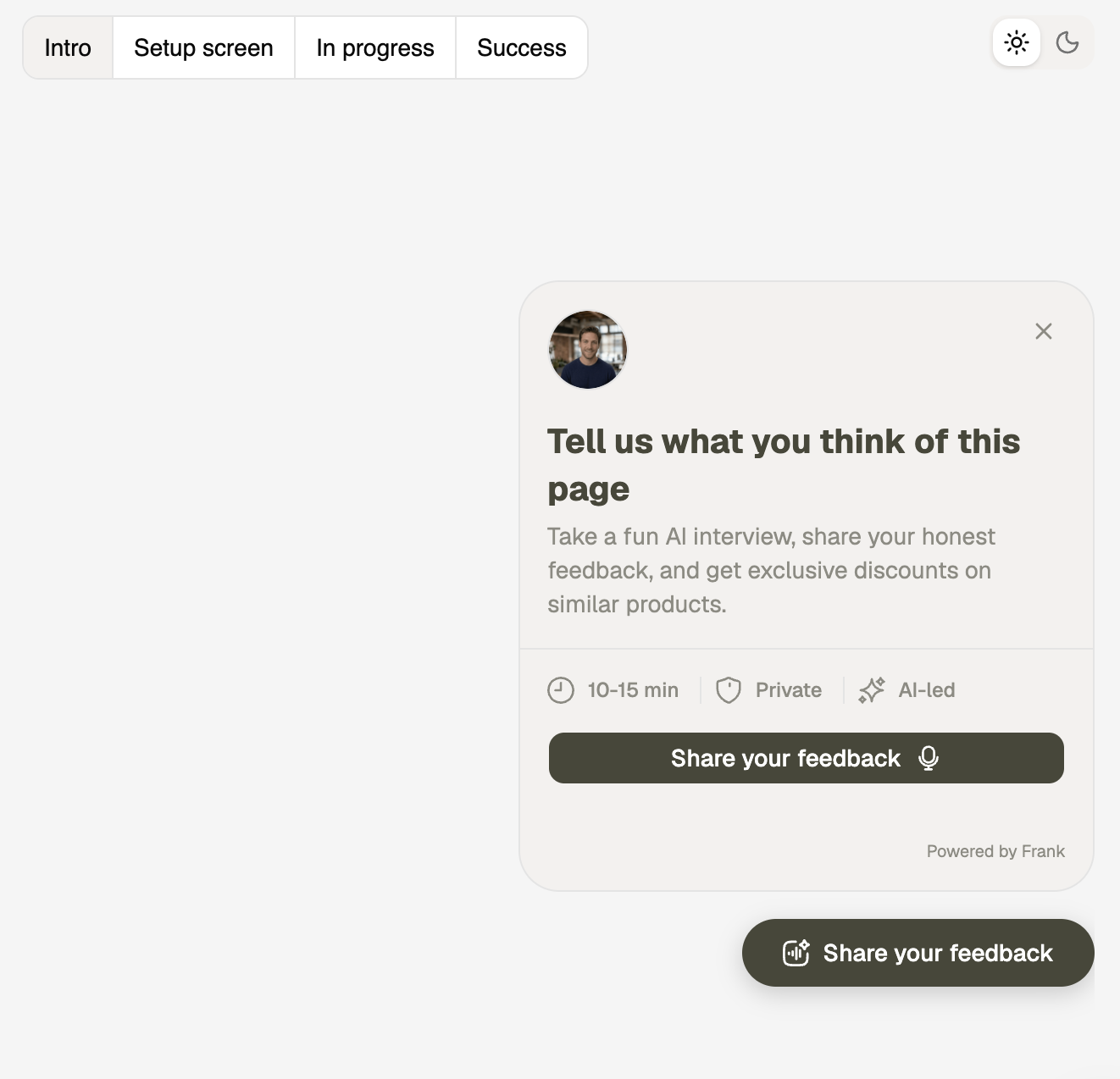
Frank is an always-on AI interviewer for product and growth teams. It talks to your own customers at the moments that matter. It can be right after a purchase to understand what drove the purchase, during cancellation to understand their needs, or at an abandoned checkout. As a result, you learn why people acted while the experience is still fresh. You don't have to recruit participants or schedule calls.
Right timing has two effects. First, recall is fresher. A customer describes a cancellation minutes after it happens, not three weeks later on a Zoom call. Second, you reach people who never accept calendar invites. Churned users and non-activators rarely book a research call. However, they may answer a short voice interview in the moment.
Each interview uses adaptive follow-ups to dig into reasons, motivations, and decision drivers. Frank runs hundreds to 1,000+ interviews simultaneously in 30+ languages. Every insight also links back to its transcript and recording. That transparent verification answers the most common worry about this category: is the AI making things up?
Pros
- Moment-triggered interviews. A website embed launches interviews at set points in the customer journey, such as a cancellation flow or abandoned checkout.
- No research expertise required. Frank is built for PMs, founders, and growth teams who run research on the side.
- Transparent verification: transcripts and recordings for every insight.
- SOC 2 & GDPR compliant.
- MCP connector that brings interview insights into Claude, ChatGPT, Cursor, and other AI tools.
Cons
- You can only interview consumers you have access to. For exploratory or concept research, you can build your own panel and send out Frank interviews.
- No Figma or prototype-testing integration.
- No built-in participant incentive payments.
Why choose Frank over Marvin
Pick Frank if your bottleneck is getting interviews, not organizing them. Marvin is strongest as a place to analyze and store research your team has already collected. That assumes someone is running interviews in the first place. Frank fills the gap for teams where a PM or founder owns the research. It collects interviews automatically at the moments you choose, then synthesizes them.
Pricing is the second difference. Marvin keeps paid pricing behind “contact sales” past its free tier, and its paid plans are annual-only. That makes it hard to test at low commitment. Frank publishes self-serve pricing: Free, Starter at $49/mo, Growth at $166/m,o and Business at $312/mo (all billed annually). There’s also a 14-day free trial with no credit card required. If pricing opacity (drawback #1) is your dealbreaker, this is the direct fix.
Pricing: Free (60 min/mo) · Starter $49/mo billed annually ($59 monthly)
Condens
Condens is a dedicated research repository built for UX and product teams, from solo freelancers up to enterprise names like Siemens and Cisco. It markets itself squarely as a repository-first tool: tags, global search, participant profiles, and an infinite whiteboard for affinity mapping, with AI features layered on top rather than positioned as the whole product.

Pros
- Unlimited automated transcription included even on the cheapest paid tier.
- Dedicated "Insights Magazine" stakeholder portal.
- Unlimited free viewer seats.
Cons
- Transcription accuracy drops for smaller languages like Danish.
- AI features are gated to the Business and Enterprise tiers and don't yet do full cross-interview thematic synthesis.
- Some reviewers found the tagging system cumbersome and the learning curve real for newcomers.
Why choose Condens over Marvin
Condens publishes real, low-entry pricing. €15/month for its Lite tier, which directly resolves Marvin's biggest complaint: opaque, annual-only, contact-sales pricing. It also reads as less overwhelming out of the box. As one reviewer put it, "Condens does not feel feature-bloated like some other research repository tools," which speaks directly to the learning-curve drawback non-researchers hit with Marvin.
Pricing: Lite €15/month (€165/yr), Business from €500/month billed yearly
Dovetail
Dovetail positions itself as a single searchable source of truth for research. It offers Projects, Channels, global tags, CRM-enriched contacts, and keyword and semantic search across everything a team has ever recorded. Its AI layer includes AI Projects, AI Channels, and AI Chat for querying the repository directly.

Pros
- Ease of use and centralized organization are the most-cited strengths on G2.
- Strong data reuse across studies.
- AI Docs let teams turn raw research into shareable, stakeholder-ready outputs with clips and reels built in.
Cons
- Several reviewers flagged missing or incomplete AI features, a complex tagging system, and rising prices paired with UI changes that disrupt existing repository setups.
- There is no native call recording. You need an integration for that.
Why choose Dovetail over Marvin
Where Marvin pushes findings into one rigid central insights view, Dovetail's AI Docs and Dashboards give teams more control over how findings get packaged and shared. This directly answers the insight-customization drawback. One honest caveat: Dovetail has moved almost entirely to "contact sales" pricing above its free tier, so it doesn't solve Marvin's pricing-transparency problem. If that's your main complaint, look at Condens or Frank instead.
Pricing: Free tier; everything above is now Contact Sales
Looppanel
Looppanel markets itself explicitly as a faster, simpler alternative to heavier platforms like Dovetail and Marvin. It auto-records interviews straight from Zoom, Meet, or Teams, then maps AI-generated notes directly onto your discussion guide questions.

Pros
- One-click auto-record with no manual upload step
- AI notes grouped by the actual question asked, not just a flat transcript
- Slack-clip sharing workflow reviewers repeatedly single out
Cons
- Auto-Analysis is capped at 3 runs per project on the Pro tier
- Transcription still makes noticeable mistakes
- There's currently no low-end or solo pricing tier, despite older marketing referencing a ~$30/month plan.
Why choose Looppanel over Marvin
Looppanel's own positioning, and its reviews, center on keeping "the researcher in control" with a simpler interface than Marvin's. This speaks directly to the learning-curve drawback. If Marvin's navigation and analysis workflow feel overbuilt for your team, this is the more approachable version of the same job.
Pricing: Free 1-month trial with full features, Pro $395/month or $4,200/yr
Maze
Maze is built for prototype and usability validation first, qualitative research second. It combines a 5M+ recruitment panel with native Figma, Sketch, and Adobe XD prototype testing, plus an AI Moderator for moderated interview studies.

Pros
- Reviewers consistently call out the intuitive interface and fast data collection.
- Strong Figma integration
- Feedback comes back quickly enough to act on inside a sprint
Cons
- Reported bugs, including heatmaps that don't always register clicks correctly and prototype instability on mobile
- No PowerPoint export for reports
- You can't edit a study after publishing without duplicating it
Why choose Maze over Marvin
Maze's AI-generated reports embed directly into Figma and Confluence, giving teams more flexible, purpose-built outputs than Marvin's single centralized insights view. This directly addresses the board-customization drawback if your stakeholders live in design tools rather than a research repository. Maze's own repository and cross-study knowledge base are thin compared to Marvin's, Dovetail's, or Condens', so if centralizing everything in one place matters more than usability testing, this isn't the tool to go.
Pricing: No public dollar figures; contact sales
Conveo
Conveo runs video-first, async AI interviews with an EU-leaning compliance posture. Public detail is thinner here than for the tools above. This profile draws on prior Frank research into Conveo specifically, not a fresh independent review sweep, and that gap is worth naming rather than papering over.

Pros
- Structured and methodology-first approach to qualitative interviews. Not a lightweight AI layer bolted onto a survey tool.
- Positioned for teams that want traditional research rigor in an async format
Cons
- Enterprise-only pricing with no free plan and no self-serve trial
- Video-first format, which limits customers to interviews
Why choose Conveo over Marvin
Conveo's heavier, more structured methodology targets teams less comfortable relying on lightweight AI auto-summarization. Conveo is a more rigorous answer to the same trust concern Marvin's "insights get pushed into one central view" complaint reflects. Conveo doesn't touch Marvin's pricing-transparency problem at all — its enterprise-only, contact-required pricing is arguably more opaque than Marvin's, not less.
Pricing: Enterprise-only
Strella
Strella pairs an 8-million-participant recruitment panel with continuous research workflows, used by teams at Amazon and Duolingo. Like Conveo, this profile draws on prior Frank research rather than a fresh review sweep for this article.
Pros
- You're not limited to your own existing customer base, making it suited to teams running continuous, high-volume research.
- A human moderator can intervene mid-session - critical for sensitive research topics.
Cons
- Weaker fit for niche B2B recruiting, where an 8-million general panel doesn't help much
- No prototype or concept-testing capability
- Incentive handling reportedly gets complicated once you bring your own audience instead of using Strella's panel.
Why choose Strella over Marvin
If your real blocker with Marvin isn't pricing or the interface, but that Marvin's AI Moderated Interviewer assumes you already have customers to interview. Strella's panel solves a structural gap Marvin doesn't address at all. That's a different problem than the four drawbacks above, and worth being precise about. Strella doesn't fix Marvin's pricing opacity, but it does solve the "we don't have enough of our own customers to interview" problem some readers actually have.
Pricing: Reported $150–$400/month
Which Tool Is Actually Right for You
Use Frank if you want to understand customer motivations and decisions at every stage of the customer lifecycle through AI-powered interviews that make customer research faster and easier to scale.
Use Condens if budget is the deciding factor and you want a lean, affordable dedicated repository that doesn't feel bloated on day one.
Use Dovetail if you're running many studies across a team and need one searchable source of truth - and you can live with contact-sales pricing.
Use Looppanel if you want Marvin's speed without Marvin's navigation, and you're a small team or solo researcher.
Use Maze if usability and prototype testing matter as much as, or more than, qualitative interviews.
Use Conveo if you want heavier methodological rigor than lightweight AI summarization and can absorb an enterprise contract.
Use Strella if your real blocker is recruiting enough participants, not the interface or the price.
The Bottom Line
Marvin is a great tool - the G2 and Capterra scores back that up, and its compliance depth is real.
But "well-reviewed" and "right for your team" are different questions. If Marvin's pricing opacity, learning curve, rigid insight view, or translation accuracy is the specific thing slowing you down, there's a tool above built to answer that exact complaint - not just a longer feature list.
If you have customers but no researcher, Frank is the way to go. It tells you why they buy, cancel, or stall while the moment is still fresh enough to act on.