
Nobody switches research tools out of spite. You switch because the tool you bought does 90% of what you need, and the other 10% turns out to be the part that actually mattered. AI interview tools are no different.
GetWhy's fine. Great, even, for what it does: AI-moderated interviews with customers, for enterprise brand teams. It isn't built for everything. Nothing to argue with there. That's a real use case, and GetWhy handles it well. It just isn't the only one. And it's nice to know your other options.
This article is for anyone weighing GetWhy who's hit a wall with one part of it, whether that's the pricing, the recruitment model, or the enterprise focus. Some of the tools below fix that exact problem. Others go a different direction entirely. Either way, the goal is the same: find the one that fits why you're here.
TL;DR
- Frank is best for continuously interviewing your own customers at key moments, from activation and purchase to churn and cancellation.
- CleverX is best if you want published per-seat pricing and a large verified panel with LinkedIn identity checks.
- Tellet is best for multilingual, multi-market EU research.
- Suzy is best for quant, qual, and a proprietary panel under one enterprise contract.
- Listen Labs is best for large-scale research with emotional-intelligence analysis and insights that build across studies.
- Discuss.io is best when you need a live human moderator to work together with the AI.
Why Look for a GetWhy Alternative?
Traditional moderated qualitative research was neither cheap nor quick, and that is the situation we are discussing here. According to the Nielsen Norman Group, a complete qualitative usability study can cost between 40,000 and 150,000.
AI-moderated tools have been developed precisely since teams wanted to carry out cheaper interviews without compromising on quality, and GetWhy does a real portion of that well.
That said, four things send people looking elsewhere:
- No visible pricing; although GetWhy does provide a self-service platform, it doesn't have a public pricing page, which means you can't get an idea of the costs before speaking to the team. This is acceptable if you prefer sales calls, but less so if you want to sign up and get started this afternoon.
- Designed for recruited audiences rather than for your customers. GetWhy recruits users through a vendor-agnostic network consisting of more than 300 million verified consumers. It's suitable for a general consumer audience, but not so good if your aim is to speak to the people who are already using your product.
- Video-first, brand-scale research. It's ideal for conducting concept and creative tests on a CPG scale, though it is less suitable for the quick, informal
- Priced and built for enterprise. Acquisition-based buying with a high level of commitment, and there's no inexpensive option available. It's suitable if you have a budget allocated for it, but it's not ideal if you're a founder who just wants to speak to five customers this week.
At other times it isn't a limitation whatsoever; you need something that GetWhy wasn't designed for, for example, combining quantitative and qualitative analysis, having a human moderator present, or carrying out a more in-depth emotional analysis.
How We Ranked GetWhy Alternatives
We picked five criteria that map straight back to the reasons people go looking in the first place:
- Pricing honesty and self-serve access. Can you view the price and begin the study without first booking a call, or is that step required?
- A free plan or trial is available. Might you like to try the product before spending money? The Forrester "State of Business Buying" report states that "trials are emerging as essential to reduce risk", a finding which is in line with what most software buyers expect nowadays.
- Recruitment flexibility. Does the tool interview your own customers, draw on a panel, or allow you to do either? It all comes down to who is responsible for carrying out the interviews within the company. Is that task the research team's responsibility, or can the product and growth teams look after it themselves?
- Channel/modality coverage. Voice, video, chat, text. Does it meet people where they actually are, or just one format?
- Depth of AI moderation. Does the AI ask a real follow-up, or stop at the first answer?
Each tool below gets scored against all five.
GetWhy Alternatives at a Glance
6 Best GetWhy Alternatives: Deep Dives
1. Frank
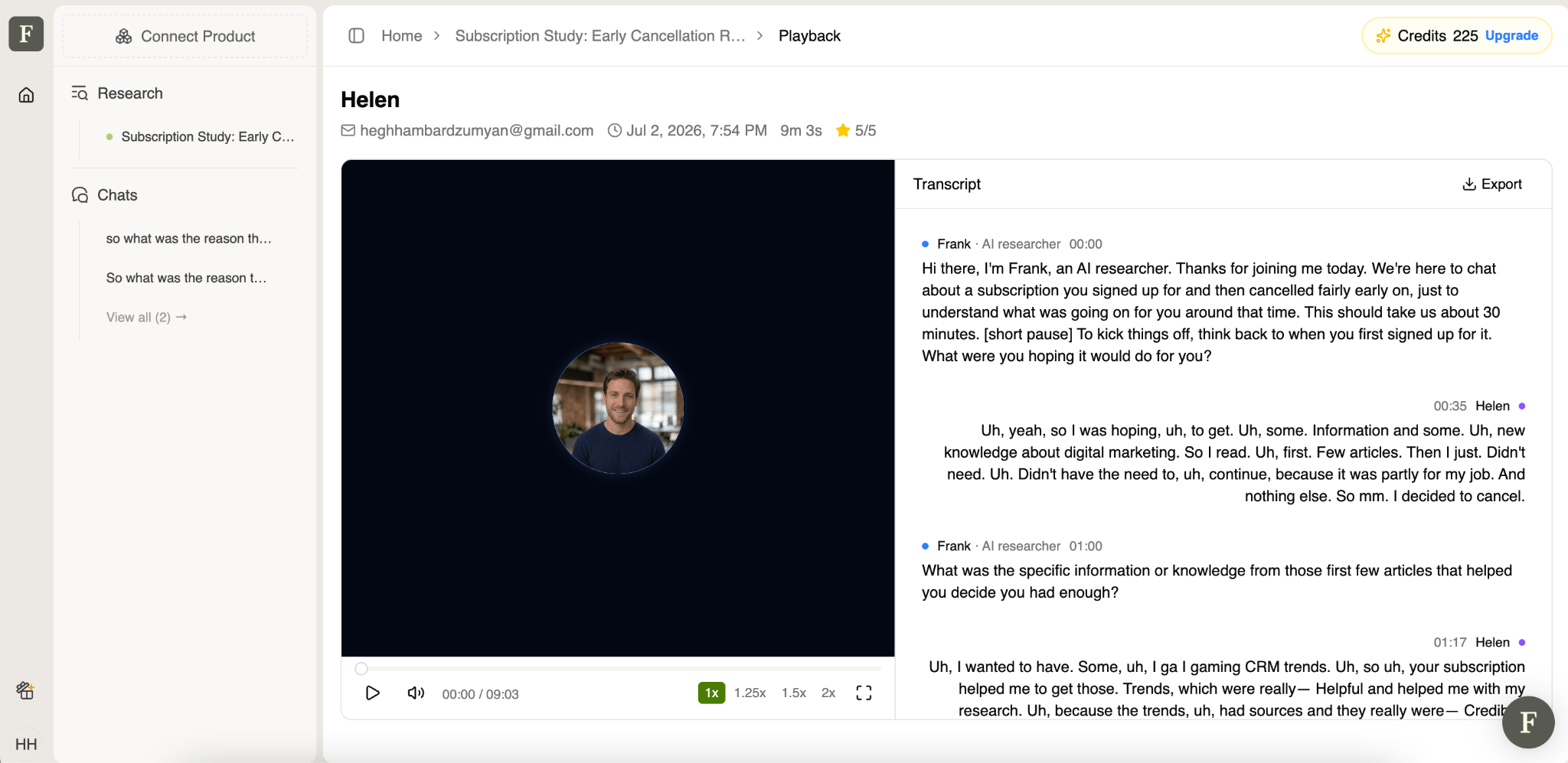
Best for: founders, PMs, and growth teams who want to continuously interview their own customers at key moments across the customer journey.
Frank is an always-on AI interviewer that talks to your real customers at key moments across the customer journey, from activation and purchase to churn and cancellation and turns those conversations into structured insights overnight.
Instead of recruiting people or scheduling interviews, Frank can interview customers right when a key customer moment happens, for example, after a purchase, cancellation, churn, or failed activation. This lets teams collect feedback while the experience is still fresh, making continuous customer research possible even without a dedicated research team.
Frank is built by Prelaunch, with research methodology behind its interview frameworks. To date, it has run more than 3,000 interviews across more than 600 research projects.
The problem Frank solves is familiar: at most startups, customer research falls to PMs, founders, or growth teams. You book five interviews, three people no-show, and the other two give surface-level answers. By the time the conversations are transcribed and analyzed, the sprint is over.
And the customers you most want to hear from are often the hardest to reach. Someone who churned, abandoned a purchase, or never activated your product isn't likely to respond to a calendar invite. Frank removes that scheduling gap by interviewing people when these moments happen, rather than asking them to come back later.
Frank skips the calendar altogether: it interviews people right after the key moment happens, so there's no window to miss. TCF, a crowdfunding marketing agency, used it to interview about 80 creators who didn't sign. The results showed the problem wasn't price but clarity: 43% didn't know what services would cost. TCF clarified its offer instead of cutting prices.
Pros:
- No scheduling: Frank can interview customers right when a key customer moment happens, such as after a purchase, cancellation, churn, or failed activation.
- Embeds directly on your website, so participants can complete the full voice interview without leaving the page.
- Runs 100+ interviews simultaneously, so research isn't limited to a handful of scheduled conversations.
- Every summary links back to the raw transcript, making it easy to verify insights and trace findings back to what customers actually said.
- SOC 2 and GDPR compliant.
- No research expertise required: state your research goal, and Frank automatically builds the interview framework.
- 30+ languages, so teams can collect feedback from customers beyond English-speaking audiences.
- Connects to your AI workflow through Frank's MCP connector, so you can bring customer interview insights into tools like Claude, ChatGPT, Gemini, Copilot, and Cursor.
Cons:
- There is no built-in panel; it's designed for chatting with your own customers, not for recruiting strangers
- No Figma prototype or multi-concept testing
- No native participant payment handling
Why Frank over GetWhy: GetWhy is built around a consumer panel of more than 300 million people, while Frank interviews your own customers at specific moments in their journey. That makes Frank better suited to understanding why someone cancelled, failed to activate, abandoned a purchase, or took another specific action while the experience is still fresh. There’s no need to recruit or schedule respondents, so teams can collect feedback continuously without relying on people to show up for a call.
Pricing:
- Free
- Starter: $49/month (billed annually; $59 billed monthly)
- Growth: $166/month (billed annually; $199 billed monthly)
- Business: $312/month (billed annually; $375 billed monthly)
- All paid plans include a 14-day free trial, no credit card required
2. Tellet
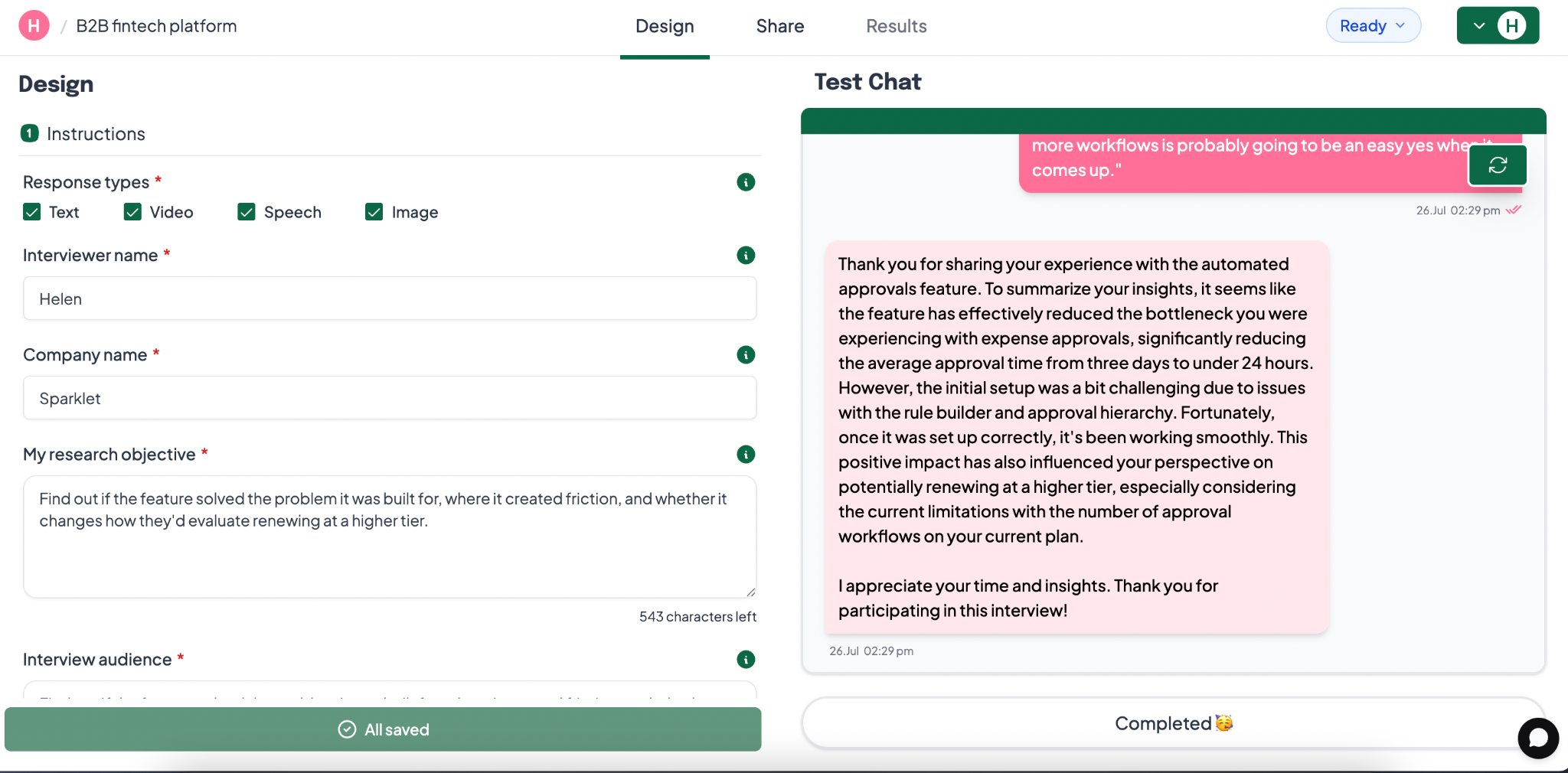
Best for: European insight teams and agencies running multi-market, multilingual qualitative research who can't justify hiring a local moderator (or a translator) for every country on the list.
Tellet runs voice, text, or video AI-moderated interviews with up to 1,000 participants at once, in 57 languages, auto-translating every conversation back into the researcher's working language as it happens.
The pitch is "qual depth, at survey speed"; the AI probes and follows up the way a trained interviewer would, just run in parallel across hundreds of conversations instead of one call at a time. It's GDPR-native, which in the EU is less a bonus feature and more table stakes.
Pros:
- Runs AI interviews with up to 1,000 participants at once, auto-translated into your working language
- GDPR-native by design, removing a compliance headache for EU studies
- Compresses multi-market qual from weeks to days
- Flexible on recruitment: bring your own panel or use Tellet's vetted regional partners
- Adaptive AI probing follows up like a trained interviewer, run in parallel across hundreds of conversations at once
- 57 languages, one of the widest ranges on this list
Cons:
- No panel of its own by default; you supply or source participants
- No cross-study querying; each study lives on its own
- EU-centric focus, so it may be less built-out for research outside European markets
- Exact pricing tiers aren't listed publicly
Why Tellet over GetWhy: Tellet is capable of handling up to 1,000 interviews at a time in 57 languages and translates each interview in real time into your working language. This means that multi-market qualitative research, which would otherwise take weeks, can now be completed in just days. The system is GDPR-compliant and is sold on a subscription basis.
Pricing:
- Subscription-based
- Per study (contact for exact tiers)
3. Suzy
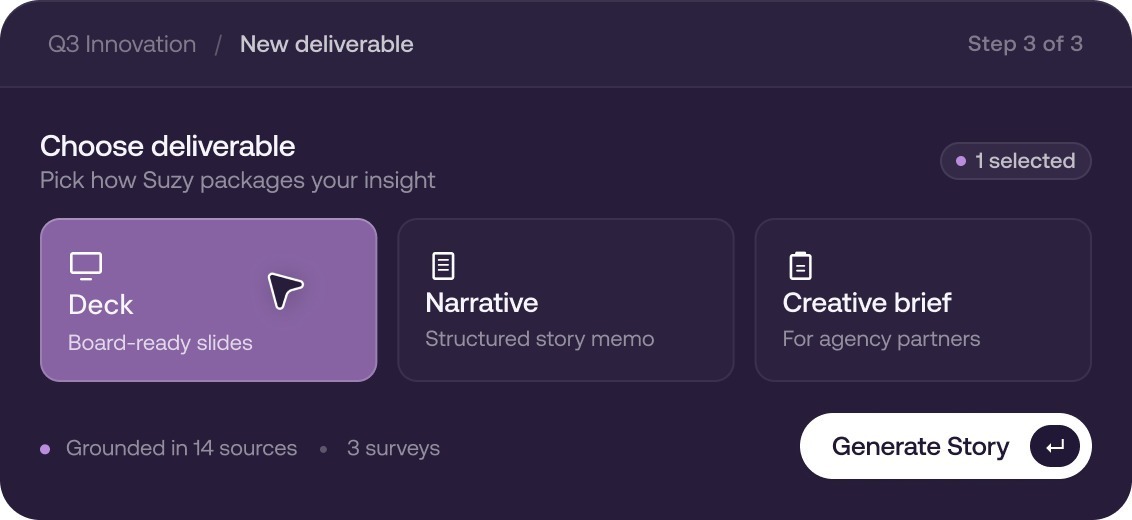
Best for: enterprise CPG, beauty, and retail brands that are done running one tool for surveys, another for interviews, and a third just to reach real consumers, and want it all under a single login.
Suzy is built around a proprietary panel commonly cited as around 1MM+ verified consumers that Suzy owns outright, and that's the detail users point to most: because Suzy owns the respondents instead of renting them from a third-party sample provider, you can re-contact the same people later without starting recruitment from scratch.
That makes it a natural fit for CPG teams who test packaging and ad creative repeatedly with the same audiences. It also prevents customer insights from getting lost between departments, since everything lives in the same panel and dashboard.
Pros:
- One platform for quant, qual, and panel access, no vendor-stitching
- Owns its panel outright, so re-contacting respondents later is easy
- A 500-person study can return complete results in around 6 hours
- Managed-service tiers available if you'd rather Suzy's team run it
- Built-in monadic testing eliminates order bias when comparing multiple concepts side by side
Cons:
- Pricing is a barrier. One G2 reviewer called it "far less usable for small teams, startups"
- Enterprise-priced and sales-led, with no public pricing page
- Qual sits on top of a survey-first core, not interview-native like others
- Best suited to constant, high-volume programs, not one lightweight study
- Panel-based by default, not your own specific customers
Why Suzy over GetWhy: GetWhy provides interview coverage, Suzy also offers quantitative data on the same platform and since it has its own panel you can return to the same respondents later on. A study involving 500 people gives full results in about six hours rather than taking six days to six weeks as with a traditional vendor.
Pricing:
- Enterprise/custom
- Sales-led; no public pricing page
4. Listen Labs
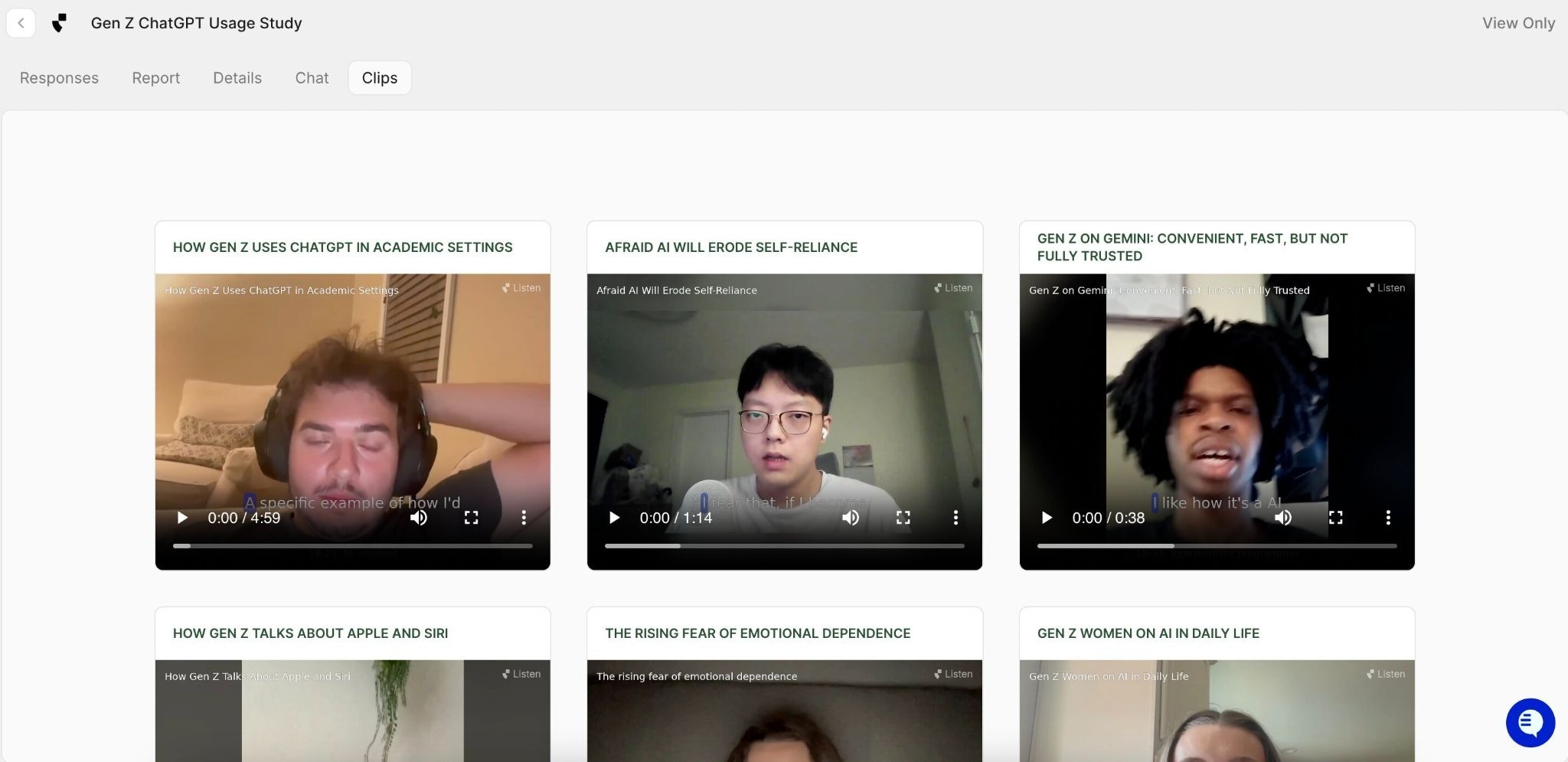
Best for: enterprise insight teams running high-stakes, large-scale AI-moderated research, annual brand trackers, major segmentation studies, strategic structuring work.
Listen Labs is the closest structural match to GetWhy on this list: both are sold as managed research engagements rather than self-serve software. A new engagement runs through a sales conversation, audience scoping, contracting, recruitment, fielding, and analysis, so it's a serious commitment, not a "sign up this afternoon" tool.
It runs AI-moderated interviews drawing on a global network of 50M+ participants, or on your own list of contacts. What is truly distinct is Emotional Intelligence: the platform flags hesitation, tone shifts, and friction at the exact timestamp they occur, instead of collapsing everything into a generic "sentiment: mixed" line.
Pros:
- Broader modality coverage than video-only; voice and text are first-class
- Emotional/behavioral signal detection most competitors here don't offer
- Mission Control compounds research across studies instead of restarting each time
- Well suited to high-stakes annual trackers and major segmentation work
- Recruit from a 50M+ global network or bring your own contact list
Cons:
- No published pricing; expect a sales conversation to get a number
- Scoping and contracting come before fielding, so it isn't built for quick turnaround
- Recruits from a panel, not the specific customers you want to hear from
- Past studies don't carry forward into new ones as easily as the "Mission Control" name implies
- Mission Control's value builds over time, so one-off studies won't see much of it
Why ListenLabs over GetWhy: Both are managed enterprise services, but Listen Labs flags hesitation, tone shifts, and friction at the exact timestamp they happen. Voice and text are first-class channels alongside video, and Mission Control carries findings across studies.
Pricing:
- Custom, demo-based
- No public pricing page
5. Discuss.io
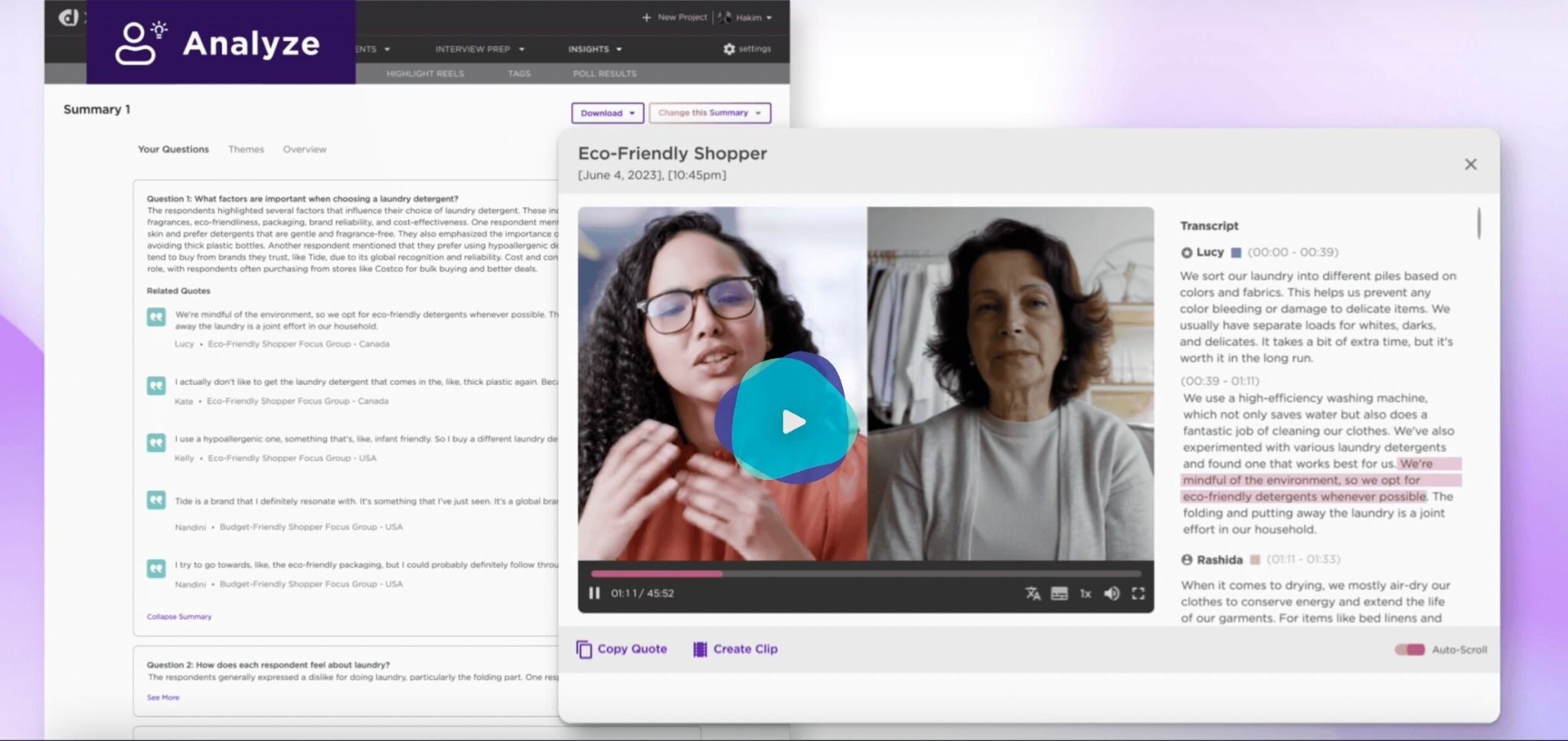
Best for: enterprise brand teams who aren't willing to hand over every conversation to an AI; some studies go better with a trained human in the room, and this platform is built around that reality.
Discuss.io’s core is live, human-moderated interviews and focus groups, with a virtual backroom so your whole stakeholder team can watch sessions in real time and react as they happen.
Users specifically call out the highlight-reel feature as a time-saver: choosing a transcript section and generating a shareable video clip on the spot, work that used to take hours of manual editing.
Recently, Discuss.io has layered AI across that workflow with Genie Experience Agents (for guide-building and faster synthesis) and a self-paced "Discuss Now" mode that runs fully AI-moderated interviews for lighter-touch studies, a way to collect live feedback from customers without booking a full moderated session every time.
Pros:
- Best choice when rapport and live stakeholder observation matter
- Highlight-reel and backroom-observation features save hours on synthesis
- Genie AI layer speeds up guide-building without removing the human moderator
- Global recruitment across 100+ countries, handled for you
- Self-paced "Discuss Now" mode gives you a lighter-touch AI-only option when you don't need a full moderated study
Cons:
- One reviewer described scheduling with third-party recruiters as "manual and error-prone".
- The same reviewer found the pricing high and closer to a service than a product
- Best suited to fewer, higher-stakes studies rather than frequent, lightweight research
- Live sessions require real scheduling, so it can't match the "launch overnight" speed of pure-AI tools
Why Discuss.io over GetWhy: Discuss.io puts a trained human moderator in its live sessions, lets stakeholders watch from a virtual backroom, and turns any highlighted transcript section into a shareable video clip instantly. For lighter studies, Discuss Now runs fully AI-moderated interviews on the same platform.
Pricing:
- Sales-quoted only
- Per-seat pricing, with enterprise contact for full deployment
6. CleverX
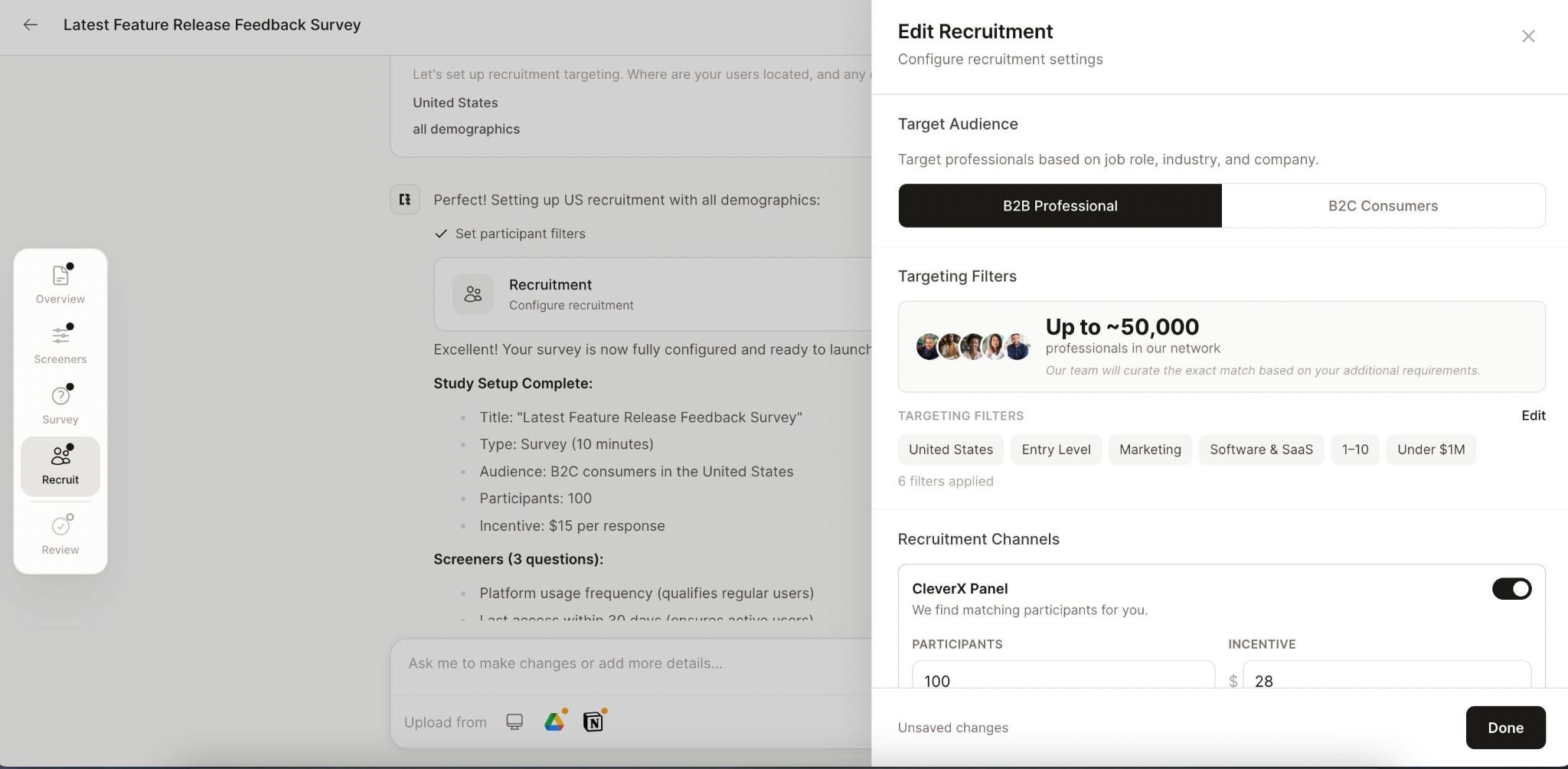
Best for: mid-to-large B2B teams tired of buying a new tool every time the research method changes, who specifically need verified professionals rather than general consumers.
CleverX takes a research goal stated in plain language and handles study design, recruitment, fielding, and reporting across six modalities: surveys, AI-moderated interviews, AI-moderated usability tests, unmoderated tests, and human-moderated versions of both.
The headline feature is its 10M+ panel of verified B2C and B2B participants, with identities checked against LinkedIn. That matters enormously if your screener says "VP of Engineering at a Series B startup" and you need that exact person.
Pros:
- Published per-seat pricing, no sales call needed to see the number
- Build studies for free before committing to a plan
- Large verified panel, with LinkedIn identity checks that make it especially strong for B2B
- Six modalities in one platform
- G2 reviewers praise ease of use and audience relevance
- Integrates with tools teams already use, like Figma, Zoom, and Calendar
Cons:
- You can build for free, but launching a study requires a paid plan; there's no stated free trial
- No instant messaging or chat channel
- A repeated pattern of participant complaints about slow incentive payouts (weeks to months). CleverX has acknowledged this and says it's reworking the payment system
- Participant credits are priced separately from the seat, so total study cost takes some math to estimate
- Built around its panel rather than your existing customers
Why CleverX over GetWhy: CleverX publishes its pricing, starting at $149 per user per month, and lets you build studies for free. GetWhy has no public pricing. Its 10M+ panel is LinkedIn-verified, so a screener asking for a VP of Engineering gets one. Six study types live in one tool, so switching methods doesn't mean buying new software.
Pricing:
- Pro: $149 per user, per month (participant credits not included)
- Studies can be built for free; launching requires a plan
Match Your Problem to an AI Interview Tool
- Want to talk to your own customers, not a panel? → Frank.
- Want a large verified research panel with visible pricing? → CleverX.
- Running multilingual research across European markets? → Tellet.
- Need quant, qual, and panel access in one platform? → Suzy.
- Running large-scale enterprise research or longitudinal programs? → Listen Labs.
- Need a human moderator alongside AI? → Discuss.io.
The main differences between these tools come down to who you can interview, how participants are recruited, which research formats are supported, and how much of the process is self-serve. GetWhy is a strong option for panel-based, enterprise qualitative research, but the alternatives above take different approaches to those same research needs.

.jpg)