
Qualtrics has been around as a customer research tool since basically the dawn of time, or 2002, whichever feels longer to you personally. And it shows. Two decades of real survey logic, real benchmarking, the kind of platform an enterprise can build a whole research team around and sleep just fine at night. That's rare. And that's impressive.
Collecting responses, tracking scores over time, all of that is real work Qualtrics does well. It's just one half of the picture. Qualtrics’ AI follow-ups add a question or two, yet the customer is still typing into a form, so the real reason behind the score rarely surfaces. Pricing is quote-only, setup takes weeks, and fewer customers answer surveys at all.
With those gaps in mind, we’ve picked the best Qualtrics alternatives in 2026 for anyone who’s ever wondered what’s actually behind the number. Below are six AI interview tools that cover the follow-up gap, compared on depth, completion, speed, price, and fit.
Key Takeaways
- Frank is best for always-on interviews that reach out the moment a customer cancels, converts, or drops off, with insights ready by morning.
- User Intuition is best for deep, laddered diagnostic studies that trace an answer back through several rounds of “why,” backed by verbatim customer quotes.
- Perspective AI is best for teams that already have a prediction or health score tool and need the missing "why" layer beneath it.
- Outset is best for enterprise teams running large-scale, multi-market research across voice, video, and text.
- Koji is best for small teams who want to build their own studies that mix structured questions with AI-moderated interviews.
- Glaut is best for market research agencies that need survey-scale sample sizes without losing conversational depth.
Why Look for a Qualtrics Alternative?
Qualtrics is built to answer a narrower question than most research teams have. It’ll hand you a score, and lately a follow-up question or two. What it won’t do is hold a conversation until the reason surfaces, and that gap is exactly what the tools further down this list are built to close.
- It does provide follow-ups, but only in written form and only to a limited extent. With Qualtrics' Conversational Feedback feature, the AI can add one or two follow-up questions to a single open-text answer and request more details when a response is vague. That is an improvement.
However, it is still composed of typed text within a form; it reduces the number of follow-ups to just one in non-English languages and in Engagement projects, and it is only available on more recent plans. There is no actual conversation taking place, and once those one or two questions have been used, no further probing occurs until a cause is reached. - Even at the right moment, it’s still a form. Qualtrics can trigger a survey when someone cancels or checks out, but what the customer gets is a set of questions to fill in, not someone asking what they meant while the decision is still fresh.
The rest of its AI works after the fact: Text iQ tags sentiment once responses are in, and Predict iQ (now set up through your account team rather than as a self-service tool) spots churn patterns in data you already have. - You don't get a price without a sales call. Qualtrics publishes no enterprise price list, and every contract is negotiated around seats, response volume, and add-ons, with implementation billed on top. The closest public benchmark is Vendr’s procurement data, which puts the median buyer at roughly $29,000 a year (accessed October 2026).
- It's not something you turn on in an afternoon. Setup, integrations, and training are typically scoped on top of the license, which is a lot of runway before your first answer comes back. Self-serve alternatives skip that runway entirely.
- Fewer people are answering surveys. Survicate's recent benchmark puts the median response rate for B2B in-product surveys (website widgets, in-app, Intercom) at 8.18%. Even when the survey sits right inside the product, most of the audience you're trying to understand never answers at all.
How We Chose These Alternatives
Plenty of AI interview platforms exist. Only a few solve the specific problem Qualtrics leaves unsolved, so instead of comparing feature lists, we judged each tool against five criteria built around that exact gap. Those criteria decided which tools made the list and what each deep dive below calls out.
- Root-cause depth - does it stop at the first answer, or keep asking until it reaches the actual mechanism? A dashboard can show a number dropping. It can't show which problem to go fix.
- Response rate & completion - a conversational format only wins if people finish it. Inbox-based surveys keep losing ground to formats that feel like a quick conversation instead of a form to fill out.
- Speed to insight - hours or days versus weeks of fielding and manual read-through. The faster a reason comes back, the more likely you can still act on it.
- Pricing transparency & entry cost - published, self-serve pricing versus a quote-only motion. G2's Buyer Behavior Report, based on over 1,000 B2B software buyers, found that for 40% of them, evaluation is now the longest stage of the buying journey.
- Fit & scope - purpose-built for a specific job or the product journey moments worth interviewing versus a general-purpose platform that has to be configured from scratch for every use case.
Overview: Qualtrics Alternatives At a Glance
The 6 Best Qualtrics Alternatives: Deep Dives
1. Frank
Best for: founders, PMs, and CS leads at SaaS and e-commerce companies who need to catch a customer's real reason for churning, onboarding, or converting, without a dedicated research team to run it.
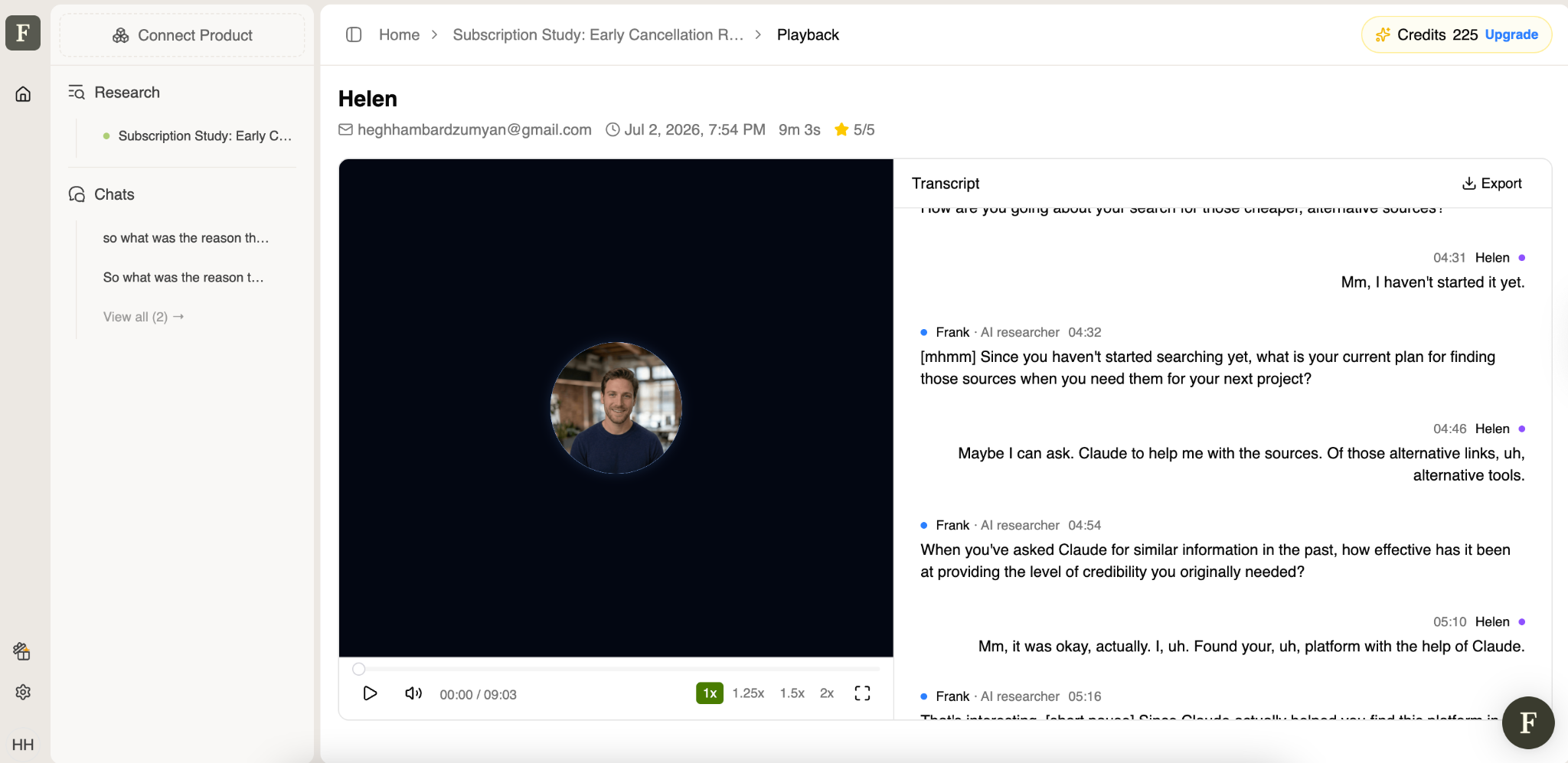
Frank is an always-on AI customer interviewer built to sit exactly where a survey gives up. Setup takes minutes: you describe your research goal (churn reasons, feature feedback, post-purchase understanding, early discovery), and Frank’s Research Agent builds the interview outline for you, no research background required. From there, Frank runs the actual conversation.
Frank is built by Prelaunch and has run more than 3,000 interviews across 600+ research projects to date. It also solves a reach problem that surveys and scheduled interviews share. The customers you most need to hear from are the hardest to get: someone who just canceled or never activated won’t fill in a long form, and won’t book a call either. Frank interviews them right when that moment happens, so there’s no invite to ignore and no slot to miss.
On a survey, a customer picks “price” and at best gets a follow-up text box or two. Frank hears “price” and asks what that actually meant, live, adapting each follow-up to what was just said:
Cancellation form: Price
Frank: You mentioned price. What were you comparing it to?
Customer: Honestly, a tool my team already pays for. We only ever used the scheduling part of yours.
Frank: So scheduling was the main reason you signed up?
Customer: Pretty much. And the other tool does that one thing for a lot less.
The dropdown said “price.” The real answer is an onboarding and positioning problem. TCF, a crowdfunding marketing agency, saw the same pattern: interviewing about 80 creators who didn’t sign, it found 43% didn’t know what its services would cost. TCF clarified the offer instead of cutting prices. The same approach works for churn at scale, or for why customers converted or dropped off.
Pros
- Adaptive voice interviews that follow up in real time based on the customer’s actual answer
- Triggered at key moments such as cancellation, checkout, and onboarding completion, so the answer is still specific
- Embeds directly on your website; participants complete the voice interview without leaving the page, with no app or account needed
- Runs 100+ interviews simultaneously, with zero scheduling and zero no-shows
- SOC 2 and GDPR compliant
- MCP connector brings interview insights into tools like Claude, ChatGPT, Gemini, Copilot, and Cursor
- 30+ languages, available 24/7
- Automated overnight summaries that pull out the specific reasons behind each answer, with themes and sentiment layered on top, no manual tagging
- Every insight traceable back to the raw transcript and recording, so nothing gets taken on faith
- Guided setup: describe the goal; Frank builds the framework; no research team needed
Cons
- No built-in participant panel; needs an existing customer base to send it to
- Not built for concept or prototype testing
- No native participant payment handling
Why Frank over Qualtrics: Qualtrics can now add 1–2 AI follow-ups to an open-text survey answer, but the customer is still typing inside a form. Frank runs an adaptive voice interview that keeps asking follow-up questions until the actual reason comes out. It’s triggered at key moments like cancellation or checkout rather than on a scheduled survey cycle, and it’s live the same day, with no contract to negotiate first.
Pricing
- Free: 60 voice minutes/month
- Starter: $49/mo billed annually ($59 month-to-month)
- Growth: $166/mo billed annually ($199 month-to-month)
- Business: $166/mo billed annually ($375 month-to-month)
- 14-day free trial
2. User Intuition
Best for: insights and CX teams running structured, recurring churn or satisfaction research programs who need to trace an answer past the first convenient reason someone clicks.
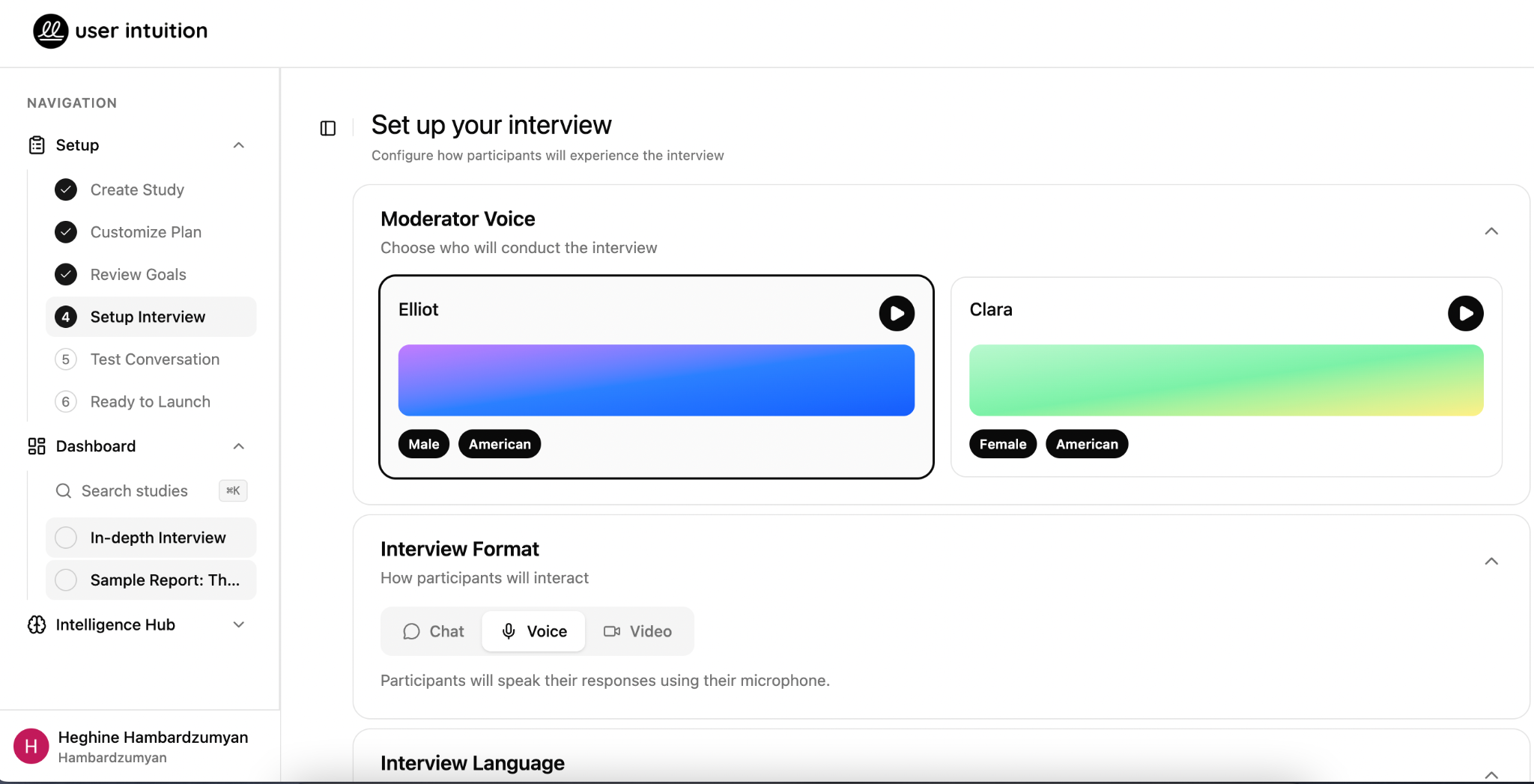
Root-cause depth is the whole premise here. User Intuition runs AI-moderated voice interviews built on laddering, a decades-old market research technique for collecting real-time customer feedback and getting past the surface answer to the motivation underneath it. Where a survey stops at “price,” or at a follow-up or two after it, User Intuition asks why price mattered, what it was being compared to, and what would've had to be true for the answer to be different.
In reality, a ladder could sound like the following: the customer states that the reason they left was the price. The interviewer then asks why price was an issue and finds out that the bill had increased at renewal.
The reason this was so disappointing was that the team had stopped using two of the features for which they were paying. The reason for this was that onboarding never managed to go beyond the first admin. By the fourth rung, 'price' had become an adoption issue, and that is the one that should be addressed.
With each study, the customer quotes are included exactly as they were for every theme, so the reason is given in the customers' own words rather than being deduced from a sentiment score.
Pros
- Root-cause depth that traces the full path from “satisfied” to “gone,” well past the first click
- Verbatim quotes in every deliverable, so the reason comes in the customer's own words, not read off a sentiment score
- Bring your own participants or recruit from a 4M+ vetted panel, so you can reach people outside your own customer list
- Pay-per-interview Starter tier, so you can run a first study without a sales-negotiated contract
- Automatically scores every interview against the research brief before it's counted, so low-quality sessions don't drag the findings down
Cons
- Doesn't flag or route at-risk customers itself, so it works best paired with whatever already tells you who churned
- Better suited to a recurring diagnostic program than a single ad hoc pulse check
- The free entry point is 3 interviews on signup
Why User Intuition over Qualtrics: Qualtrics determines the cause of an answer by referring to sentiment labels or by looking at one or two follow-up questions within the form, whereas User Intuition employs laddering by repeatedly asking why until the initial answer is transformed into the fundamental cause and then attaches the customer's own words to each of the findings. With User Intuition, the results are available within 24 hours, as opposed to the number of weeks it takes to administer a survey and have an analyst go through each of the open-text responses.
Pricing
- Starter: $30 per voice interview with your own participants, $60 with panel participants
- Professional: $2,499/mo ($25 per voice interview, 3-month minimum)
- Pay-per-quality-interview model on Starter.
3. Perspective AI
Best for: CX and retention teams already running a health score or prediction platform (ChurnZero, Gainsight, Vitally) who need the diagnostic layer to sit underneath it.
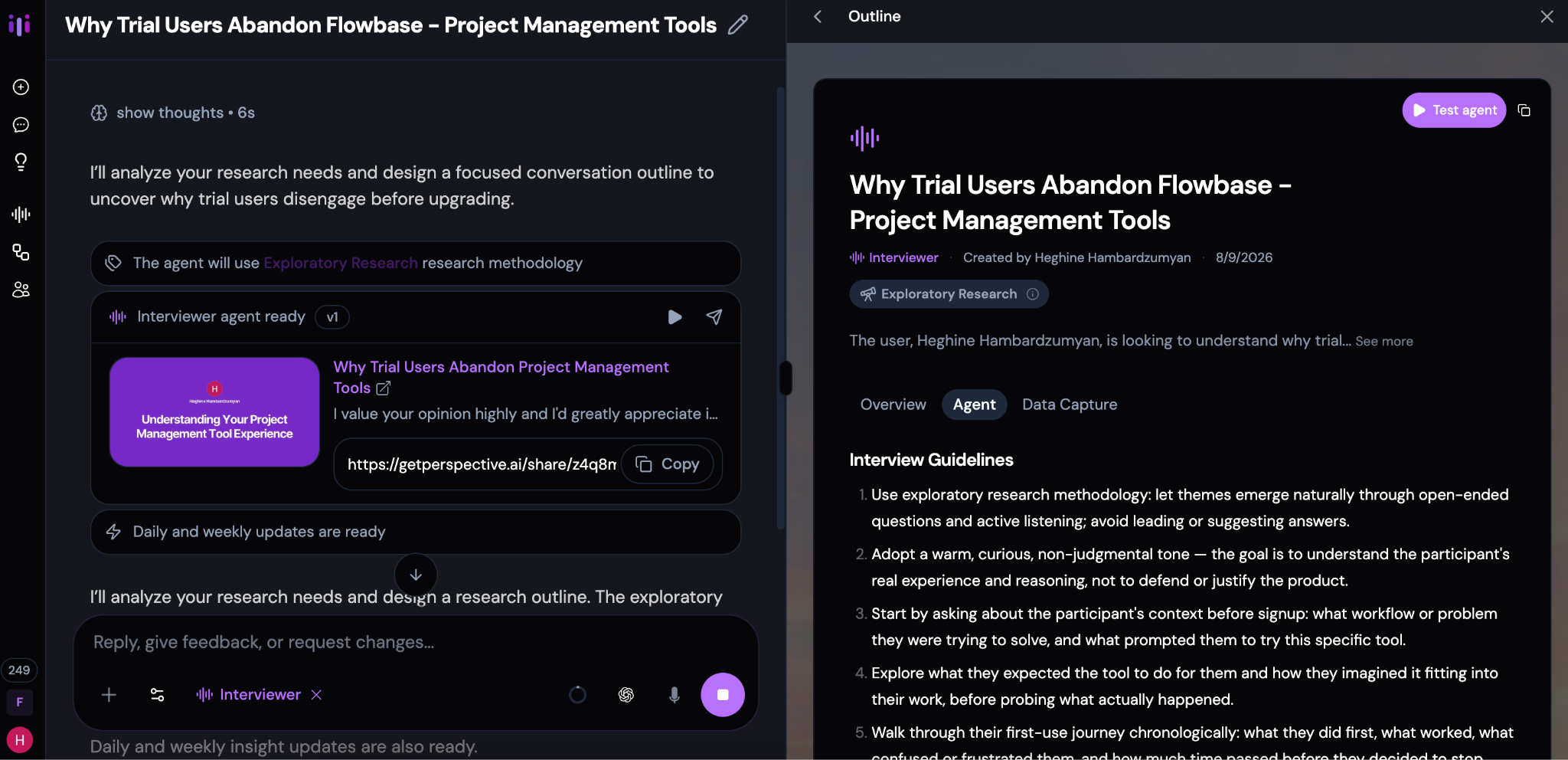
A health score provided by a platform such as ChurnZero or Gainsight can identify an account as being at risk on the basis of usage data, but the 'reason' behind that identification generally comes from a limited CRM dropdown or from the notes of the customer success manager, notes which are usually scarce and tend to favor the person who complained most loudly.
Perspective AI integrates with that system and reviews the conversations involving the accounts it marks as being at risk; this includes the exit interviews with accounts that have left and the at-risk interviews carried out before the renewal decision is finally made.
Unlike User Intuition, which is a study that you have to commission, Perspective AI is a continuous stream of conversations that is driven by the risk signals you are already monitoring.
Pros
- Exit interviews with lost accounts and at-risk interviews triggered by health-score flags, before the renewal decision is final
- Built specifically to pair with an existing prediction/CX platform, no rip-and-replace of what you already run
- Interviews run as accounts get flagged, rather than on a scheduled survey wave
- Feeds directly into a broader closed-loop feedback workflow instead of sitting as a standalone dataset
- Free tier (100 credits, about 10 conversations) to test before committing to anything, plus a full-service Research-as-a-Service option for teams that want it handled end to end
Cons
- Works best paired with a prediction tool rather than standing alone as a full research suite
- Best suited to teams that already have a way to identify at-risk customers
- Less useful without an existing program to plug into
Why Perspective AI over Qualtrics: Qualtrics' Text iQ system assigns sentiment tags to the responses after they have been collected, and its more recent AI-powered follow-ups only include a few questions within the form. Perspective AI conducts a full interview with the accounts that your health score identifies as being at risk before the renewal decision is made. It integrates with the prediction platform that you currently use, providing an explanation of the reasons without replacing your present system.
Pricing
- Free (100 credits, about 10 conversations)
- Pro $99/mo (1,000 credits)
- Custom Enterprise, plus a full-service Research-as-a-Service option.
4. Outset
Best for: enterprise research and insights teams running large-scale, multi-market studies that want every respondent probed instead of just scored.
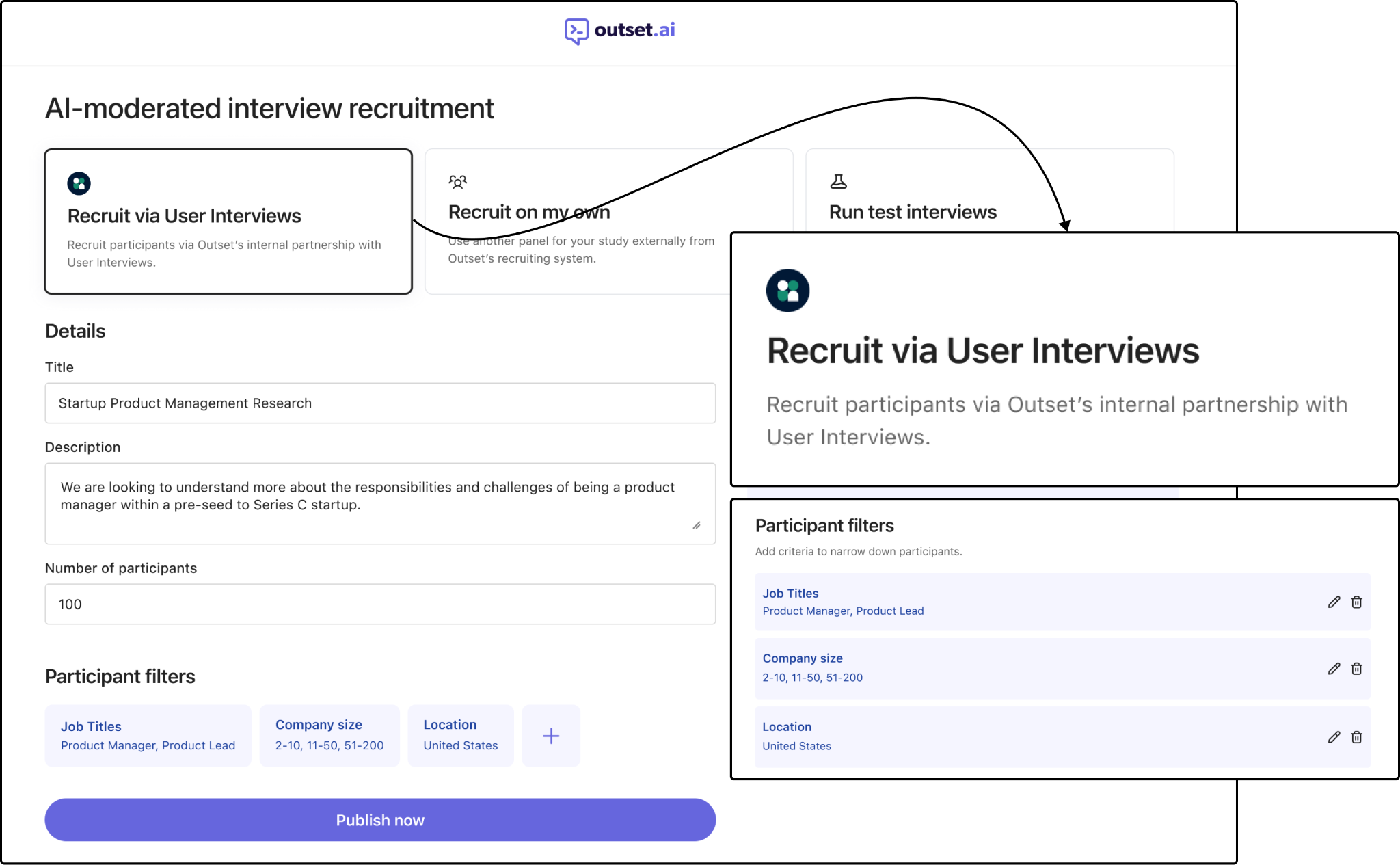
Outset is the closest thing on this list to a like-for-like swap for Qualtrics’ enterprise reach, rebuilt around conversation rather than a questionnaire. It runs AI-moderated interviews across video, voice, text, and voice-to-voice, with dynamic follow-up probes per question, so a study fielded to thousands of people doesn't have to trade depth for volume the way a survey does.
To carry out recruitment, Outset covers more than 1.1 billion potential participants in over 85 countries via its partner panels, which means that multi-market, multi-language studies do not need a separate panel vendor. The company's advantage in the enterprise sector is in terms of compliance and setup, offering SOC 2 Type II and GDPR compliance, custom screeners and quotas, and the option to use your own customer list or to recruit through Outset's partner panels.
Pros
- Up to 10 dynamic follow-up probes per question, so depth holds up even at enterprise volume
- One platform offers four modes: video, voice, text, and voice-to-voice, so that the format is tailored to the study rather than the study being tailored to the format.
- 40+ languages for global, multi-market programs
- 1.1B+ potential participants in 85+ countries through partner panels, so you're not stuck bringing your own list
- Enterprise-grade compliance out of the box: SOC 2 Type II and GDPR
- Custom screeners, quotas, and the option to bring your own customer list alongside partner-panel recruitment
Cons
- Heavier setup than a founder-led team typically needs
- Custom pricing only, no public self-serve tier, still a sales conversation to get a number
- It may feel too heavy for small teams that only want quick customer interviews
- It is less focused on always-on interviews tied to specific customer actions like churn, support resolution, or onboarding
Why Outset over Qualtrics: Qualtrics enterprise agreement is designed for a certain scale, offering multi-market coverage, support for 40 or more languages, and compliance with both SOC 2 Type II and GDPR. The difference lies in what is given to each respondent: rather than having to click through a scale question, they receive an AI-moderated interview that includes up to 10 follow-up probes per question.
Pricing: Custom, scoped to research needs and team size.
5. Koji
Best for: small product and marketing teams that want structured survey questions and AI-moderated interviews in the same study, built and run themselves.
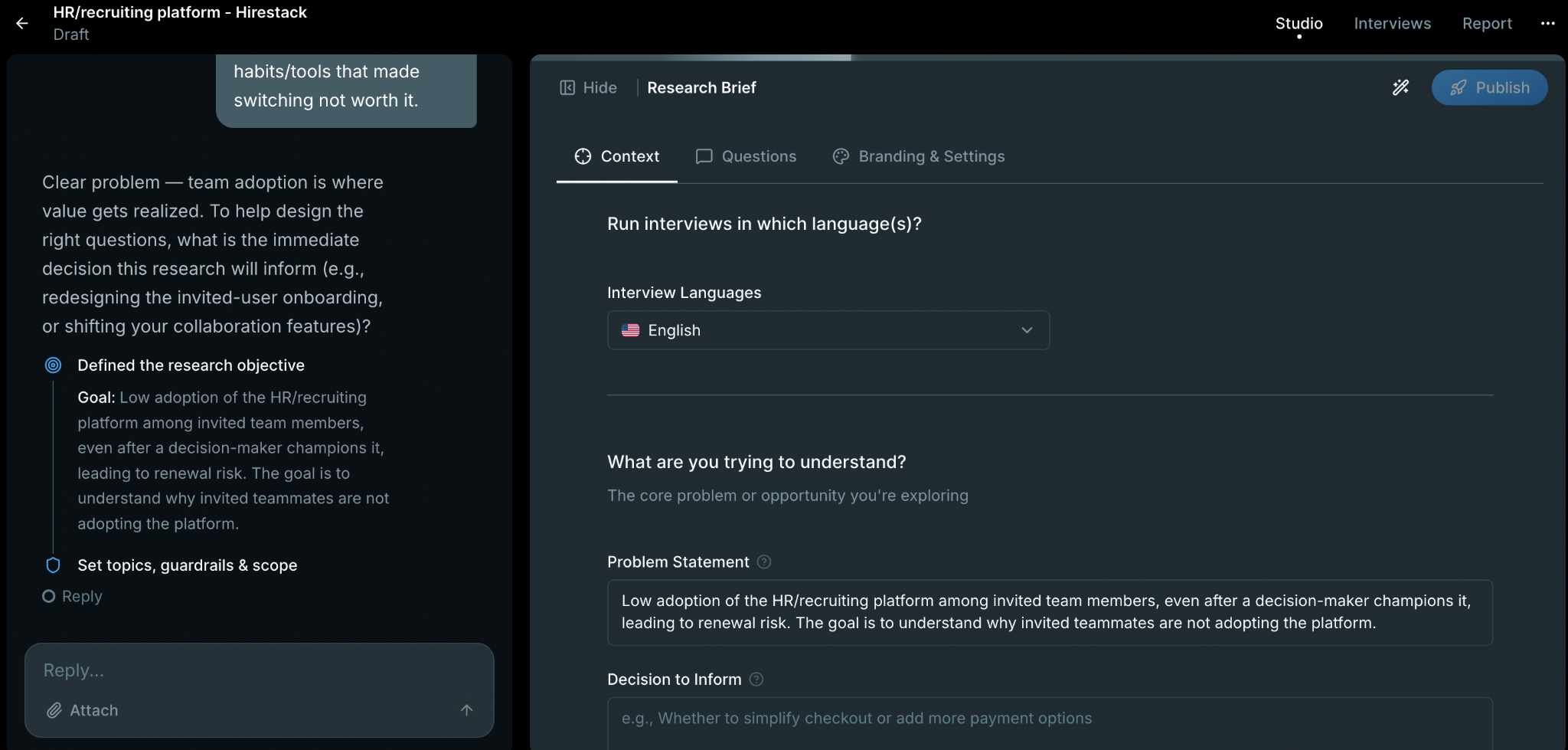
Koji is a self-service tool for creating studies. You set up the study, specify your target audience, compose your questions, determine the AI moderator's personality and tone, and then let it run. What makes it stand out is the combination of different methods: a single study can include open-ended AI interviews as well as scales, rankings, and multiple-choice questions, so both the qualitative and quantitative aspects of the study are located in the same place.
That is the way most founders carry out their AI-powered churn research: they have neither a dedicated team nor a set schedule. The participants do their interviewing at their own convenience, and the results accumulate as the sessions are completed, along with individual reports for each interview and an overall synthesis of the study.
Pros
- Transparent, published pricing; a study can go live in about 15 minutes
- Six structured question types in a single study: open-ended, scale, single choice, multiple choice, ranking, and yes/no
- Configurable AI moderator persona that helps scaffold study design and the research brief
- Quality-gated credits: a low-effort or gibberish response doesn’t consume a credit
- Quotes, themes, and sentiment update as interviews are completed
- Flexible recruitment: bring your own list, share a recruitment link, or recruit from panel partners in 130+ countries, included on every plan
Cons
- Newer, smaller platform than others, with a thinner track record at large enterprise scale
- Built around studies you design and launch, not interviews triggered by customer actions like cancellation or checkout
Why Koji over Qualtrics: Koji makes its pricing available without including a separate charge for professional services. It is similar to Qualtrics in that it supports structured questions such as scales, rankings, and multiple choice; unlike Qualtrics, however, it uses an AI moderator to handle the open-ended sections of a study by conducting them as a full interview, rather than just a couple of follow-up questions in a text box.
Pricing
- Insights: €29/mo
- Interviews: €79/mo
- Both plans include voice and text; they differ by credits, seats, and studies.
6. Glaut
Best for: market research agencies and insights consultancies running large client studies across multiple markets, where survey-scale sample sizes are a client expectation, not optional.
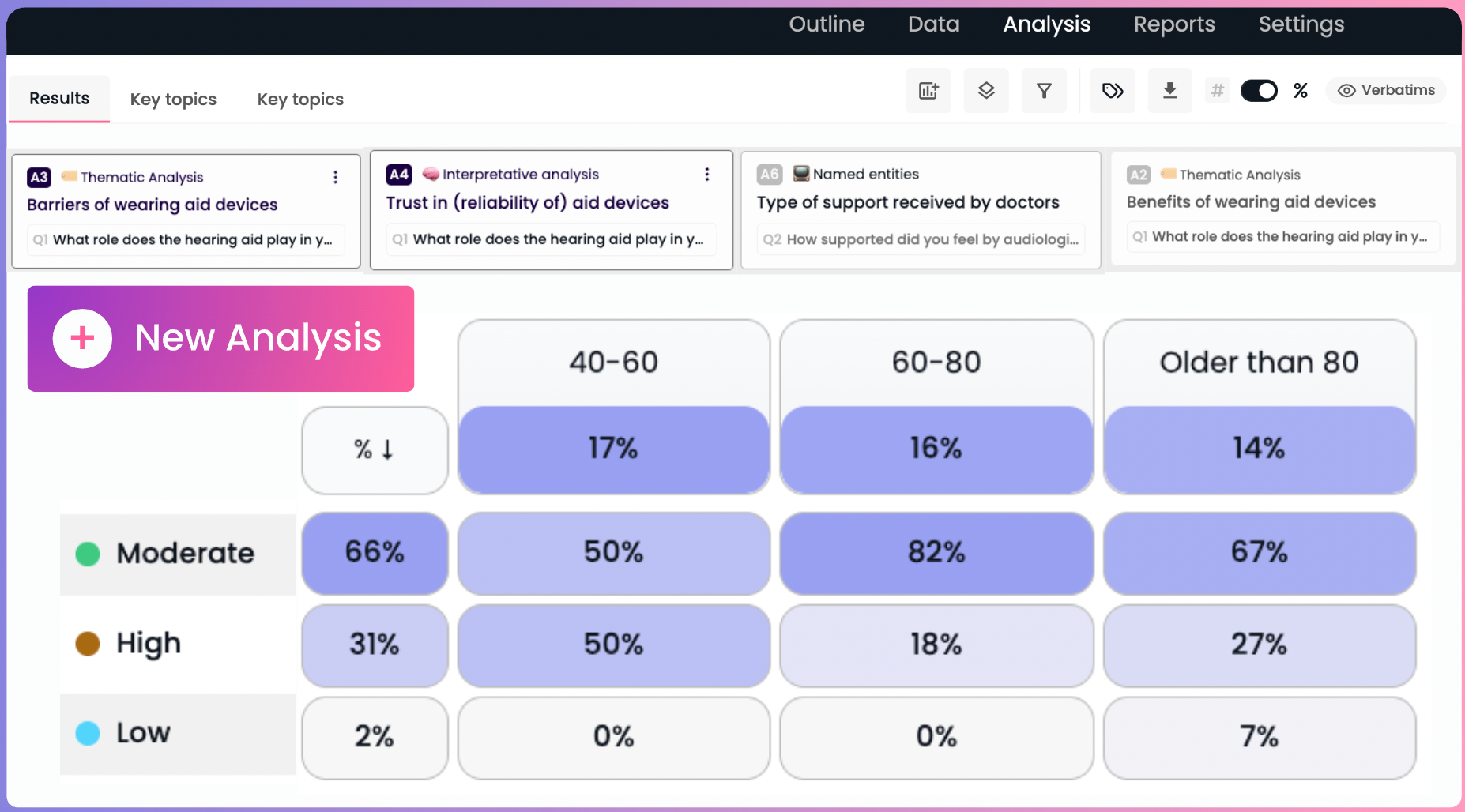
Glaut is built for the completion-rate problem head-on. It runs what it calls AIMIs: AI-moderated interviews designed to hit the sample sizes an agency plans a study around, while every respondent still gets an adaptive back-and-forth instead of a rating scale to click through.
The kind of audience that Glaut caters to is unlike that of most of the tools on this list; while other tools might be designed for a founder who is conducting their first study, Glaut is more in line with the way a research agency operates, by carrying out large studies, covering multiple markets and multiple languages, and satisfying a client who expects the same statistical reach as would be provided by a conventional survey program.
Pros
- Voice-based AIMIs in 50+ languages, so multi-market studies don't need a separate vendor per region
- Real-time fraud detection flags low-quality or bad-faith responses before they ever hit your dataset
- Embeds directly into an existing survey stack via an iframe so you don't have to rip out the quant platform you already run
- ISO 27001 certified and GDPR-compliant, already trusted by established research firms
- Interprets tone, hesitation, and intensity, not just word choice, so verbatim analysis goes beyond a transcript
- Integrates with any panel provider, so you keep your trusted recruitment sources while gaining the fraud and depth layer
Cons
- More agency/research-maturity oriented than a lightweight startup tool
- Demo-based pricing, not self-serve; still requires a conversation to get a number
Why Glaut over Qualtrics: While a Qualtrics survey can obtain a large sample, all respondents are given the same rating scale. Although a live interview provides depth, it rarely achieves the sample size that an agency's client requires. Glaut's AI-moderated voice interviews (AIMIs) provide each respondent with an adaptive conversation at sample sizes comparable to those of a survey.
Pricing: Custom, demo-based.
Now, Which One Answers Your Why?
Every one of these was built by someone solving their own specific headache, which means each one's great at exactly one thing and just okay at the rest.
- Got a red metric, no research team, and no enterprise budget? Frank’s the one that shows up the second someone cancels and just asks, before the reason gets fuzzy in their head.
- Trust your health score but tired of it going quiet on the "why"? Perspective AI is the conversation that was missing underneath it the whole time.
- Keep getting answers that feel like the easy way out? User Intuition doesn't let the first answer be the last one.
- Running research at a size where "a few hundred interviews" barely counts as a big week? That's Outset's whole reason for existing.
- Want survey-style questions and AI interviews in one study you build yourself? That’s Koji.
- Promising a client full sample sizes as an agency? Glaut lets you hit the numbers without flattening every answer into a scale.
One thing worth saying straight: if what's on your plate is a giant, regulated, audit-proof dataset, Qualtrics is still the better tool for that. Nothing here replaces it; it just answers the one question a survey was always going to leave sitting in "Other."
None of this matters until you actually run it. Pick one, point it at five customers, and see what comes back.

.jpg)