Confession: most "churn research" is a folder of cancellation emails nobody's opened since March. Every team has one. Nobody's proud of it.
It's not a motivation problem. One churned customer, easy, you just ask. A hundred of them, every time, in every plan and language, without eating someone's whole week? Completely different challenge. That's the "at scale" part. And it's the part that kills most churn research plans before they even really start.
So before that folder gets one email heavier, here's what running churn interviews at scale actually looks like in 2026.
TL;DR
- One person can only run so many churn interviews. Reaching saturation across every plan and language takes far more time than most teams have.
- "Churn at scale" means four things: enough interviews per segment, consistent quality, fast outreach, and full coverage. Not just more interviews.
- Manual setups can usually hit one of those four, not all of them at once.
- An AI Interviewer, Frank, automates the whole thing, adaptive interviews triggered at cancellation, in 30+ languages, summarized overnight.
Why Churn Interviews Don't Scale
Give it three churn interviews; that's usually as far as the good intentions carry you. Everyone's still telling themselves this is going great, right before the whole thing quietly falls apart.
1. The math is not on your side
Qualitative research runs on a rule most teams have never heard of, called saturation: the point where new interviews stop teaching you anything new. A study out of Emory University, published in Qualitative Health Research, put actual numbers on it. Researchers found that "code saturation," basically hearing the full range of reasons people give, showed up after about nine interviews.
But "meaning saturation," the point where you actually understand why those reasons matter, took 16 to 24. As the authors put it, code saturation tells you when you've "heard it all." Meaning saturation is what lets you "understand it all." Big difference if you're trying to make a product decision off it. Big difference if you're trying to work out how many interviews you actually need before a finding is safe to act on.
The catch: those numbers hold for one fairly similar group of people. The moment you sell three plans across four regions, you don't need 16 interviews. You need 16 per segment. "Let's talk to some churned customers" turns into a 60-to-100-interview project fast, and nobody even planned it.
2. One person can only do so many
Recruiting, scheduling, running the call, writing it up: even a fast interviewer loses a real chunk of a day per conversation. Run that math against the saturation number above, and hitting it for even one segment takes months, not a sprint.
There's also a cost nobody puts in the plan. A former Adobe Sign exec, writing about thousands of renewal cycles, put it simply: of all the customers his team lost over the years, he never lost a single one he'd personally visited. Great insight. Also, a reminder that the version of churn research that actually works doesn't scale by adding more hours to someone's week. It scales by adding more people to the room, or by looking for the best tools to understand churn instead of another hire.
3. By the time you're done, the answers already expired
While you're slowly working through the list, the product keeps shipping, pricing keeps shifting, and the earliest interviews start describing an app that no longer exists. This isn't just a logistics problem; it's a memory problem. A study published in PLOS ONE tested how recall accuracy holds up over longer retention intervals and found that the longer the gap between an event and the retelling, the more memory reconstruction and error creep in. Ask a customer why they canceled two months later, and you're not getting the reason. You're getting the reason as it exists today, softened, rationalized, or half-forgotten.
Net result: most "churn interview programs" quietly shrink down to whoever happened to still remember and reply. Not a sample. A leftover.
What "Churn At Scale" Actually Means in 2026
Ask ten people what running churn interviews at scale means, and you'll get ten different numbers, and none of them will be the right answer. Scale was never a number. It's whether the system still works on a bad week.
The math already told us what scale requires
It was basically a spec. Saturation needs a solid batch of interviews per segment, so volume isn't optional. One person can only run so many conversations a week, so consistency can't depend on whoever has a free afternoon. Memory fades the longer you wait, so timing isn't a nice-to-have; it's the difference between the real reason and the polished-up version of it.
Four things fall out of that, not one big number.
1. Volume
Enough completed interviews per segment to actually hit saturation, not three anecdotes and a vibe. Most teams count up their churn interviews at the end of the quarter and call it a day. Almost nobody checks whether that count holds up segment by segment.
2. Consistency
The customer who canceled this morning and the one who cancels two hundred cancellations from now should get the same quality of conversation. In practice, they rarely do. Everyone else gets a dropdown menu asking them to pick a reason and move on. That gap in effort looks sloppy. Also, it quietly skews the whole dataset toward whichever customers happened to be easiest or most important to reach.
3. Timing
Outreach fires the moment someone churns, while the reason is still sharp in their head. Not batched into whatever gets pulled together for next month's churn review. A churn interview run the same day, and one run six weeks later, isn't the same data. They just look the same in a spreadsheet.
4. Coverage
Every plan, every region, every language a customer might cancel from, not just the English-speaking, high-touch accounts someone had time to call. Coverage is the requirement that breaks first and quietest, because nobody decides to drop the Portuguese-speaking segment or the cheapest plan. It just never gets to the top of the list.
Those four things aren't really four separate asks. They're one requirement: a system that doesn't quietly cut corners the moment real volume shows up.
Where the Manual Churn Interview Breaks, and What Actually Fixes It
Those four requirements sound great on a slide. Here's what actually happens to each one the second a real team tries to run it by hand.
Churn interview volume relies on whoever replies
Most churn interview "programs" are just an exit survey, an email, or a dropdown, sitting there waiting to see who clicks. That's not a sample. That's whoever was annoyed enough, or polite enough, to bother.
University of Chicago researchers tested this with a national survey matched against real government records. People who answered looked meaningfully different from people who didn't, even after adjusting for demographics. Paying people more to respond didn't fix it either; it just brought in a different skewed group. Applied to churn: quiet cancellations never show up anywhere, and no amount of survey-nudging fixes that. It just changes who you're missing.
What fixes it: outreach that doesn't wait for someone to opt in. A real conversation, initiated automatically, is how you actually get churned customers to talk to you instead of hoping they fill out a dropdown on their way out.
Consistency in churn interviews depends on account size
In practice, "consistency" usually means the founder personally rings the customer on the enterprise plan, and everyone else gets whatever's left, a canned email, a static form, or nothing. The data ends up shaped by whoever was worth someone's calendar that week.
What actually fixes it: the same depth of conversation, with the same ability to follow up and probe, regardless of whether the account was worth $20 a month or $20,000.
Churn interview timing depends on who has time that week
Even teams with good intentions end up batching outreach into whatever gets pulled together for next month's review, days or weeks after the cancellation, once the reason has already gone soft.
What actually fixes it: outreach triggered by the cancellation event itself, not a calendar reminder. No list-pulling, no "we'll get to this Friday."
Some plans and languages never make it into churn interviews
Nobody sits down and decides to skip the Portuguese-speaking segment or the cheapest plan. It just never makes it to the top of a manual to-do list, and over time, those blind spots become permanent.
What actually fixes it: a process that runs identically across every plan, region, and language by default, not as a stretch goal for when the stars align.
Building an always-on churn interview system
A webhook that fires the second someone cancels. An AI interviewer that can hold a real conversation instead of reading from a script. Somewhere for the answers to land so a human can actually use them. That's the whole system described, piece by piece. It's also how more founders are using AI to understand churn, instead of hiring a research team to chase it by hand.
Which is just... an AI interviewer called Frank. And that's exactly the whole idea behind it. Lay the four requirements against manual effort and against Frank, and the pattern is hard to miss:
How Frank Runs Churn Interviews at Scale
Every fix from the last section Frank already does. Here's what that actually looks like inside the real product.
Frank is an AI customer interviewer by Prelaunch, built to catch churned customers the moment they cancel, ask the follow-up questions a form never would, and do it consistently across every plan and language, without a research team behind it.
How to set up a churn study
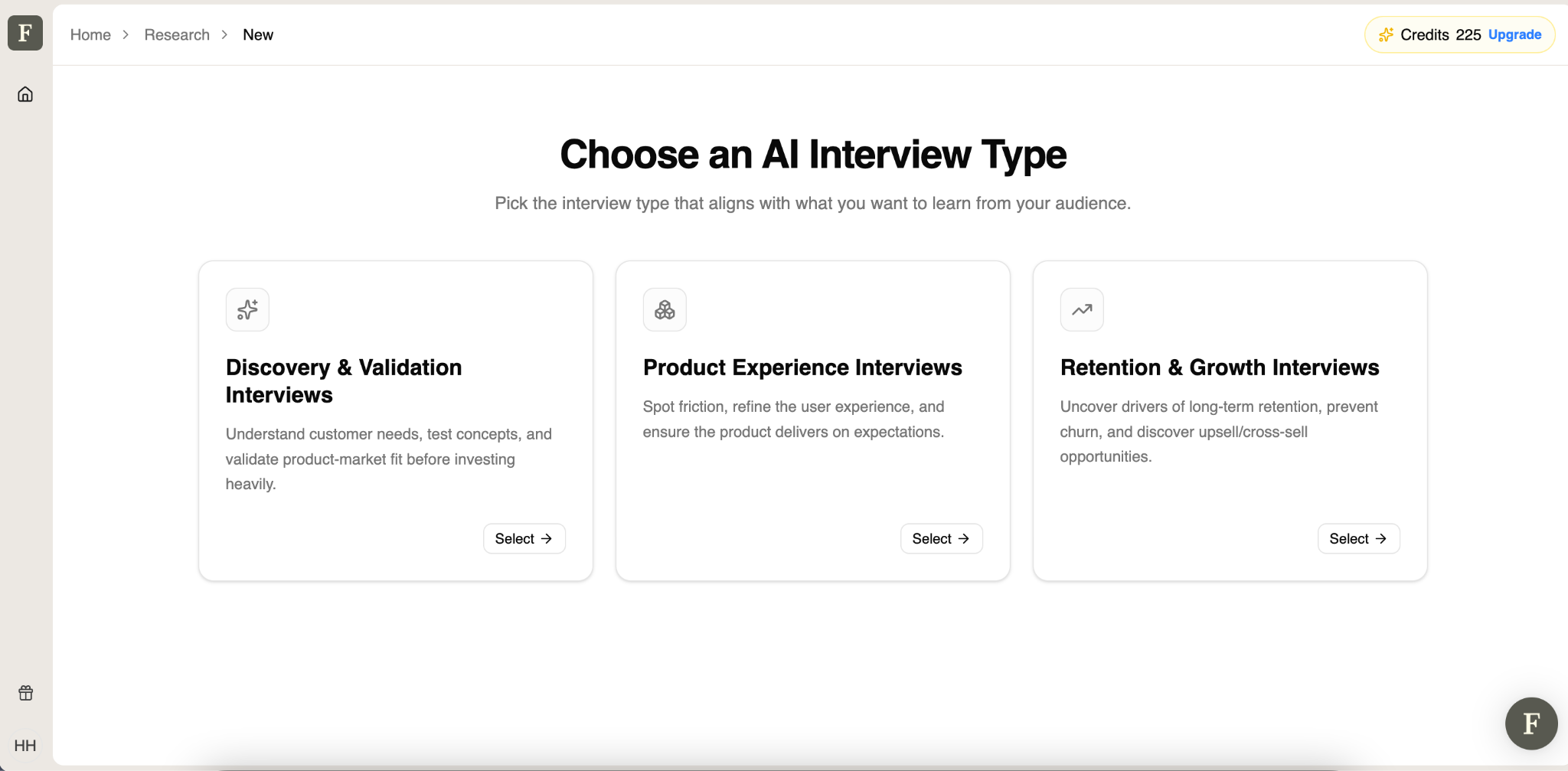
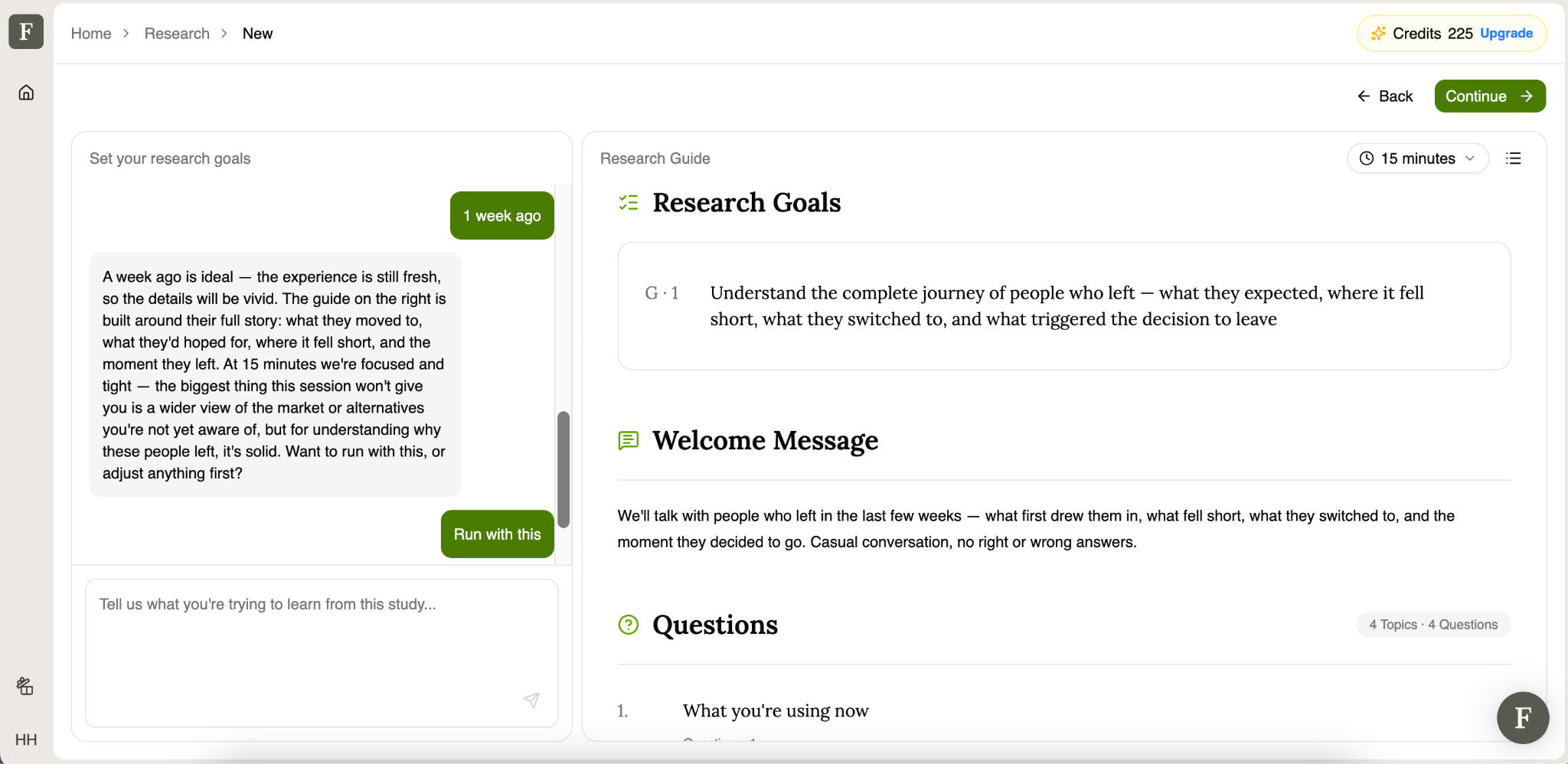
Pick Retention & Growth Interviews as the study type, and tell Frank what you're trying to learn, in plain language, the same way you'd brief a researcher. Frank asks a couple of quick follow-up questions and drafts a full discussion guide in real time while you chat. From there, you choose the format, language, and interviewer persona, preview the conversation, and publish. The system that would've taken a quarter to stitch together by hand takes about as long as writing a Slack message.
How Frank Conducts the Interviews
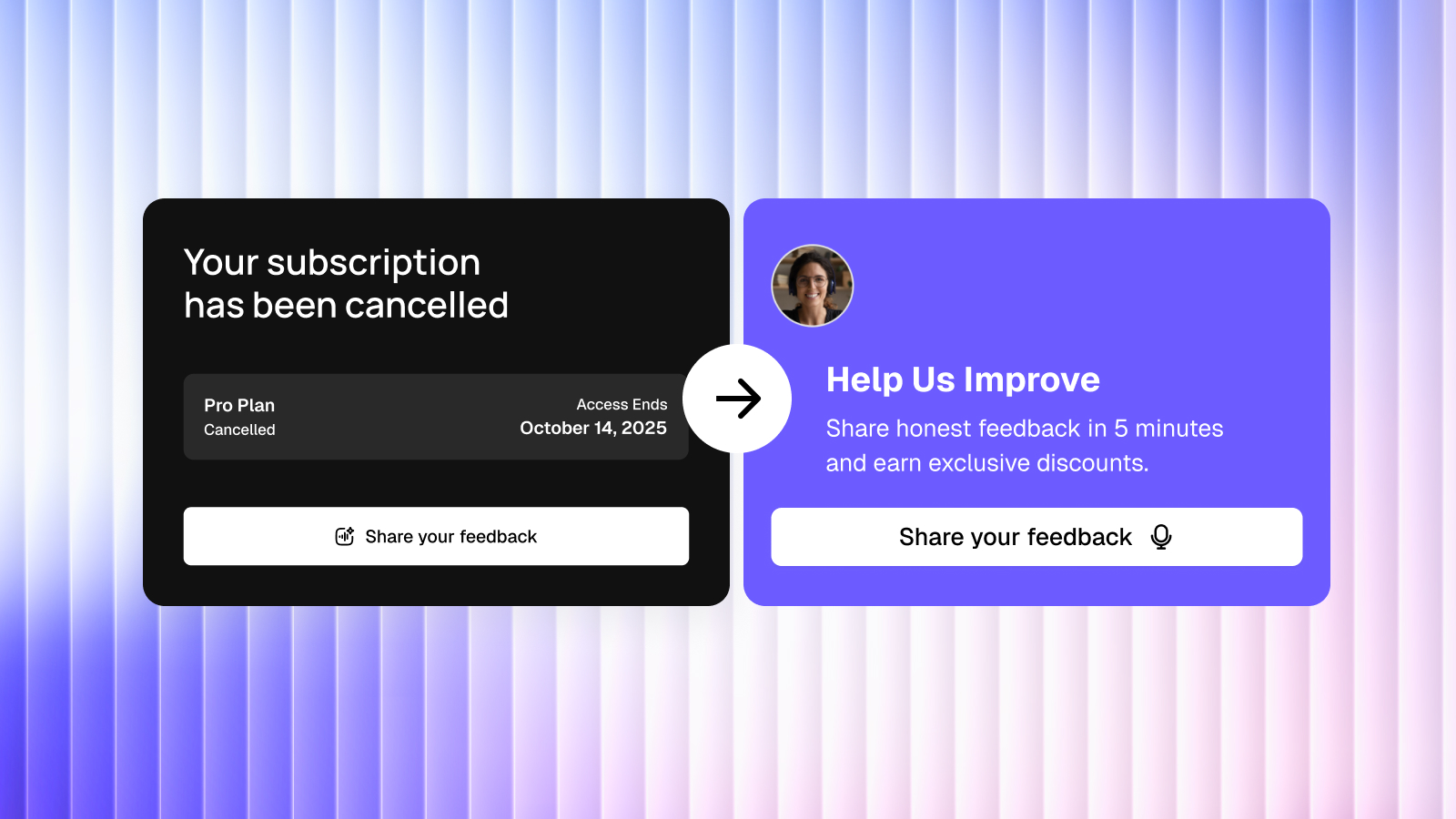
Frank connects to the moment someone cancels, downgrades, or hits a renewal milestone, and reaches out right then, no webhook to build, no list to pull. The conversation adapts to what the customer actually says instead of stopping at the first answer, in natural voice today (WhatsApp chat and video coming soon). All of it runs across 100+ interviews at once, in 30+ languages, so the segments that used to fall off a manual list just don't anymore. If someone says "it wasn't quite right," Frank asks what "not quite right" actually meant, which is how Frank understands why they churn instead of just logging that they did.
How to Review the Results
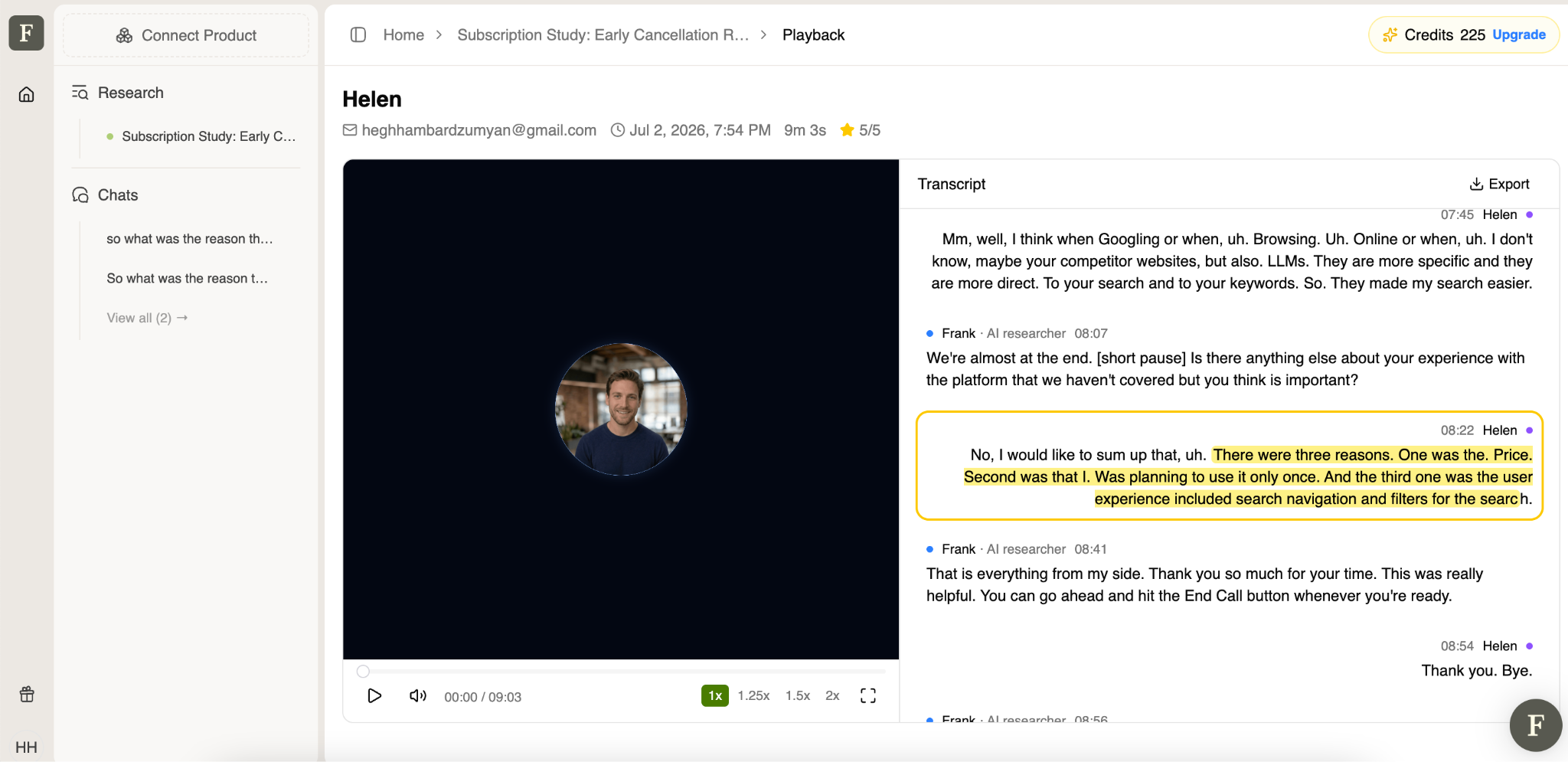
Every conversation gets grouped into automated summaries overnight, ready before your first coffee. Every summary links back to the original recording or transcript, so if a finding looks surprising, you can hear the customer say it yourself.
Conclusion
So that's really it. Churn interviews break at scale because one person can only do so many, and by the time you've done enough, the answers have gone stale. "At scale" just means the same good conversation, every time, for every plan and language, without someone's whole week disappearing into it. Manual setups can't hold that line. An AI interviewer that shows up the moment someone cancels can.
That's what Frank does. It's already built, already running, and ready whenever your next customer hits cancel.

FAQs
How many churned customers do I need to interview before the results mean anything?
It depends on how many segments you sell to. The number that matters isn't your total customer base, it's how many distinct plans, regions, or customer types you're trying to understand. Each one needs its own count before patterns become reliable.
Is it too late to interview a customer weeks after they canceled?
Not too late, but weaker. The longer the gap between the cancellation and the interview, the more the answer reflects how the customer feels now rather than what actually happened. Sooner produces more reliable data than later.
Do exit surveys still serve a purpose?
Yes, for volume. Surveys are efficient at collecting a reason at scale, but they stop at the first answer. A dropdown can show that price was the stated reason for a percentage of cancellations. It can't show what "price" actually meant to that customer. Surveys are suited to breadth; interviews are suited to depth.
Why do AI interviewers tend to surface more accurate reasons than a form?
Because they can follow up. A form records the first answer and closes. A conversation, whether AI-led or human-led, can ask what's behind that answer before moving on.
Does an AI interviewer replace a Customer Success team?
No. It runs the conversation and organizes what comes back into patterns. Deciding what to do with those patterns still sits with the team.
Can churn interviews run across multiple languages at once?
Yes. Interviews can be conducted in the customer's own language and delivered back as summaries in whichever language the team reads in, allowing non-English-speaking segments to be covered without separate processes.
How long does setting up a structured churn interview study typically take?
Roughly as long as it takes to describe the research goal. The interview type, discussion guide, format, and language are configured from that input, without requiring engineering work.