.jpg)
When revenue's growing, no one pays attention to customer health. Acquisition gets the attention. Retention shrinks into a survey app no one checks. By the time churn shows up in the cohort report, the damage is already done - and you're staring at hundreds of unread post-purchase responses, half of them open-text answers no one had time to read.
This is the operator reality on most Direct-to-consumer (DTC) and e-commerce teams in 2026. The good news: AI changes what's possible at every stage of the post-purchase feedback loop. AI post-purchase feedback means using AI to both analyze the feedback you already collect and to collect new feedback through AI-conducted interviews that go deeper than a survey can. This article walks through the 4-stage workflow lean teams are using right now, where AI-conducted customer interviews replace shallow surveys, and a 30-day plan to get started without rebuilding your stack.
Key Takeaways:
- Post-purchase feedback works better as a conversation than a survey - AI now makes conversations scale the way surveys used to
- AI sentiment dashboards solve analysis. AI customer interviewers solve depth.
- The brands winning in 2026 aren't sending more surveys - they're having more conversations
- You can run your first AI-driven feedback loop in under 30 days
Why Post-Purchase Feedback Fails Most Ecommerce Teams
• Growth pulls attention away from customer health
There's a structural reason CX gets neglected during growth phases. As one DTC retention analysis put it, "Most DTC brands pour 80–90% of their marketing budget into acquisition. New customers, new ads, new campaigns. And then they wonder why profitability stays flat."
This is the growth tax. Every dollar pulled into acquisition is a dollar not spent on understanding why existing customers aren't coming back. And it shows up in the data: industry churn estimates suggest roughly 70% of new Shopify stores don't survive their first year, and annual merchant churn on Shopify sits around 28%. Most of these brands aren't dying from bad products - they're dying from never asking the right post-purchase questions.
• Open-text responses pile up unread
Free-text answers are where the gold lives. The actual why behind a 6/10 NPS or a returned product. But reading 300 open-text responses manually is impossible at the pace ecommerce teams move. So most teams skim and miss patterns, or skip the open text entirely and stick to multiple choice. Either way, the why disappears.
• Surveys tell you what, not why - and no one owns the next move
Multiple-choice surveys give you ranked categories. Generic NPS gives you a number. Neither tells you what to fix first. And even when an insight does surface, it often dies in a slide deck because no one's clearly responsible for acting on it. The product assumes Customer Experience (CX) owns it. CX assumes marketing owns it. Marketing assumes ops owns it. The same patterns that cause customer insights to get lost play out cleanly here: research becomes "nice to know" instead of decision fuel.
AI changes what's possible at every one of these steps - but only if you use it for the right job.
The 4-Stage AI Post-Purchase Feedback Workflow
The workflow has four stages: centralize feedback, tag sentiment and surface themes, replace surveys with AI-conducted interviews, and route insights to an owner who acts on them.
The mistake most teams make is treating AI as a sentiment dashboard. In practice, AI plays a different role at each stage of the post-purchase feedback loop. Here's how the workflow actually breaks down.
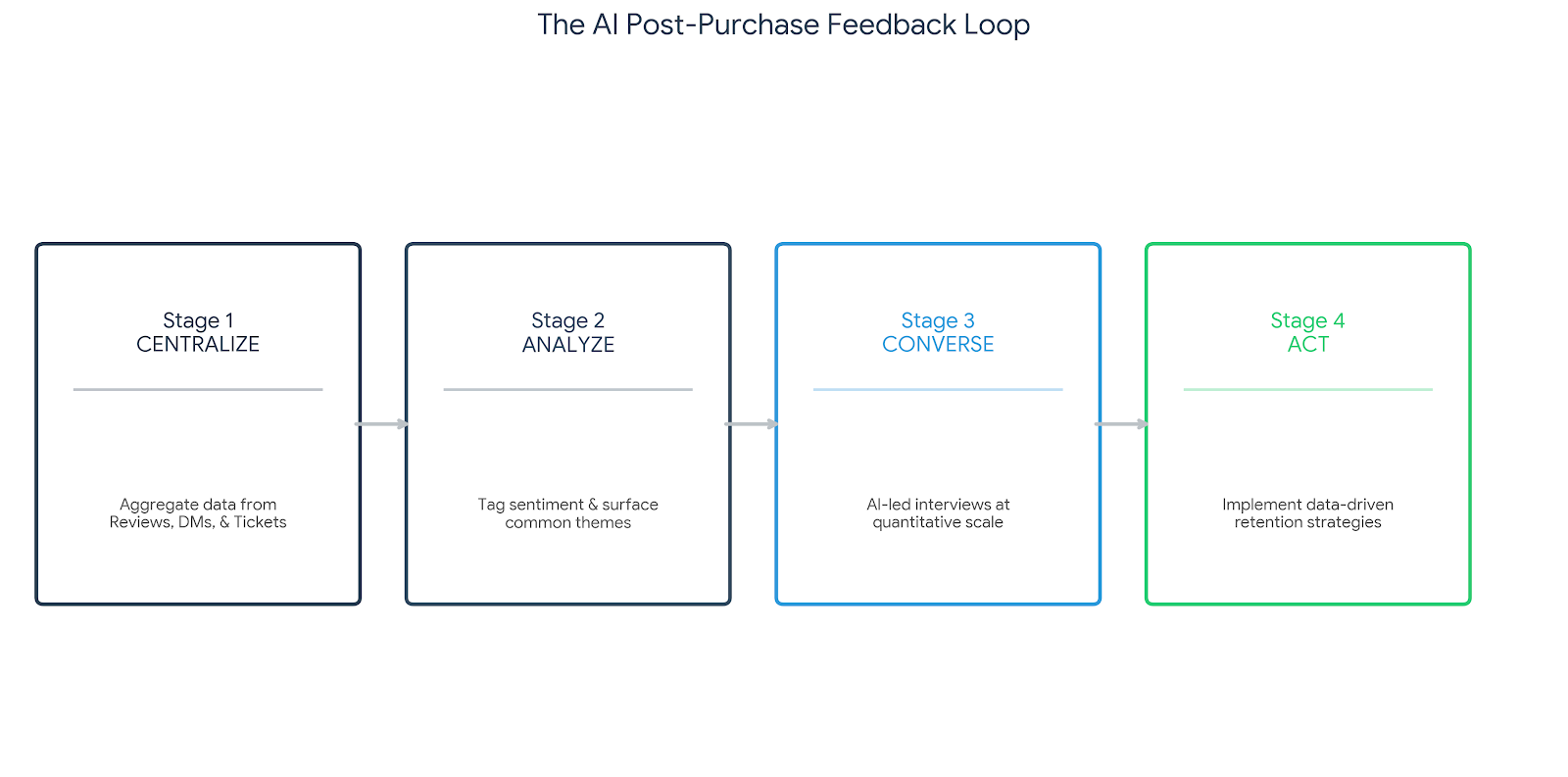
Stage 1 - Centralize feedback across reviews, surveys, tickets, and DMs
Most ecommerce teams have feedback scattered across five tools: Yotpo for reviews, Gorgias for tickets, KnoCommerce or Fairing for surveys, Klaviyo for NPS, and the Instagram inbox for DMs. Themes that span channels - say, sizing complaints showing up in returns and in support tickets and in negative reviews — stay invisible because no one's looking at them together.
Stage 1 is the unsexy foundation. Pull all post-purchase feedback into one place where AI can read it. This is what voice-of-customer platforms like Chattermill, Lumoa, and Survicate do. As Yotpo's retention strategist Moran Khoubian frames it, "The most impactful retention strategies are built on shared data between a brand's tech stack, so your brand has a 360-degree view of every single customer."
Stage 2 — Use AI to tag sentiment and surface themes
Once your feedback is centralized, AI does what humans can't do at scale: it reads every response, tags by topic (shipping, sizing, packaging, support), tags by sentiment (positive/negative/neutral), and clusters themes across channels.
A trust caveat here. AI sentiment tools hallucinate. They mistag sarcasm. They generate confident-sounding summaries that don't match the underlying responses. The fix isn't to skip AI. It's to spot-check. Pull 10 random responses tagged "negative – shipping" and read them yourself. If the AI is right 9 out of 10 times, ship it. If it's right 6 out of 10, find a better tool.
Stage 3 - Replace shallow surveys with AI-conducted interviews
This is where the workflow shifts. Stages 1 and 2 make existing data more useful. Stage 3 changes what data you collect in the first place.
Surveys are designed to count. Interviews are designed to understand. A 5-question NPS survey gives you a score and maybe a sentence. A 10-minute conversation gives you the actual story. The depth comes from probing reality instead of speculation, and from following the tension instead of the script.
The problem until recently: interviews don't scale. A traditional moderated interview costs $500–$1,000 and takes weeks to schedule and analyze. Which is why most ecommerce teams default to surveys even though they know surveys can't answer the questions that matter most.
That tradeoff is what AI customer interviewers break. An AI agent can run hundreds to 1,000+ interviews simultaneously, in 30+ languages at survey-scale economics. The result: qualitative depth at quantitative reach.
When to Use Surveys vs. AI Interviews
Surveys are for measuring things you already know how to ask about. They usually help you to find satisfaction scores, delivery speed, and whether a promo code worked. AI interviews are for the questions you don't know how to structure yet: why a customer almost didn't buy, what convinced them to stay after a bad shipping experience, what "quality" actually means to a specific segment. If you can predict the answer options, use a survey. If you're trying to discover a reason, a motivation, or an unexpected theme, run an interview.
The right moments to run an interview also matter. A post-delivery interview surfaces a different signal than a churn interview, which surfaces a different signal than a discovery call with a new buyer.
Stage 4 — Route insights to owners and measure the fix
Insight without ownership is theatre. Stage 4 is where AI tags route automatically: shipping issues to ops, sizing patterns to product, brand-perception themes to marketing. Tools like Shopify Flow and Klaviyo segments handle the routing. Then you measure: did the same theme drop in the next batch? Did the support ticket volume on that issue fall? As Ecorn's post-purchase survey guide puts it bluntly, "A post-purchase survey only matters if somebody owns the next move."
How Frank Runs Post-Purchase Interviews for You
Frank is an AI customer interviewer built for the conversation layer of an ecommerce feedback workflow. Instead of treating post-purchase feedback as a single survey, Frank can interview customers at different moments throughout the customer journey and adapt its follow-up questions based on their responses.
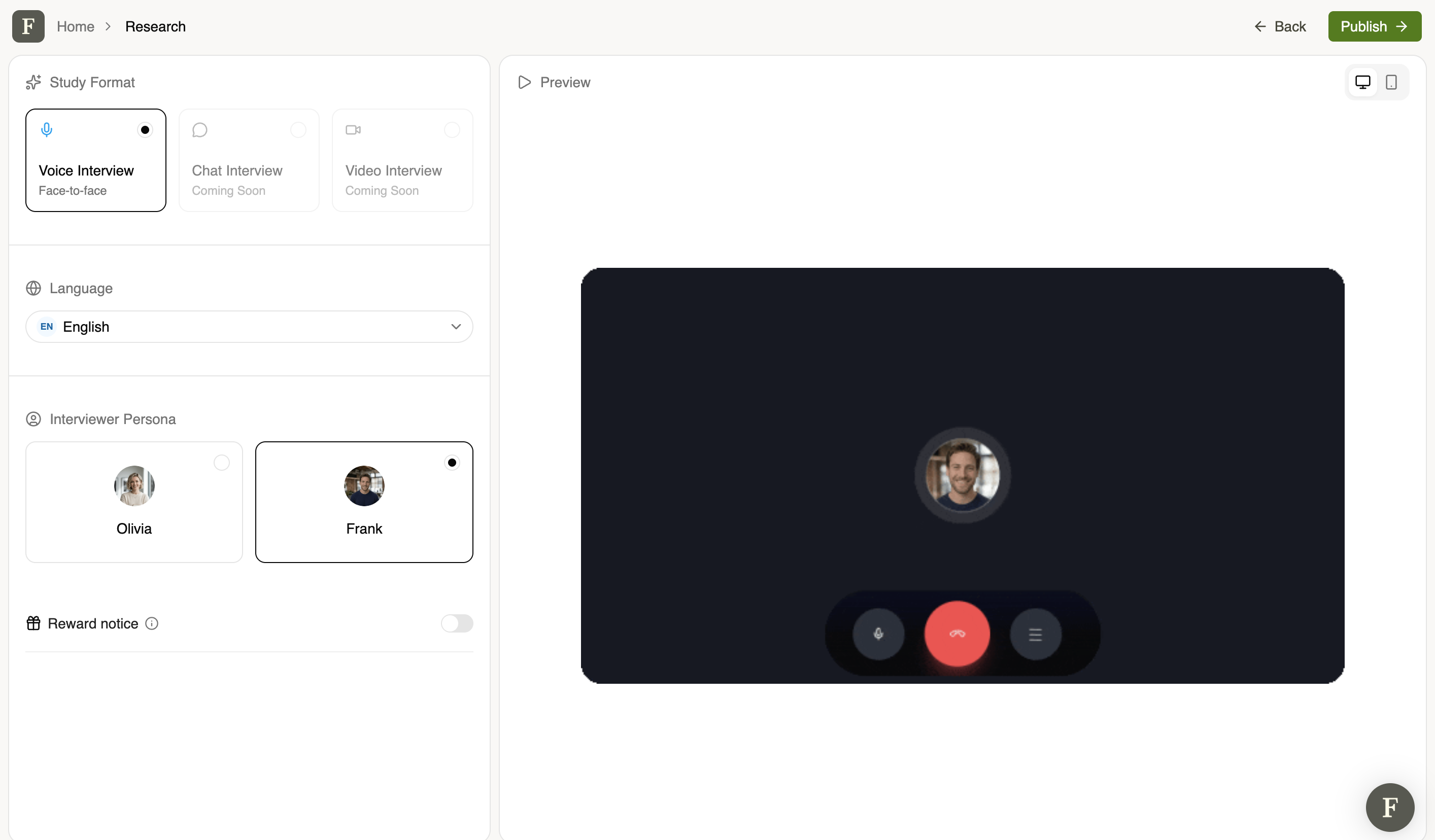
1. Post-delivery. Trigger an interview when an order is marked delivered, while the experience is still fresh. Frank can explore expectations vs. reality, packaging, first use, and whether the customer would recommend the product, with adaptive follow-ups when something interesting comes up.
2. Shortly after purchase. Interview customers while the buying decision is still fresh to understand what drove the purchase, what nearly stopped them, what convinced them, and which alternatives they considered.
3. At churn or cancellation. Replace a shallow exit survey with a deeper conversation about why the customer decided to leave. Frank captures the customer's reasons in their own words and can probe further when a response reveals an underlying issue.
These are starting points, not a fixed list. The same approach can be applied to other moments in the customer lifecycle where an ecommerce team needs to understand customer motivations, experiences, or decisions.
How Frank works: You define the interview goal and key questions, and Frank conducts the conversations via voice, using adaptive follow-ups to explore relevant responses. The resulting transcripts and structured insights surface themes, motivations, and decision drivers for your team to review and act on. Frank supports 30+ languages and can conduct hundreds to 1,000+ interviews simultaneously.
The AI Post-Purchase Feedback Tool Landscape
Tools in this space are split into four categories. Survey tools with AI add-ons are best for attribution and short, structured questions.
Review platforms with AI summaries work for product reviews and social proof.
Sentiment and theme analysis platforms sit on top of your existing data and tag at scale.
AI customer interviewers - Frank, Strella, Listen Labs, or the alternatives - are the newest category, built for depth at survey scale rather than dashboards.
Most ecommerce teams will end up using one tool from the analysis category and one from the interview category. They're complementary, not competing.
30-Day Plan to Get Started For Post-Purchase Feedback Analysis
You don't need a new stack to start this. Just need four weeks and the tools you probably already have. Here's how to sequence it.
- Days 1–7: Centralize what you already have. Pick one place all post-purchase feedback lands - even a shared inbox, or a tool like Chattermill or Lumoa if you already have one. Pull in the last 90 days of reviews, tickets, and survey responses from Yotpo, Gorgias, and your survey tool. Don't wait for a perfect integration - a CSV export is enough to start.
- Days 8–14: Tag sentiment and surface themes. Run your centralized feedback through an AI tagging tool. Spot-check 10 random “negative” tags against the actual text before you trust the output. If it's wrong more than 1 in 10 times, fix the setup or swap tools. By day 14 you should have a ranked list of your top 3–5 recurring themes.
- Days 15–21: Run your first AI-conducted interview batch. Pick one moment you want to analyze. For example, post-delivery is the easiest starting point. Set up 20–50 interviews with an AI interviewer like Frank. Write 4–6 open-ended questions tied to the themes you found in week two. Let the tool ask adaptive follow-ups; don't over-script it.
- Days 22–30: Route insights to an owner and set a measurement. Assign each theme from your interview batch to one owner - product, ops, or marketing. Set up one routing rule for your top theme. Pick your KPI metric to check in 30 days: ticket volume, return rate, or repeat purchase rate on that specific issue.
Run it once to see what breaks, and tighten it before you scale to more interviews or more channels.
The Brands Winning Aren't Sending More Surveys
Post-purchase feedback isn't a survey problem. It's a conversation problem dressed up as a survey problem because conversations didn't scale until recently. They do now.
The teams pulling ahead in e-commerce aren't the ones running more NPS campaigns. They're the ones who've stopped treating AI as a smarter dashboard and started treating it as something that can actually talk to their customers - at the moment, context is freshest, in the customer's own words, at a price that makes it worth doing weekly instead of quarterly.
If you've been sitting on hundreds of unread responses while your retention numbers slip, the answer isn't to send another survey. It's to ask better questions, more often, and let AI handle the conversation while you handle the next move.
Try Frank on your next post-purchase cohort and see what your customers actually have to say.

Frequently Asked Questions
What is AI post-purchase feedback?
AI post-purchase feedback is the use of AI to both analyze feedback you already collect - reviews, survey responses, support tickets - and to collect new feedback through AI-conducted interviews. Analysis tools tag sentiment and surface themes across channels. Interview tools ask open-ended questions and adapt their follow-ups in real time, giving depth a fixed-question survey can't.
What is the difference between a post-purchase survey and an AI customer interview?
A survey gives you a score or a preset category. An AI-led interview asks open-ended questions and follows up based on what the customer says, surfacing the actual reason behind an answer rather than just the answer itself. Surveys measure; interviews explain.
When should an ecommerce brand use an AI interview instead of a survey?
Use an interview when you don't already know the answer options. It can be discovering why customers churn, what nearly stopped a purchase, or what a vague complaint like “quality” actually means to a segment. Use a survey when you're tracking a known metric, like NPS or delivery satisfaction, over time.
What questions should ecommerce brands ask customers after a purchase?
The most useful post-purchase questions probe a specific, recent moment rather than a general impression: what almost stopped them from buying, what they expected versus what they got, and what would make them buy again. Anchoring questions to the most recent order, rather than asking customers to generalize, tends to produce more reliable answers than a general satisfaction question.
What can AI customer interviews reveal that surveys cannot?
AI interviews can surface the specific moment something broke down, the actual words a customer uses to describe a problem, and follow-up context a fixed-answer survey has no mechanism to capture. Because the interview adapts to each answer, it can chase down an unexpected theme a survey question was never written to catch.
How do AI customer interviewers work?
An AI interviewer like Frank is set up with a set of interview goals and key questions. It then conducts the interview, asking the scripted questions plus adaptive follow-ups when a customer's answer opens up something worth exploring. Results come back as structured summaries with themes, motivations, and decision drivers, verifiable against the underlying transcript or recording.