The question you ask a customer should never be the same twice. Not for variety's sake. But because the person on the other end keeps changing. The version of them deciding to buy is not the version deciding to stay, and neither is the version filling out a cancellation form at eleven at night. Tired. Already shopping with your competitor.
Most companies miss this. They ask once, right after purchase, usually a cheerful "how satisfied are you, 1 to 10?", as if a number ever explained a breakup. Then they go quiet for the rest of the lifecycle: through onboarding, through adoption, through retention, through returns, while the customer keeps forming opinions about them.
This guide walks through which question to ask at each stage, from awareness through to churn. You just have to ask at the right moment. That’s all it ever was.
TL;DR
- Customer questions should change at each stage of the lifecycle, because the customer’s mindset and friction points change.
- Asking a single question at one point in time tells you what happened, not why.
- Open-ended questions reveal the reason behind a behavior. Yes-or-no questions only confirm what you already know.
- The best time to ask is right after a trigger: an abandoned cart, a canceled order, a delivery. People give more honest answers then than in a general periodic survey.
- AI voice interviews can help teams collect and analyze customer feedback at scale, making it easier to spot recurring themes and turn them into action.
What Different Signals Actually Tell You
Analytics tell you what happened. Surveys tell you how satisfied people say they are. Neither explains why. That has to come from a real conversation.
That’s why the goal is to ask better questions, not more of them. Trigger-based interviews are quickly becoming one of the best ways to get live customer feedback at every stage of the lifecycle.
Repeatable Structure for Each Lifecycle Stage
Each of the stages afterward has the same structure intentionally. You can state the goal in a single sentence. There is a moment when you ask it. A number of open questions. An explanation of what the answer tells you. And then there is something to do about it. Together, these eight stages show the moments that are most worth interviewing, in any situation where a customer's mindset changes enough that a general survey ceases to be effective.
Stage 1: Awareness/Consideration
Goal: Find out what first created the need and what nearly made them stop considering you.
When to ask: During a pre-purchase survey, after a demo, or through a micro-survey on the ad landing page.
When someone visits your website, they've often been researching for a while. A recent Gartner survey of B2B buyers found that people use about seven different sources before making a decision. This means the key moment rarely happens on your site. It happens earlier. If you don't ask, you'll never know where.
Questions to ask at awareness
- What made you start looking for something like this?
- What else did you look at, and what stood out?
- What almost stopped you from trying us?
- How did you first hear about us?
What the answers show: Trigger events, competitive strategy, messaging gaps, and hesitation points.
Clicks and conversions won’t show you most of this. A separate Gartner survey of 632 B2B buyers found that 73% actively avoid suppliers who send irrelevant outreach (Gartner, 2025). So the questions you ask here need to feel tailored, not like a form they’ve already filled out a hundred times.
How to deal with this: Rewrite your ad copy and comparison pages in the language people use to describe the problem, and address the specific concerns that come up before they turn into silent drop-offs in your funnel.
Stage 2: Purchase/Conversion (including Cart Abandonment)
Goal: Find out what made the decision easy and what almost got in the way at checkout.
When to ask: Right after the purchase, or when someone abandons their cart.
This is where the numbers get uncomfortable. Baymard Institute puts the average cart abandonment rate at about 70%, across 50 studies (Baymard, 2025). That means seven out of every ten people who add items to their cart leave without buying. Baymard estimates that $260 billion in lost orders across the US and EU could be recovered through better checkout design alone. Among shoppers who abandoned for a reason other than “just browsing”, 40% said extra costs like shipping, tax, or fees were too high. Your analytics won’t show that as a reason. It only shows up as a missing number.
Questions to ask at purchase or cart abandonment
- What made you decide to buy today?
- What almost stopped you from buying?
- What questions did you still have when you left?
- What stopped you from finishing your order?
What the answers show: Purchase friction (pricing, shipping, and trust), the factors that trigger a decision, and the root cause of abandonment.
How to deal with this: Fix the checkout at the points where people hesitate. Be upfront about prices and shipping, and place trust signals where people tend to drop off.
Stage 3: Post-Purchase
Goal: Pin down the gap between what the customer expected and what they got.
When to ask: Right after delivery or first use.
The gap is greater than most brands are willing to acknowledge. Both product perception and unmet expectations are among the main causes of returns, which means the disappointment generally lies not in the product failing but in the product not matching the image that someone had in their mind. You had created that image on your product page weeks before the product arrived.
More and more ecommerce teams are using AI in order to get this kind of feedback and to spot the gap right after delivery, while it's still fresh.
Questions to ask after purchase
- What did you expect when it arrived?
- How does it compare to what you expected?
- What surprised you, good or bad?
- What do you wish you’d known before you bought it?
What the answers show: Gaps between what your marketing and product pages promise and what the first use delivers.
How to deal with this: Rewrite product descriptions so they reflect the real product, set expectations earlier and more clearly, and fix the problems that come up during that first use.
Stage 4: Onboarding
Goal: Find out whether the customer reached their first “this works” moment, and what got in the way if they didn’t.
When to ask: At the end of onboarding, or a few days after sign-up.
Many customers leave quietly, so you never find out why. In Userpilot’s benchmark of 62 B2B SaaS companies, the average activation rate was 37.5% (Userpilot, 2024). That means roughly two in three people who sign up never reach the point where the product proves its value. Most of them don’t announce it. They just stop showing up.
Questions to ask during onboarding
- What were you hoping to get done when you signed up?
- What felt confusing or slower than you expected?
- What almost made you give up before you finished setting up?
- What would have made the first week easier?
What the answers show: Activation blockers, confusing UX steps, and missing guidance.
How to deal with this: Simplify the steps where people struggle, add help at those points, and redesign onboarding around what confuses users, not what you assumed would.
Stage 5: Adoption/Usage
Goal: Find out how the product fits into someone’s routine, compared with how it was designed to.
When to ask? Thirty to sixty days in, or when a usage milestone has been reached.
Usually there is a big difference between the product you have developed and the product that people in fact use. Pendo’s analysis of 615 software products found that around 80% of features are rarely or never used (Pendo, 2019). This does not mean that the features in question are inadequate; it only proves that no one has found out what people were actually doing with them on a day-to-day basis.
Questions to ask about adoption
- How does this fit into your day?
- What are you using it for that you didn’t expect?
- Which features have you stopped using, and why?
- What bugs you about using it regularly?
What the answers show: Real versus intended use cases, feature friction, and underused value.
How to deal with this: Build the roadmap around how people use the product, not how it was marketed. Retire features that get tried once and abandoned.
Stage 6: Retention/Loyalty
Goal: Find out what keeps that person with you, and what it would take for them to leave.
When to ask: At renewal, at loyalty milestones, or in periodic check-ins with long-term customers.
Retention is the stage teams skip, because nothing looks broken. But Bain & Company’s Fred Reichheld found that in financial services, a 5% increase in customer retention produced more than a 25% increase in profit (Bain & Company). Loyal customers are worth far more than a dashboard suggests. And the ones who have never been asked why they stay are often the first to leave when a better offer comes along.
Questions to ask about retention
- Why have you stayed with us?
- What would make you consider switching?
- If one thing disappeared tomorrow, what would make you think twice about staying?
- How has your experience changed since you started?
What the answers show: Core value drivers, latent churn risk, and competitive vulnerability.
How to deal with this: Strengthen what drives loyalty, even if it’s not what you assumed. Address the risks before renewal, not after.
Stage 7: Returns/Refunds
Goal: Find out the reason for dissatisfaction and distinguish between a product problem and an expectation problem.
When to ask: When the return or refund request is made, or right after it has been processed.
Returns tell you things most companies don’t pay attention to. In Rithum’s survey of more than 6,000 consumers in North America and Europe, 61% named poor fit as their main reason for returning items. One in three had returned something that didn’t match its online description or photos (Rithum, 2025). That isn’t a shipping issue. It’s a “we set the wrong expectation” problem, and the return is just where it shows up.
Questions to ask after a return
- What made you decide it wasn’t right for you?
- Was it the product, or the experience around it?
- What could we have done differently?
- Would you give us another try?
What the answers show: Product-market fit gaps, quality issues, mismatched expectations, and win-back potential.
How to deal with this: Fix recurring product defects and make listings more accurate. Build win-back offers around the specific reason a customer returned the item, not a generic “come back” discount.
Stage 8: Churn/Cancellation
Goal: Find out the real reason someone left, because the reason they pick from the cancellation dropdown is rarely the right one.
When to ask: During the cancellation flow, or shortly after in an exit interview.
The most dishonest part of the whole cancellation process is the dropdown menu. Even though the reason 'too expensive' rarely suggests that the price was wrong, it usually shows that the customer no longer thought the value received was worth paying for, the real cause being what they have typed into the field below, a section which almost nobody takes the time to read.
Questions to ask at cancellation
- When did you realize this wasn’t working for you anymore?
- Did something specific happen that made you decide to leave?
- What would have needed to change for you to stay?
- What are you switching to, and what makes it better?
What the answers show: The real reasons for churn rather than the stated ones, competitive losses, and unmet needs.
How to deal with this: Get your churned customers to talk to you by asking inside the cancellation flow, before they have mentally checked out. A follow-up email after they leave almost never gets a reply. Then fix the issue that keeps coming up across cancellations, build save offers around the real reasons people leave, and close the competitive gaps customers name on their way out.
Lifecycle Question Map
The one thing you should take from this is the table.
How Frank Can Help
Knowing what to ask at each stage of the customer lifecycle is only part of the challenge. The other is collecting feedback at the right moment and turning it into insights your team can act on. Traditional surveys often capture limited responses, while conducting individual interviews at every stage takes time and resources.
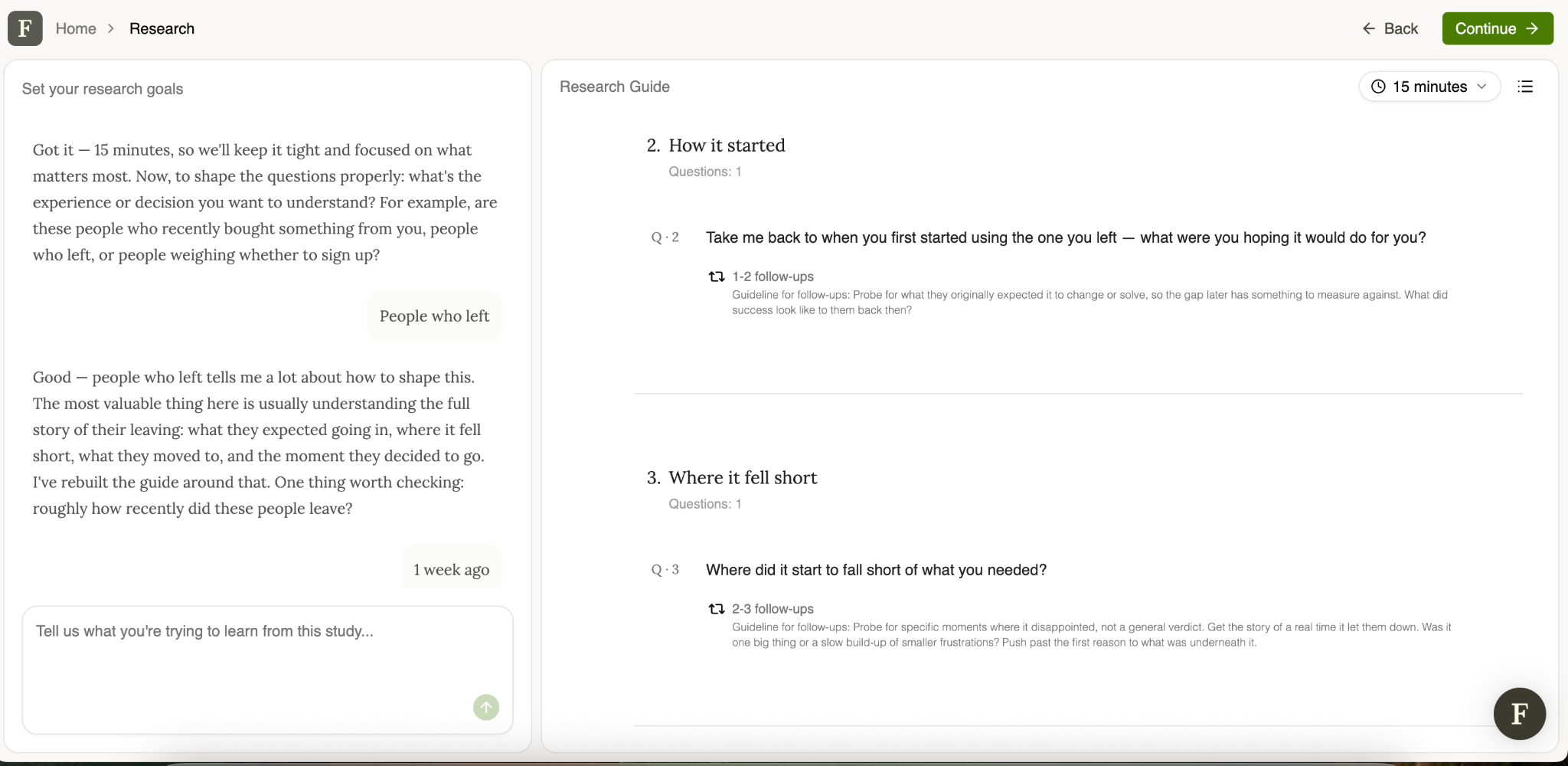
AI voice interviews offer another way to collect customer feedback. Frank, for example, lets teams explore the reasons behind customer behavior through conversations that can follow up on answers rather than relying solely on predefined survey questions.
Here are a few ways this approach can support the stages covered in this guide:
- Cart abandonment. Understand what stopped customers from completing a purchase, beyond what conversion analytics can tell you.
- Feature adoption. Frank’s feature discovery interviews help teams understand which features customers use, which they ignore, and why.
- Returns and post-purchase. For ecommerce teams, customer interviews can reveal gaps between product expectations and the actual experience.
- Churn and cancellation. Churn interviews help uncover why customers leave and what might have convinced them to stay.
- Retention. Feedback from existing customers can reveal what keeps them loyal and what could make them consider switching.
These conversations can be conducted in more than 30 languages, and Frank can be embedded directly into a website or app using a website widget. Automated summaries help teams identify recurring themes, quotes, and sentiment without manually reviewing every transcript.
Frank has conducted more than 3,000 interviews across 600+ research projects. The goal is not to interview customers at every possible opportunity, but to understand their experiences at the moments when their feedback can help explain a behavior or inform a decision.
Conclusion
Eight stages, eight different versions of the same customer. The one abandoning a cart has nothing in common with the one filling out a cancellation form at eleven at night, tired and already shopping somewhere else. Ask them all the same 1-to-10 question, and you get a spreadsheet of shrugs.
There’s no trick here. No secret framework, no clever workaround. Just show up at the right moment, ask a real question, and accept that the answer will be messier than a number.
Start with one stage, the one costing you the most right now, and ask it properly.

FAQs
What’s the difference between closed-ended and open-ended questions?
A closed-ended question gets you a number or a category: satisfied or not, yes or no. An open-ended question gets you the reason behind the answer.
When is the best time to reach customers at each stage?
Right when it happens, not afterward. Ask about cart abandonment the moment the customer leaves the cart. The more time passes after the event, the more polished and less honest the answer becomes.
Can the questions be automated instead of asked manually or by email survey?
Yes. That’s the whole point of trigger-based AI interviews: they start automatically when a cart is abandoned, an order is delivered, or a customer cancels.
How do you turn responses into action items?
The interview is only half the value. The other half comes from spotting recurring themes, pulling direct quotes, and tracking sentiment across hundreds of conversations, so the team doesn’t have to read each transcript individually. Done well, the result is a short, prioritized list.
How does Frank decide which questions to ask at each stage?
During setup, you define the goal for that situation, whether it’s cart abandonment, cancellation, post-delivery, or something else. Frank suggests key topics based on that goal, then adapts in real time as the customer speaks.
Do you need a large customer base for Frank to be useful?
No. Because interviews are triggered by individual actions rather than run as one big batch survey, Frank works just as well for a handful of cart abandonments or cancellations as for hundreds at once.