Okay, so here's a thing nobody tells you when you set up your first churn interview outreach: you send it, feel super productive about it for a second, and then nothing. Zero replies. Ok, maybe one, or a few, if you're lucky. Usually not even that.
The instinct is to blame the customer. They're gone, they're annoyed, why would they respond. Except that's not really what's happening. You just sent a generic exit survey, on a random day, with a subject line that literally screams "survey," to someone who's already moved on. And you still feel surprised when it gets ignored. Wow.
Getting a real response rate out of churn outreach isn't complicated. It comes down to four things: timing, channel, wording, and depth. Ask at the wrong moment, use the wrong channel, word it like an accusation, or stop at a vague answer, and outreach goes nowhere.
Here's how to actually fix each one.
TL;DR
- Timing: There's a window. Too soon and it's still raw. Too late and the memory's already been rewritten into something simpler.
- Channel: Email can be a weaker channel for eliciting conversational feedback. Text, messaging apps, or voice messages still get opened.
- Wording: How you phrase the question changes whether people answer. Ask like you're curious, not like you're accusing them.
- Depth: "Too expensive" isn't the real reason; it's just where the form stops. Getting the actual reason takes a follow-up question.
- Automation: Manual outreach becomes difficult to apply consistently at scale. It only holds up automated, every time, for every customer, which is the whole reason an AI interviewer called Frank exists.
Why Churned Customers Ignore You (Before You Fix Anything, Understand This)
1. The format is already working against you
Exit surveys start at a disadvantage before anyone even opens them, because online surveys as a format get fewer responses than other formats. A big review of survey studies found this holds consistently. That's not a reason to skip the survey; it's a reason to stop treating "just send a form" as some safe, no-cost default. Sending it is the easy part. Getting a churned customer to actually talk to you is a separate problem, and picking a channel isn't enough to solve it on its own.
2. There's no single reason someone churns
Expect more than one cause behind any cancellation, not a single clean reason. A systematic literature review looked at customer touchpoints across tech, telecom, banking, and gaming, and one thing stood out: churn rarely traces back to one clean moment or one clean cause. It's usually a build-up across several touchpoints, where a few different frustrations compound until cancellation is the outcome, and one of the best ways to understand why people churn ends up being the one that looks at that whole path,
3. Small details in the churn outreach decide whether you get an answer
Small details in how the outreach is put together both affect response rates; things like personalization and even which day a message goes out can shift whether it gets answered at all, though the effect depends on context and how much the customer trusts the sender in the first place.
Your churned customers aren't the issue; your churn outreach setup is
A weak format, a generic message, and bad timing rarely happen on purpose, but stacked together, they produce exactly what most teams end up with: a folder of unopened churn emails nobody bothered to explain.
The rest of this piece pulls those apart one at a time, starting with the one everyone screws up first: timing.
Timing: The Right Moment to Ask About Churn
Reach out somewhere in the middle, after the decision has settled, but before the story's had time to get rewritten. That's a recommendation, not a proven formula: what the research actually shows is that nobody’s memory sits still.
Studies on recall find people don't just forget details over time; they swap them for versions that make more narrative sense, while staying convinced they remembered it right. Convenient, right? And the same pattern shows up specifically in post-decision memory.
For churn outreach, the timing window works like this:
- Ask too soon: the story's still raw and half-formed
- Ask too late: the story's been rewritten into something simpler and tidier
- Somewhere in between is where you catch the real, still-accurate version
Timing alone won't save a bad ask. But get it wrong, and nothing else in the message matters much, which is exactly why it's worth getting right before writing a single word.
Channel: Where You Ask Matters as Much as When
Use a channel built for conversation such as text, messaging apps, or voice, instead of email. It's that email can be a weaker channel for eliciting conversational feedback. Email response rates have dropped enough that some are calling it a real turning point for how companies should be collecting feedback at all.
Text and messaging apps haven't hit that wall yet, mostly because people still use them for actual conversations, not just marketing blasts, which is part of why they've become some of the best ways to collect feedback in real time instead of waiting on a form that sits unread for days.
What retention teams actually do
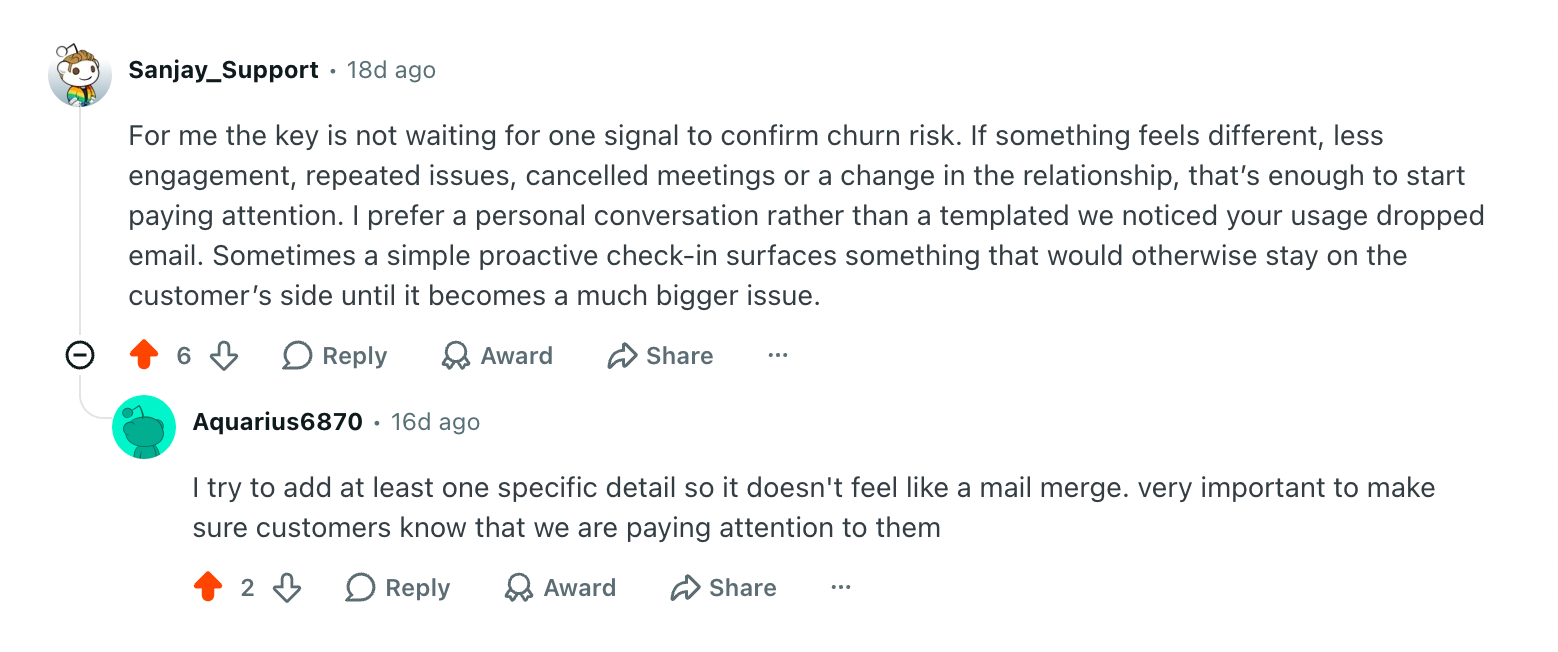
A message that reads as if it came from a real person outperforms one that reads as automated, even when the automated version technically reaches more inboxes. That tracks with what practitioners report too: on r/CustomerSuccess, one CSM put it plainly when describing why they skip the automated route entirely:
Another commenter, describing how their team actually splits outreach by account size, backed that up from a different angle:
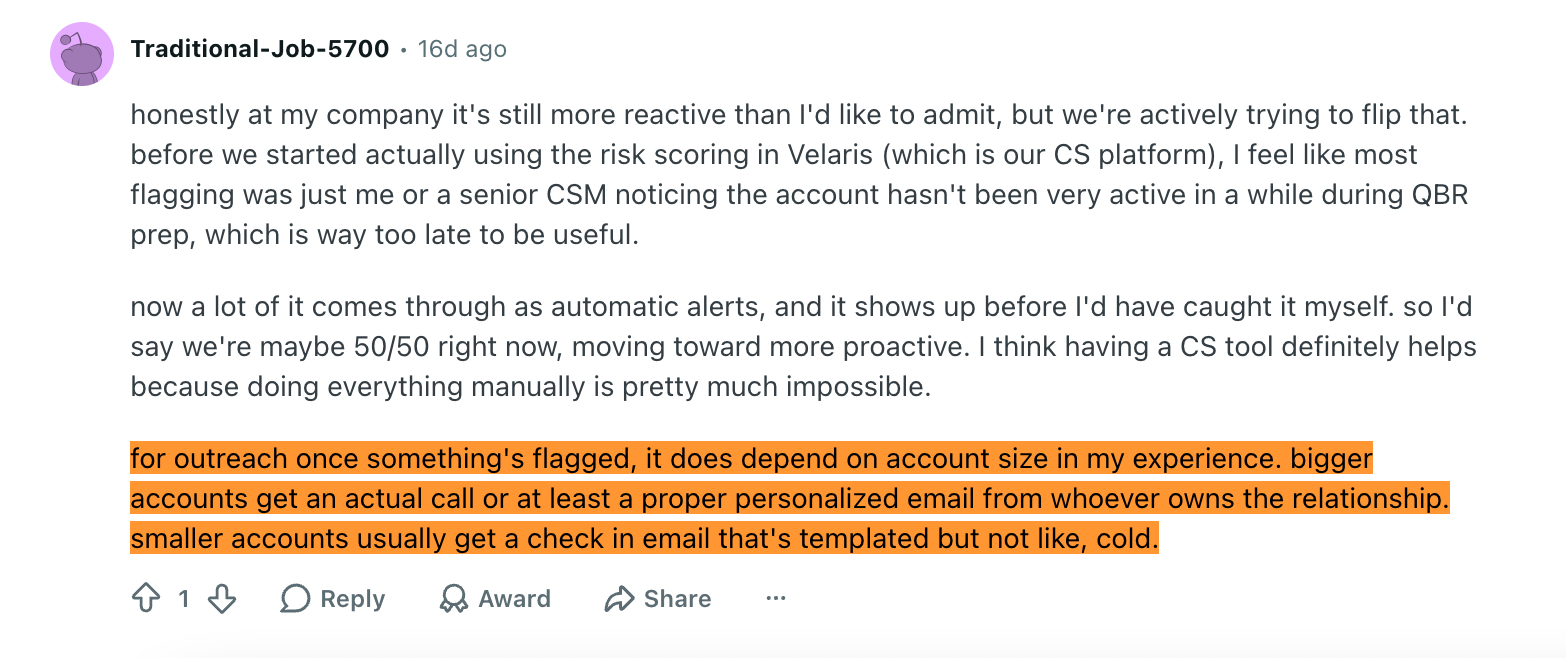
Notice what's not up for debate in that thread: nobody's defending the fully generic, batch-sent version. The disagreement is only about how much personal effort a given account gets, never whether it should get any. Even the templated version they describe still isn't cold.
Channel gets you opened. What you actually say once you're in front of them is a separate fight, and that's next.
The Message: What Makes a Churned Customer Actually Bother to Answer
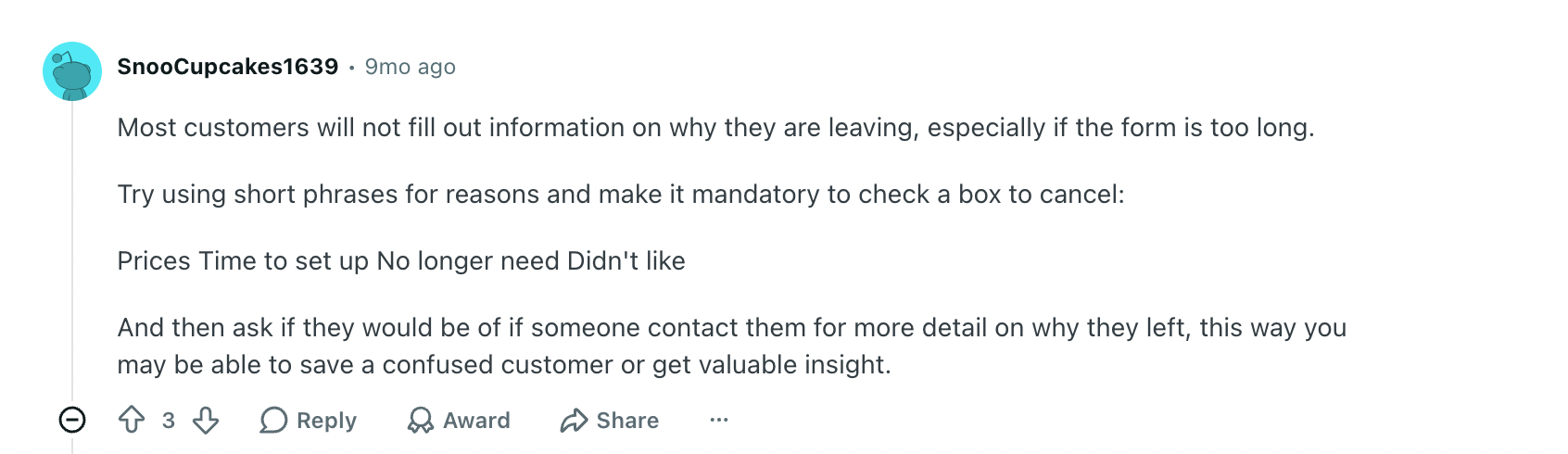
Keep the initial ask short and easy to answer. A famous research in web survey studied this directly across dozens of real surveys and found that questions demanding a longer, more thought-out answer consistently got skipped more than ones asking for a quick reaction; cognitive burden, not topic sensitivity, was one of the strongest predictors of who bothered to respond at all.
People running churn forms into the ground every day land on the exact same conclusion, just from the other direction. On r/CustomerSuccess, one commenter's advice to someone struggling with a near-zero response rate was brutally honest:
Open-Ended vs. Multiple Choice: The Churn Question Tradeoff
Closed questions get answered more often; open questions get you the real story. Pick based on which one you need more. Peer-reviewed research comparing the two formats directly confirms open-ended questions consistently produce more missing data than closed ones, precisely because they demand active recall and typing instead of a single click.
That's not an argument for going all-multiple-choice, though; the original poster in that same thread had already tried the closed-list version and hit the ceiling of what it can tell you:

The open-ended-versus-multiple-choice tradeoff for churn surveys comes down to one sentence: closed options get filled in, but a bored, fast checkbox click isn't the same as an honest answer.
Wording: The Cheapest Fix in Churn Outreach
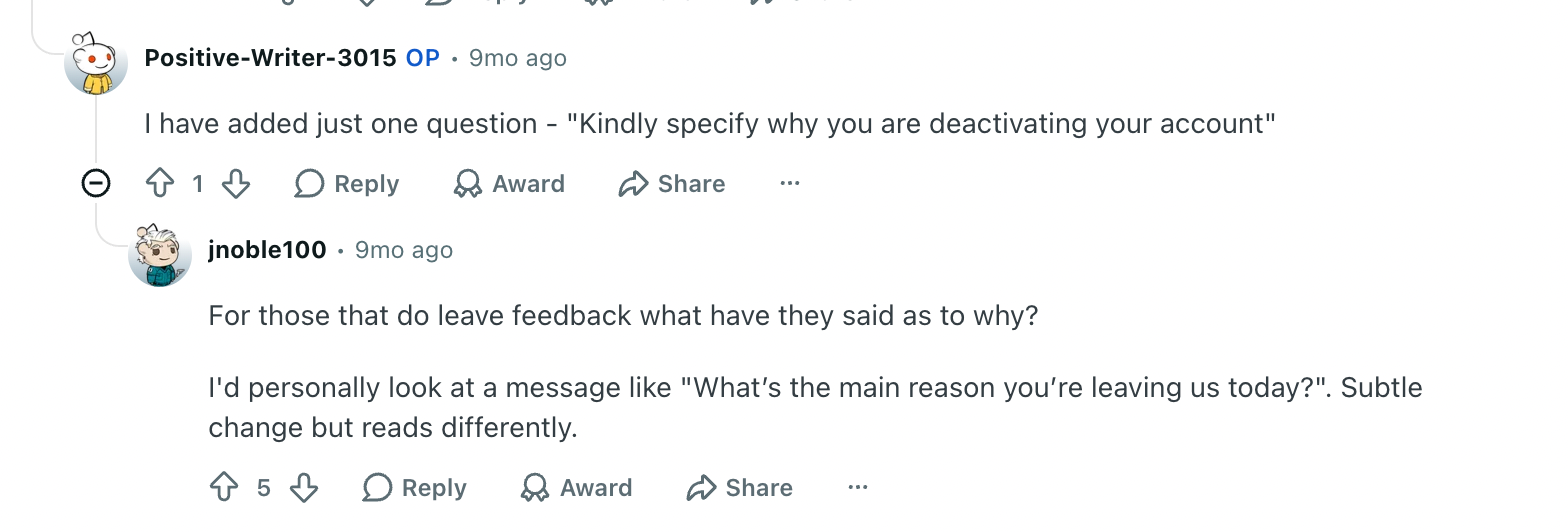
Ask like you're curious, not like you're accusing someone; it's the cheapest lever of the four, and it costs nothing to change. Take your basic exit survey question: "Why did you cancel?" Now change four words: "What made you cancel?" Same question, same channel, same timing, and yet the response rate moves. "Why did you cancel?" sounds a little like an interrogation, while "What made you cancel?" doesn't carry the same accusatory edge.
People are rediscovering the same thing in real time. Watching the OP's original question, "Kindly specify why you are deactivating your account," one commenter suggested almost the identical fix:
Getting someone to open the message and answer the question is most of the fight. What happens with vague answers once you have it, that's the next problem, and it's where a static form hits its limit.
Why Static Churn Surveys Fail, Even With a Real Answer
An answer isn't the same as the real reason
"Too expensive" could mean the price itself, a missing feature, or a competitor that made the comparison look bad, and a fixed-question form has no way to tell which. The same gap shows up with almost any vague churn answer:
The same gap shows up with almost any vague churn answer:
- "Missing features" could mean a workflow that isn't supported, a competitor that offers it, an expectation set by the pricing page, or a feature that exists but is hard to find.
- "Bad support" could mean slow response times, one mishandled ticket, an inconvenient channel, or a need for more technical depth than the team could offer.
A form stops at the label. A single follow-up like "which feature?" "What happened with support" is what tells you which of those it actually was.
People tell the truth more easily when they don't feel judged
People disclose more honestly in a computer-administered format than to a human asking the same question, a documented pattern in how people disclose information generally, not just in churn surveys. One meta-analysis found computer-administered assessments consistently produce more honest self-disclosure than the same questions asked by a human, and this holds even when people know they're talking to a chatbot. One participant put it simply: "You can be more honest with AI... because it's not human and they don't feel judged."
Follow-up depth matters when the goal is to understand the root cause
Following up on a vague answer is what separates a useful churn interview from a static form, and it's also the step that doesn't scale by hand. A human interviewer can follow up. A script can't, and a form definitely can't. Someone has to notice the vague answer, decide it's worth a second message, and go write one. Most of the time nobody has the hour.
Put all four fixes together and, congratulations, you've basically just described a piece of software. It's got a name and everything. It's called Frank.
How Frank Handles Churn Outreach: Timing, Channel, Wording, and Depth
Frank is an AI customer Interviewer built by Prelaunch and is one way teams have automated churn outreach. It's a useful reference point because it maps onto the same four levers directly: timing, channel, wording, depth, rather than solving a different problem.
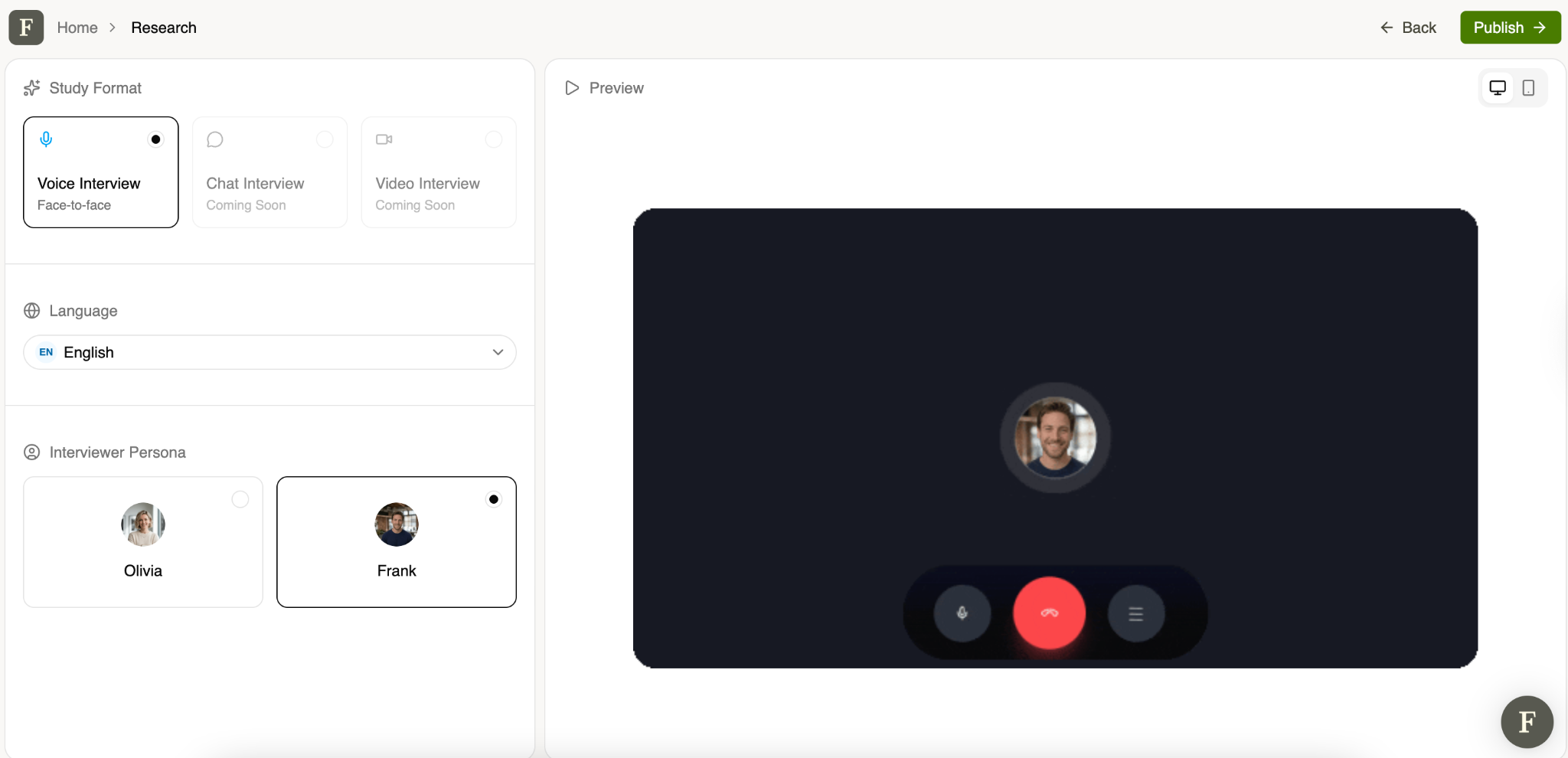
- Timing. Frank reaches out automatically the moment someone cancels or downgrades, rather than depending on someone remembering to set a reminder within the ideal window. No timing pressure.
- Channel. Conversations run in natural voice today (WhatsApp and video coming soon), in over 30 languages, channels that read as a conversation rather than a form.
- Wording. Questions are built to sound curious rather than accusatory, following the same "what made you cancel" logic covered earlier.
- Depth. Frank follows up on vague answers the way a human interviewer would, asking what "bad software" or "missing features" actually meant, instead of stopping at the first response the way a static form does.
There's a fifth factor worth naming on top of those four: whether the customer feels safe being honest at all. Even with all four solved, someone can still hold back if they suspect the real answer means a retention call is coming. Taking the human off the other end of the conversation is one way to lower that guard. Turns out the easiest way to make someone comfortable being honest is to not have a person on the other end at all. And that's basically how Frank runs churn interviews.
For churn interviews, the research on judgment-free disclosure is what this operationalizes: people say more when nothing about the conversation feels like it's angling for something. Here's what that looks like side by side.
Churn Outreach: Best Practices at a Glance
That's the general playbook. Here's what it actually looks like when you compare doing it manually against having Frank handle churn outreach at scale:
Everything You Need For Churn Outreach, At a Glance
The honest tradeoff: doing it right by hand for a dozen customers a month is totally doable. Doing it well for every single churned customer, every month, without it swallowing someone's whole week? That's where manual effort just runs out of gas.
The Actual Point
Turns out your churned customers were never the problem. You were just showing up at the wrong time, in the wrong inbox, asking in a way that made them want to close the tab.
Fix that, and "why did you cancel" stops being a mystery and starts getting real answers. Do it by hand for a dozen customers a month, or let Frank do it for a hundred, overnight, in whatever language they actually speak, which is, respectfully, a better use of your time than writing exit survey emails at 11 pm.
The fix replaces "starts being a real funny reason" with "starts getting real answers. It keeps the rhythm of the original sentence while actually saying what was meant (you get real answers instead of a vague brush-off), and drops "funny," which was ambiguous and undercut the point.

FAQs
1. How should you reach out to a churned customer?
Reach out within the first week or two after cancellation, while the reason is still fresh but the customer has had a moment to process the decision. Use a channel built for conversation. Ask a neutral, curious question instead of an accusatory one. If the answer comes back vague, follow up with a specific question to find out what that actually meant before treating it as the real reason.
2. When's the best time to send churn outreach after a customer cancels?
The best window is somewhere in the middle: not immediately, and not weeks later. Reach out too soon, and the customer hasn't processed their decision yet. Wait too long, and their memory of why they left has already simplified into a tidier version of what actually happened.
3. Why does email get such a low response rate for exit surveys?
Because email has lost trust as a feedback channel over the years, on top of online surveys already underperforming other formats in general. Text and messaging apps tend to get opened because people still associate them with real conversations.
4. Should churn surveys use open-ended or multiple-choice questions?
Both, ideally. Closed questions get answered more often but cap what you learn. Open questions get the real story but see more people drop off before finishing. The tradeoff is response rate versus depth, not a right-or-wrong choice.
5. Why do customers give vague answers like "too expensive" instead of the real reason?
Because static forms and fixed question sets can't follow up. "Too expensive" could mean the price, a missing feature, or a competitor that looked better by comparison, and there's no way to tell which without asking a follow-up question.
6. How is Frank different from a standard exit survey?
A standard exit survey collects a predefined answer and usually stops there. Frank conducts a conversational interview and follows up on vague responses, helping teams understand the underlying reason behind churn rather than just collecting a cancellation category.