.jpg)
All founders know how a startup is supposed to work. Talk to customers. Learn what matters. Build accordingly. Simple enough, right?
Except that in the middle of a fundraise, a hiring push, and after a buggy release, "talk to customers" somehow never makes it to the top of the list.
And when founders do make time for it, the process is a mess. Surveys go out, one-word answers come back. Weeks pass, chasing users who never respond. Eventually, the roadmap gets built on gut feeling and whoever happened to complain the loudest. Not ideal.
AI is starting to close that gap. Not by removing the judgment part (that's still yours), but by cutting the time and effort it takes to run discovery consistently. This article covers how founders are actually using it.
TL;DR
- AI helps founders do product discovery faster by surfacing customer needs, frictions, and motivations earlier
- The best AI workflows support the whole process, from shaping questions to analyzing feedback
- AI is most useful when tied to real moments like sign-up, churn, failed activation, or post-call follow-up
- AI interviews help uncover the reasons behind behavior, not just the behavior itself
- Frank makes this easier by running customer conversations and turning them into structured insights quickly
Why Product Discovery Keeps Getting Deprioritized
1.Product discovery always loses to more urgent work
Product discovery gets deprioritized because it always loses to more visibly urgent work such as hiring, fundraising, shipping, fixing, even though founders genuinely care about it. Unlike shipping a feature, good discovery takes real effort finding the right people, talking to them properly, and making sense of what you hear. In most early-stage teams, that means discovery becomes something founders intend to do more of, rather than something they actually do.
2.The feedback you do get is often too thin
Founder feedback is often too thin because most inputs, such as surveys, form responses, support notes, and dashboards, describe what customers did, not why they did it. Because most of those inputs don't go deep enough. Analytics can show you where users drop off, but they can't tell you what those users were hoping for, what confused them, or what almost made them stay.
3.By the time you get insight, the moment is gone
Timing is the third problem: by the time an interview gets scheduled to explain a failed activation or a cold lead, the moment is already behind the customer, and the insight is half as useful. But by the time an interview finally gets scheduled, that moment is already behind the customer. The memory is fuzzier, the context is weaker, and the insight is half as useful as it would've been the day after it happened.
Founders know discovery matters. The hard part is doing it often enough and doing it while the moment is still fresh. AI is changing both of those things.
How AI discovery compares to other methods
No single method covers everything. The point should be to close the specific gap they leave open: understanding why, at a scale founders can actually sustain.
What different research methods tell you:
- Analytics — What happened?
- Surveys — What do customers say?
- Interviews — Why did it happen?
- AI interviews — Why did it happen, at a larger scale and closer to the customer moment?
How Founders Use AI for Product Discovery
Founders use AI for product discovery primarily to identify high-impact customer problems, understand why users churn or convert, and decide what to validate next. Product managers use AI more often to support feature discovery, prioritize problems, and analyze ongoing research.
A PM might use AI for feature prioritization, tag recurring themes, or generate follow-up questions inside a running discovery workflow. A founder usually starts wider. The questions are more strategic. Are we building the right thing? Why aren't users converting? Which problem is painful enough to actually drive growth if we solve it?
A simple AI product discovery workflow
Across all of this, the process founders follow tends to boil down to six steps:
- Identify the business problem — What do you actually need to understand right now?
- Collect existing signals — Pull together support tickets, sales notes, churn data, surveys, and analytics.
- Create research questions — Use AI to turn assumptions into open-ended questions worth asking.
- Interview customers — Talk to them directly, or use AI interviews to collect feedback at scale.
- Analyze responses — Look for recurring needs, friction points, motivations, and objections.
- Turn insights into decisions — Decide what to fix, test, validate, or dig into next.
Start with the business question, not the feature question
Founders use AI for product discovery by starting with business problems rather than individual features. Instead of asking "How can we improve this screen?", they ask things like:
- Why are good-fit leads dropping after the demo?
- Why are users signing up but not reaching the first value?
- What customer problem is painful enough to drive growth if we solve it properly?
AI can help founders pull together signals from across the business and spot where the real friction is. Atlassian’s definition of product discovery is useful here because it keeps the focus on customer needs and business context, not just feature ideas.
Use AI across the places where founders already get signals
Founders use AI to pull signals from every channel where feedback already sits, such as support tickets, sales call notes, CRM comments, onboarding feedback, churn reasons, instead of reading it manually, one source at a time.
Instead of reading everything one by one, founders can use AI to:
- group repeated complaints
- spot common friction points
- compare what prospects say versus what customers say
- see what keeps showing up before churn, drop-off, or silence
That helps answer a more founder-relevant question: what is the biggest problem putting pressure on growth right now?
Use AI to sharpen the questions before talking to customers
AI helps founders turn vague questions into ones that surface motivation and friction. "Do users like this feature?" is technically a question, but it's not going to get you anywhere. AI can help reframe it into something that actually works like: "What were users trying to do when they reached this feature, and what made it feel confusing, unnecessary, or not worth continuing?"
That shift matters. It moves discovery away from surface opinions and closer to motivations, friction, hesitation, and unmet needs. NN/g advises that interview guides should use “broad, open-ended questions” plus follow-up probing.
Use AI interviews when the founder cannot speak to everyone
AI interviews let founders hear from the churned users, stalled leads, and failed activations they could never realistically interview themselves, the exact people they most need signal from.
AI interviews help fill that gap by collecting deeper feedback around the trigger moments that matter most:
- right after a demo request
- right after churn or downgrade
- right after failed activation
- right after a support issue
- right after a sales call
That makes discovery easier to scale without turning it into a giant scheduling exercise. NN/g says AI interviews offer faster feedback at scale, even though they are not a replacement for deeper human-led interviews.
Use AI to turn feedback into a decision
Founders use AI to convert incoming feedback directly into a decision about what to build, fix, or test next, not to collect insight for its own sake.
Once feedback starts coming in, AI can help answer questions like:
- Which friction point shows up most often before conversion drops?
- What are high-intent leads actually worried about?
- Which segment feels this problem most strongly?
- What should we fix, test, or validate before we build more?
The logic is simple enough. Ask the right questions, stay close to the customer moment, and learn fast enough to act on what you hear.
How Frank Helps Founders Use AI for Product Discovery
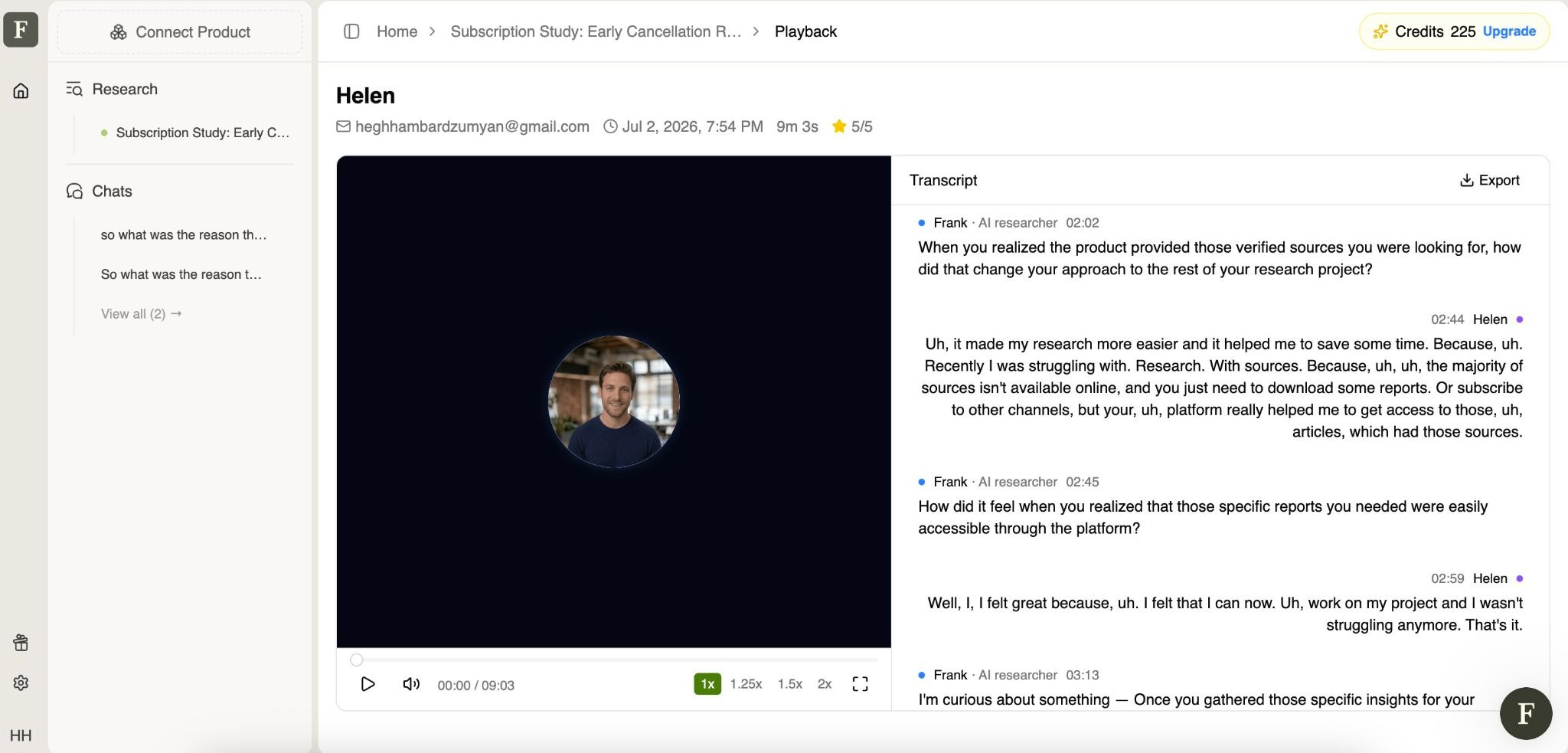
The six-step workflow above is straightforward in theory. In practice, most founders don't have the time to run it themselves; customer interviews take real hours, and those hours are usually the first thing to get cut. AI customer interviews close that gap: an AI interviewer like Frank runs the conversations on a founder's behalf, at the moments that matter, so discovery keeps happening even when nobody has a free afternoon to run it by hand. (1, 9)
General AI interview capabilities: (2)
- Automate customer interviews without manual scheduling
- Ask follow-up questions dynamically, based on how the conversation develops
- Conduct interviews at scale, across many customers at once
Frank-specific capabilities: (2)
- Trigger interviews automatically at specific customer moments, such as churn or failed activation
- Run interviews in 30+ languages
- Analyze conversations into recurring themes
- Provide transcripts, recordings, and chat logs behind every summary
- Return structured insight the next day, built on a research methodology shaped by the experience of running 100,000s of interviews
(4 - each row now states what the founder wants to learn, not what Frank specifically does)
How Frank Works for AI-Powered Product Discovery (5)
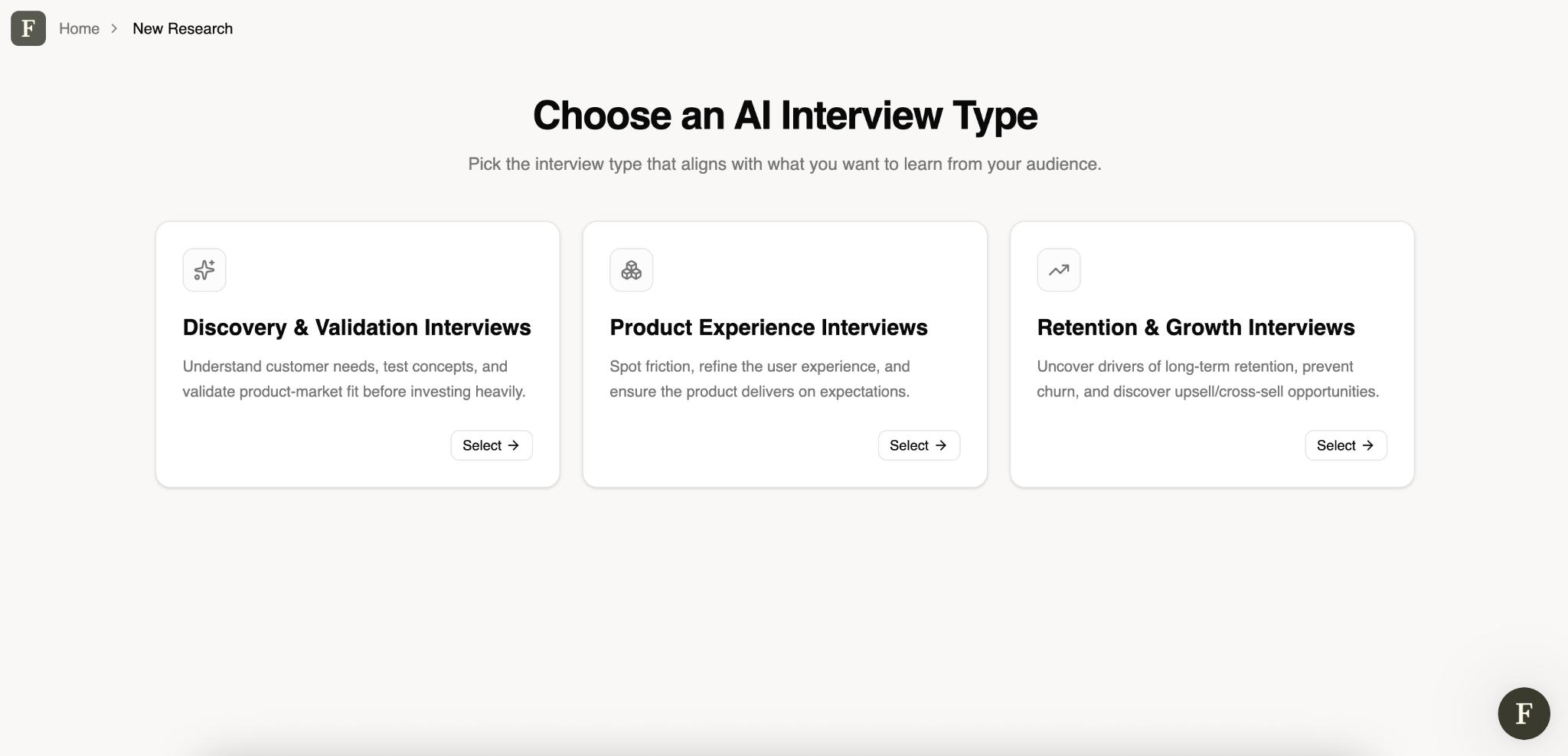
The process runs in these steps: (6)
- Start from the AI interview type, then a question, not a research project. Founders begin where they already are wanting to know why customers churn, for instance rather than setting up a formal research initiative.
- Trigger the interview at the right customer moment. Once a trigger is set (a churn event, a failed activation, a completed demo), the interview goes out automatically, through channels that already feel familiar, so customers don't need to schedule a traditional interview. (7)
- Ask follow-up questions. The conversation adapts as it goes, pushing past the first answer to get at what the person actually meant, felt, or struggled with.
- Turn conversations into structured insight. Interviews become summaries and recurring themes founders can act on directly: the friction point behind a churn spike, the objection stalling a segment of leads, each traceable back to its transcript, recording, or chat log. That's what founders walk away with: evidence for what to fix, test, or validate next, organized around the decision it's meant to support rather than left as raw feedback. (8)
This is also the shape of the workflow Frank is built to run automatically, at scale, and without the founder having to manage any of the four steps by hand.
Conclusion
No single method like surveys, analytics, or human interviews covers everything, and that was never really the problem. What derails most founders is that even the right method rarely gets run consistently enough to matter.
But hope is a difficult way to build a roadmap.
AI doesn't replace the judgment that makes a startup good. It just makes more space for customer understanding. You don't need a bigger team or a six-figure research budget; you need a way to listen that doesn't require clearing your calendar.
If product discovery is the thing you keep meaning to get back to, Frank is a practical way to keep it moving without waiting for the perfect moment to show up.

FAQ
Can AI really help with product discovery?
Yes. AI supports product discovery by sorting messy feedback, sharpening research questions, spotting patterns, and helping teams learn from more customers without slowing down. It works best applied to those specific parts of the job; it doesn't replace the judgment call of what to build.
How is AI product discovery different from surveys?
Surveys are good for quick signals, but they usually stay close to the surface. AI can go further by asking follow-up questions, picking up on friction, and helping uncover the reasons behind a customer’s behavior.
When should founders use AI interviews instead of customer calls?
AI interviews are most useful when founders need to hear from more people than they can realistically speak to themselves. They work especially well after moments like churn, failed activation, a demo request, or a sales call, when the signal is still fresh.
What are the best moments to trigger AI interviews during product discovery?
The strongest trigger points are usually the ones closest to intent, friction, or exit. For product discovery, the most useful ones are right after an inquiry form, when a user churns or cancels, after a discovery or sales call, and after failed activation.
Can Frank help uncover why users do not activate or why they churn?
Yes. That is one of the clearest use cases for it. Frank can reach users close to the moment they stalled or left, ask follow-up questions, and bring back clearer insight into what blocked progress or changed their mind.
How can founders trust AI-generated insights?
Founders can trust AI-generated insights by tracing them back to the source conversation, the transcript, recording, or chat log behind each summary. That traceability is what makes the insight verifiable, rather than something to take on faith.
Do founders still need to talk to customers directly?
Yes. AI makes discovery easier to keep going, but it does not replace direct founder contact with customers. It helps fill the gaps, widen the sample, and keep learning moving between the conversations that founders can have themselves.
Is this only useful for bigger teams?
No. In some ways, it matters even more for smaller teams. When nobody has time to run discovery as a full process, AI can help keep customer learning alive without needing a dedicated research function.