

How many free trials have you started this year? And how many did you abandon without explaining why?
Your trial users do the same. They sign up, explore your product for a few days, then disappear. Your analytics show when they stopped logging in, but not why.
To find out, you need to understand two things: what users expected when they signed up and where the product fell short. Ask the first question early in the trial and the second when it expires. Comparing the answers can help you distinguish a marketing or positioning mismatch from a product or onboarding problem.
The challenge is getting those answers at scale without a dedicated research team. This guide explains how to structure trial-expiry interviews, use AI to explore the reasons behind non-conversion, and turn those findings into changes worth testing.
Why Trial Users Leave Without Telling You
“We get signups, but users go quiet after a few days. We have no idea what went wrong until they’re already gone.”
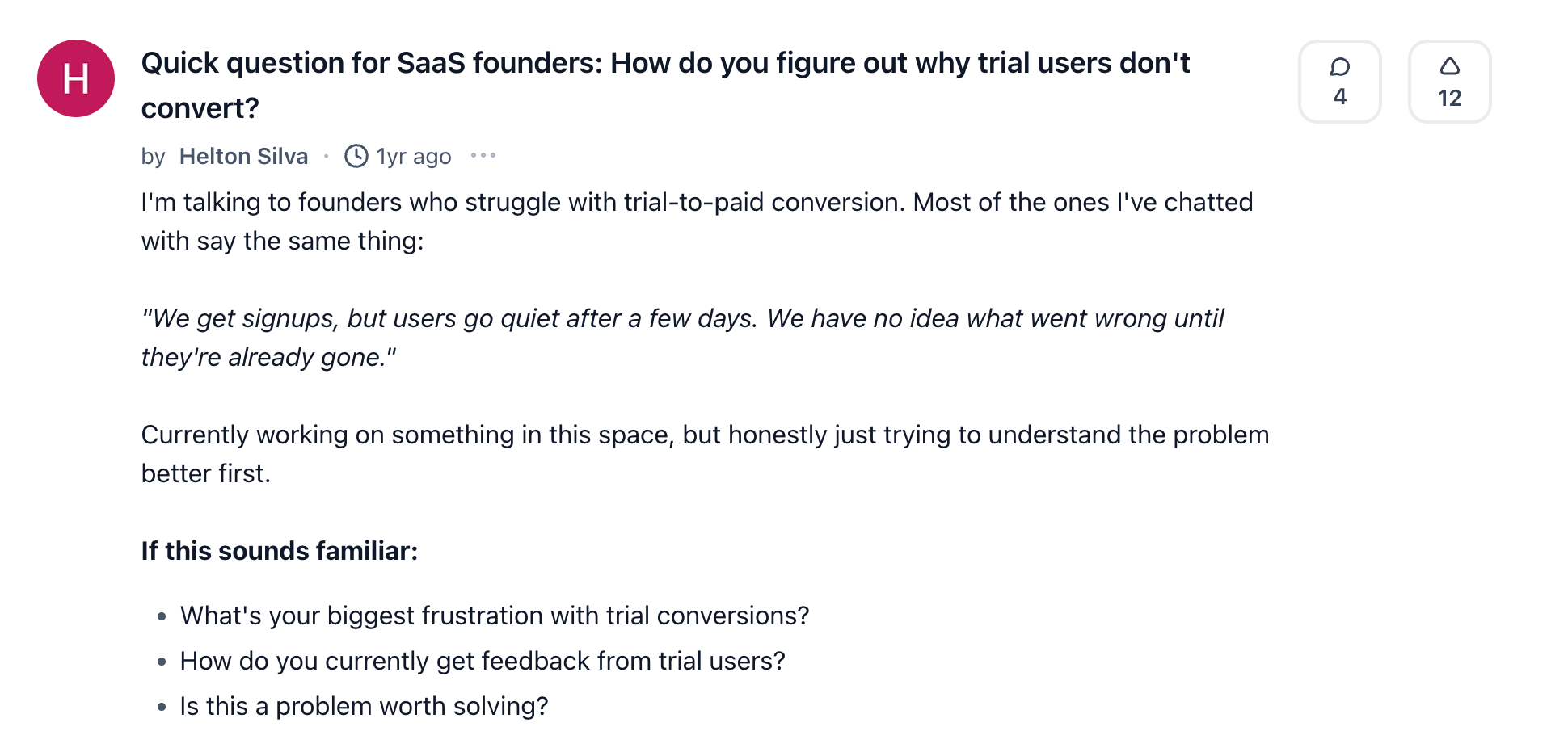
Helton Silva raised this problem in a Product Hunt discussion: how do SaaS founders figure out why trial users don’t convert? It captures a familiar challenge for self-serve products. Your dashboard can pinpoint the exact day someone stopped logging in, but it can’t explain the reason.
The silence problem
When a paying customer cancels, you may get some feedback. You might get a cancellation flow, a support ticket, or an exit survey. A trial user who doesn’t convert may give you none of that. They simply don’t come back.
Parth Ahir described the frustration in the same thread: “Biggest frustration? Silence. You build something you know delivers value, but users vanish before hitting that ‘aha’ moment. By the time you’re aware they’re gone, the window’s closed.”
So where do you ask? You can’t attach a survey to a cancellation button, and you can't reply to an invoice. You need another way to reach trial users while their experience is still fresh.
Why exit-survey answers can mislead you
Even when customers give you an answer, their first explanation may not tell the whole story. An AI-interview company ran a study of 723 recently churned B2B SaaS customers in December 2025 and found that, in only 27.4% of cases, the first reason people gave matched what really drove them away. About a third (34.2%) pointed to price. Of the 247 who did, only 8.5% had actually left over price. Across the study, the reported underlying reasons included onboarding problems, account-management issues, and ROI that never materialized.
There is an important caveat: the study examined people canceling paid plans, not trial users, and equivalent figures for trials have not been established. The findings therefore shouldn’t be treated as a prediction of trial behavior. They do, however, illustrate why it can be useful to explore an initial answer rather than accept it at face value.
A dropdown menu can’t ask a follow-up question. A human or AI interviewer can. If someone says a product was “too expensive,” the next question might be whether the price exceeded their budget or whether the product didn’t deliver enough value to justify the cost. Those answers suggest different problems to investigate. This guide covers how to ask better customer interview follow-ups.
Buyers vs. serial trial-hoppers: you can’t tell them apart from a funnel alone
Some trial users are exploring without an immediate intention to buy. With so many tools offering free trials, it's reasonable to compare several products before deciding.
The challenge is that usage data alone may not distinguish someone casually exploring options from a serious buyer who tried your product and walked away. If you treat both groups the same, you might change your product to address a problem that was actually about targeting—or rewrite your messaging when the real issue was onboarding.
Ask about signup intent, then compare the answers with activation and conversion data. Over time, this can help you identify which signals are associated with stronger buying intent.
Why no one on a small team owns trial research
Frank’s guide to churn research describes how, in a 20–50-person company, churn research can fall between product, growth, support, and the founder. Trial research can be even easier to overlook: a non-converting trial may not generate a cancellation event, support ticket, or exit survey.
Many founders resort to emailing people who left and hoping a few respond. That can produce useful conversations, but it may not be enough to understand patterns across a much larger signup volume. The goal is to collect follow-up feedback more consistently without turning research into another full-time responsibility.
How to Use AI to Find Out Why Trials Don’t Convert
You can build a workflow yourself using events, webhooks, and interview tools, or use a platform designed for customer interviews. Either way, the research process starts with the same questions.
1. Separate signup intent from the delivery gap
Most churn research boils down to one question: “Why did you leave?” But that question can hide two different issues.
The first is signup intent: what did the user expect your product to help them do? The second is the delivery gap: where did the product fall short of that expectation?
Ask about intent at signup or early in the trial, before the experience changes how the user describes their original expectations. Ask about the delivery gap when the trial ends without converting.
For example, someone might sign up expecting a feature your product doesn’t offer. That could point to a mismatch between your marketing and the product. Another user might have the right expectations but struggle to complete setup. That suggests a different issue.
These answers are starting points for investigation, not definitive diagnoses. Compare them with product usage and conversion data before deciding what to change.
Signup answers can also help you segment trials by their goals. Someone who says they’re casually comparing options may need a different follow-up from someone trying to solve an urgent business problem. Whether either signal predicts conversion should be tested against actual outcomes.
2. Trigger the conversation at the right moment
Don’t save all your research for a monthly review. Ask while the experience is still fresh.
Frank’s churn guide describes connecting cancellation events to interview requests through tools such as Stripe webhooks or Zapier triggers. For trials, teams can configure an interview link in a trial-ended email or place an interview widget on the trial-expired screen, depending on their setup.
The important distinction is that the trial-ending event and interview delivery need to be configured. A platform won’t necessarily know when an individual user’s trial expires unless the relevant workflow or integration provides that information.
Timing matters because people may remember a recent experience more clearly than one from several weeks ago. Collecting feedback close to trial expiry can make it easier for users to recall what they tried, where they got stuck, and what they expected to happen.
3. Use adaptive follow-ups instead of relying on a static script
A form that records “too complex” leaves the meaning unclear. An interviewer can explore what the customer means: Was the interface confusing? Were the instructions insufficient? Was an important integration missing?
In the churn study mentioned earlier, it took an average of 4.2 rounds of follow-up to get to the underlying reason, rising to 4.7 among people who initially blamed price. These figures describe that study’s paid-customer sample, not a guaranteed number of follow-ups for trial interviews.
A fixed script provides consistency, but adaptive follow-ups let an interviewer explore unexpected answers. An AI interviewer like Frank can ask follow-up questions based on what each respondent says instead of following exactly the same path in every conversation.
4. Aggregate transcripts into themes, not just a folder of anecdotes
Reading dozens of transcripts takes time, especially on a small team. A useful analysis should surface recurring themes, show how many interviews support each one, and link the findings back to the underlying conversations.
For trial research, consider tagging each interview with relevant context, such as the plan the person evaluated, company size, activation status, or key features used. This can help you see whether certain problems recur among the users you most want to convert.
For example, themes might include:
- Expected a feature the product doesn’t offer
- Got stuck during setup
- Couldn’t connect an essential integration
- Didn’t see enough value to justify the price
- Chose a competitor that better matched their needs
Treat theme counts as a summary of the interviews collected, not automatically as a representative estimate of your entire trial population. Response rates and who chooses to participate can affect what you hear.
5. Use AI to identify changes worth testing
A list of themes still leaves you deciding what to do first. AI can help organize the evidence and suggest next steps, but you shouldn’t ask it to predict with certainty which changes would have converted non-buyers.
Instead of asking, “Based on these 50 trial interviews, which three changes would most likely have turned evaluators into paying customers?”, try:
“Based on these trial interviews, identify the three most recurring barriers to conversion. For each barrier, cite supporting quotes, distinguish direct evidence from interpretation, and suggest a change we could test. Flag any conclusions that need to be checked against product usage or conversion data.”
This keeps the recommendations tied to the evidence and gives your team a practical next step: investigate the most consistent barriers, prioritize them, and test whether addressing them improves conversion.
Teresa Torres, a product discovery coach, has written about the risks of relying on AI to analyze interview transcripts without sufficiently focused questions or checking the underlying evidence. A narrower prompt makes the analysis more useful, but every key finding should still trace back to the original conversation.
How Frank Runs Trial-Expiry Interviews
Even with a clear method, running interviews manually can be difficult for a founder who also handles sales, support, and hiring. Frank helps teams conduct AI-moderated customer interviews and organize the resulting feedback.
For trial research, there are three useful moments to consider:
- When a trial expires without converting. Add Frank’s floating widget to the trial-expired screen or include an interview link in the trial-ended email. The team needs to configure the relevant placement or delivery workflow.
- At signup or first login. Ask a short set of open-ended questions about what the user hopes to accomplish before their experience changes how they describe their original expectations.
- When a paying customer churns or downgrades. Place an interview on the cancellation or downgrade page to explore the reasons behind the decision.
Depending on the setup, Frank can appear as a floating widget on a website or be accessed through an interview link. Its voice interviews adapt follow-up questions to the participant’s answers rather than following a fixed script.
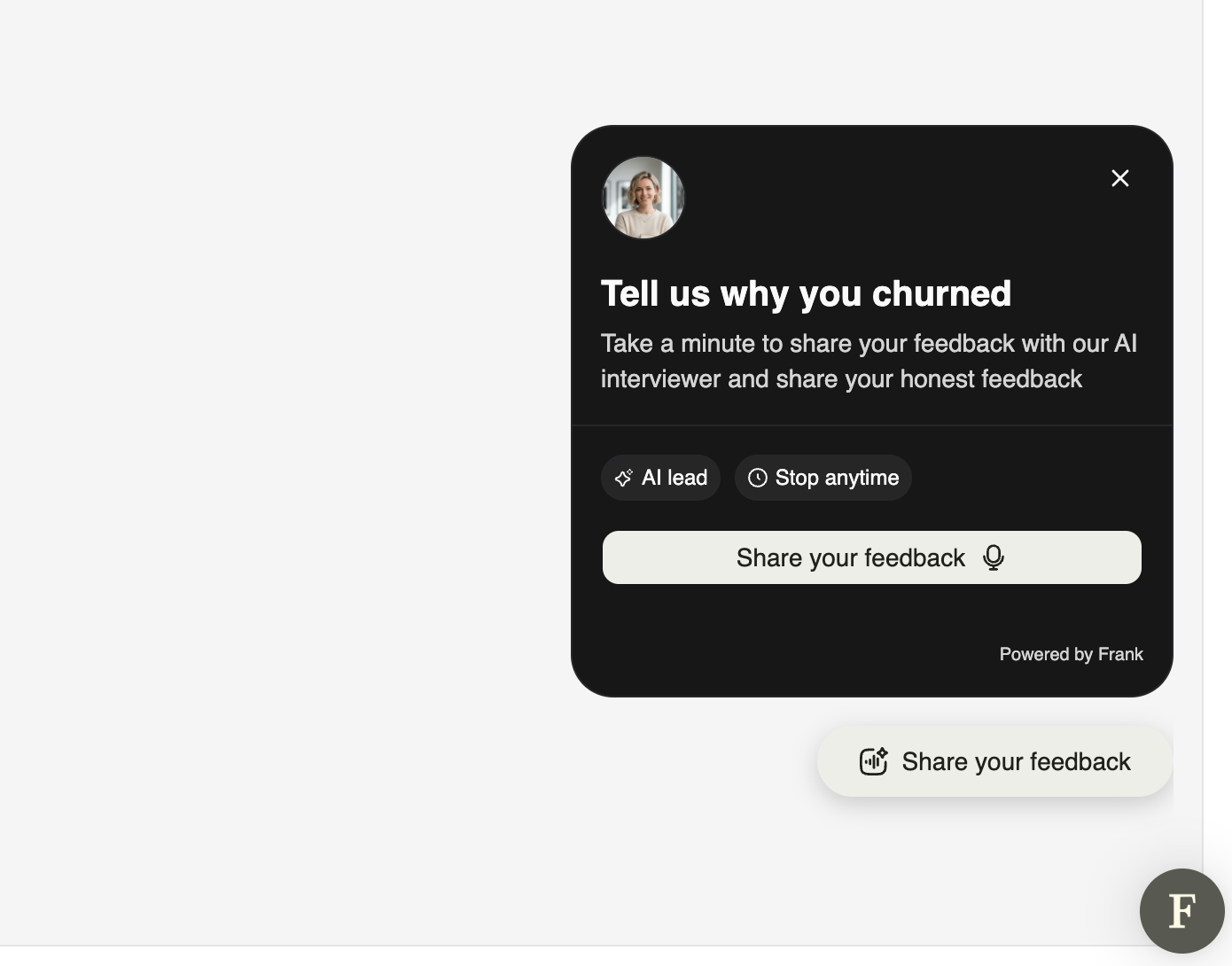
Teams can review interview transcripts and recordings to check the context behind a finding or investigate an unexpected response. Frank supports up to 1,000 concurrent interviews in more than 30 languages. It is SOC 2- and GDPR-compliant. Frank can also group responses into themes, helping teams identify recurring patterns without manually reviewing every conversation first.
The value isn’t that AI makes every conclusion correct. It’s that teams can collect and organize more qualitative feedback, then use the evidence to decide what to investigate or test next.
Where to Start This Week
Start by writing two open-ended questions:
- At signup or first login: “What are you hoping this product will help you do?”
- At trial expiry without conversion: “What, if anything, prevented you from getting the value you expected from the product?”
Keep the questions neutral. Avoid suggesting reasons such as price or missing features before the user has had a chance to explain their experience.
If you can implement both questions, do so: the signup answer gives you a baseline for interpreting the trial-expiry answer. If you can implement only one this week, start with the trial-expiry question to investigate recent non-conversions, then add the signup question so you can compare expectations and outcomes for future trials.
Review the first batch of responses yourself. Check whether the recurring themes are supported by the original answers, compare them with product usage data, and choose one problem to investigate or test.
Over time, this process can help you understand whether trial users leave because of a mismatch in expectations, product friction, or a value proposition that hasn’t become clear enough.

FAQ
How many trial-expiry interviews do I need before I see real patterns?
There isn’t a universal number. Frank’s guide to interview counts discusses interview counts for different research goals. The number you need depends on how diverse your users are, how specific your questions are, and whether new interviews continue to reveal distinct themes. Look for recurring patterns, but don’t assume that repeated answers from a small or self-selected sample represent every trial user.
Will trial users who never paid respond to an AI interview?
There is limited published evidence specifically about response rates among users whose trials expire without converting. Someone canceling a paid plan may have a clear reason to explain their decision, while someone whose trial quietly expires may have less motivation to respond. Test the workflow with your own audience and measure the response rate before assuming you’ll hear from a particular share of trial users.
Isn’t this just a churn interview, renamed?
Not exactly. Churn interviews usually focus on customers who cancel or downgrade a paid subscription. Trial-expiry interviews investigate why someone who had an opportunity to try the product didn’t become a paying customer. The method described here also separates the user’s original expectations from their experience during the trial, giving teams two perspectives to compare.
Can I trust AI-summarized transcripts?
Not without checking the evidence behind important findings. In her discussion of AI-assisted interview analysis, Teresa Torres describes problems with AI-generated summaries and inaccurate direct quotes. Make sure important insights link back to the original transcript or recording, and verify surprising findings before making product decisions.
Do I need a research background to run this?
You don’t need a dedicated research team to start. Define the question you want to answer, ask it at the right moment, review the responses, and compare the themes with product data. Open-ended questions and follow-ups can help you understand customers’ reasons, but treat your findings as evidence to investigate rather than proof of a single cause.


