You looked at Strella. Smart choice to look. Also smart to keep looking.
Maybe the price felt off for how often you actually run research. Maybe you couldn't find the right people. Maybe you just wanted someone to click through a Figma file before you built the whole thing, and Strella simply doesn't do that.
These are structural gaps, not complaints. Strella is a genuinely capable platform. Amazon and Duolingo use it for good reason. But their use case and yours might just be different.
This article covers six alternatives, each matched to a specific problem. Find the one that fits where you're actually stuck.
Why Look for a Strella Alternative?
Strella is good at what it does. But every tool has a natural home: the team size, budget, and research workflow it was actually built for. Strella's home is the enterprise research team. If that's not you, a few things will start to feel off.
- Pricing targets research teams, not founders — plans start at $150–$400/month, which doesn't make sense if you're running just a few studies per quarter
- Panel is broad, not deep — 8M participants work for general consumer research, but niche B2B profiles (e.g. ops leads, bootstrapped SaaS PMs) are hard to target precisely
- No prototype or concept testing — limited compared to the best AI interview tools on the market; no Figma or clickable prototype support
- Incentive handling drops off with your own audience — payments, gift cards, and tracking all fall outside the platform the moment you bring your own customers
How We Ranked These Alternatives
Not every research tool belongs on every list. These six made it because they each solve something specific, and we evaluated them against the same five criteria.
- Depth of insight — does the tool actually surface why customers behave the way they do, or does it stop at what they clicked and when? According to the GRIT, the convergence of "what" and "why" is now the baseline expectation for research.
- Audience access and panel quality — can you find the exact person you need, including hard-to-reach B2B profiles, without already having a customer list?
- Concept and prototype testing — does it support Figma imports, side-by-side concept comparison, or clickable prototype validation before a line of code gets written?
- Participant incentive handling — are payments built into the platform, or is that your problem to solve separately?
- Founder-friendliness — can someone with no research background set this up, run it, and actually understand what came back? The State of User Research found that non-researchers are now doing research across product, design, and marketing teams, whether they feel equipped for it or not.
Overview: Strella Alternatives At a Glance
6 Best Strella Alternatives: Deep Dives
1. Frank
Best for: founders, product, and marketing teams at startups and growing companies who want real customer insights fast, deep, and without a research budget.
Frank is an always-on AI customer interviewer built by Prelaunch, the team behind a Silver ESOMAR Award for Breakthrough Research Methodology. The platform runs hundreds of thousands of customer interviews across SaaS and e-commerce companies worldwide.
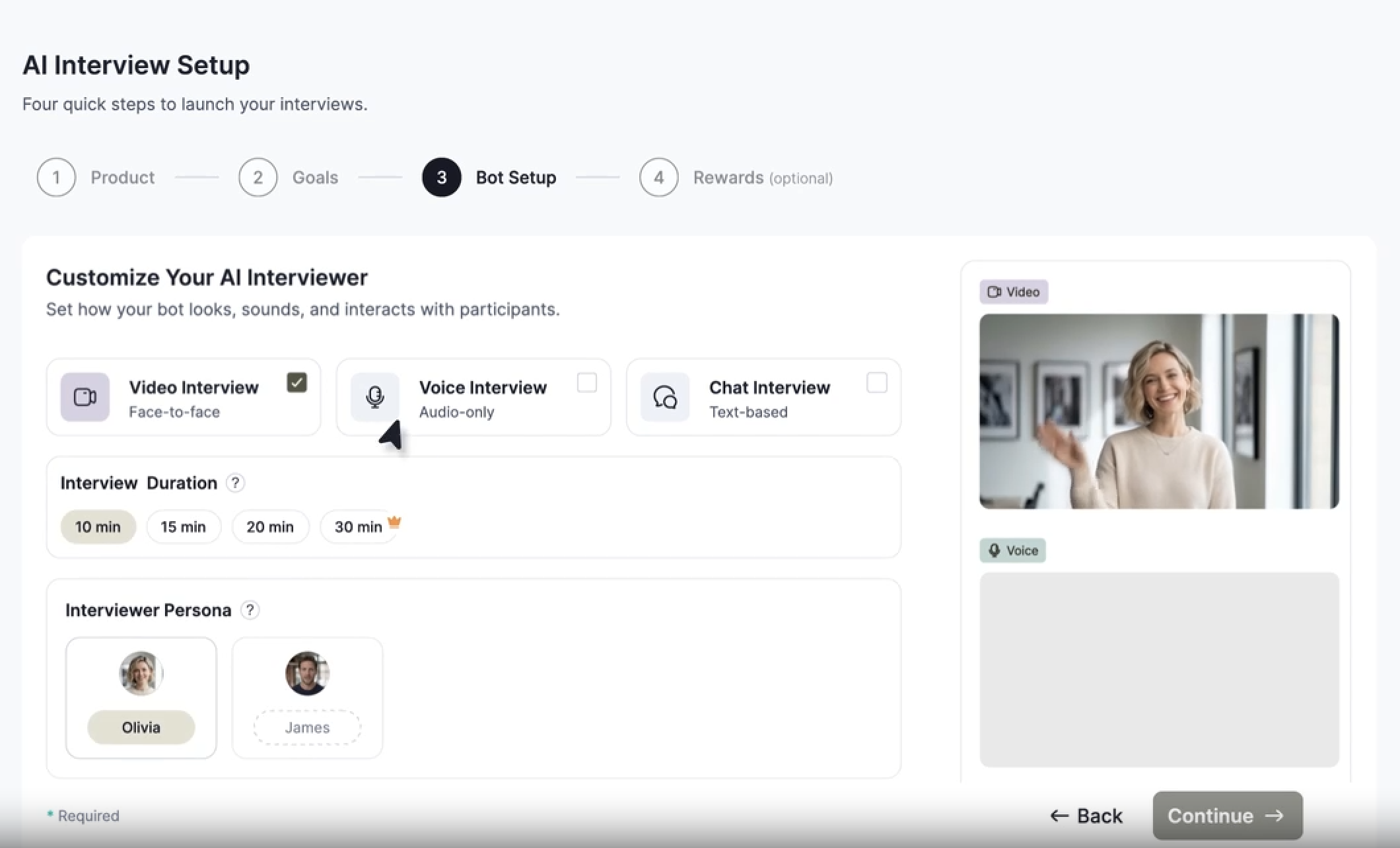
The setup takes under five minutes. You share your research goal: churn reasons, feature feedback, post-purchase understanding, early discovery, and Frank's Research Agent builds the interview outline. From there, Frank runs the conversations: adaptive voice interviews that follow up in real time based on what each customer actually says, not a fixed script.
It catches customers right after key actions. A cancellation flow. A checkout. An onboarding completion. Instead of weeks of tagging and summarizing, it automatically identifies key themes, patterns, and sentiment, so teams can move from conversation to decision within hours, not weeks.
Pros:
- Runs 100+ simultaneous interviews, zero scheduling, zero no-shows
- Participants join via voice, no app downloads, no account creation, no scheduling friction on their end
- Participants tend to give more honest answers to AI than human interviewers, reducing social desirability bias
- 30+ languages
- Every insight is traceable back to raw transcripts and recordings
- Guided setup: describe your research goal, Frank builds the framework, no research background needed
- Companies using Frank report 56% higher feature adoption and 20% lower churn rates, with a six-week research cycle compressed into roughly three days
Cons:
- No built-in participant panel; you need an existing customer base to send this to
- No native participant payment handling
- No Figma prototype or multi-concept testing
- Video interviews are not yet available
Why Frank over Strella: Strella's pricing is built for teams running research continuously at scale. Frank is built for the teams who need to understand their customers honestly, deeply, and fast, without paying for a platform sized for a research department. If you have an audience and a real question, Frank removes every other obstacle between you and the answer.
Pricing:
- Free
- Starter: $49/month
- Growth: $166/month
- Business: $312/month
2. Respondent
Best for: founders starting from zero who need to recruit specific, verified participants
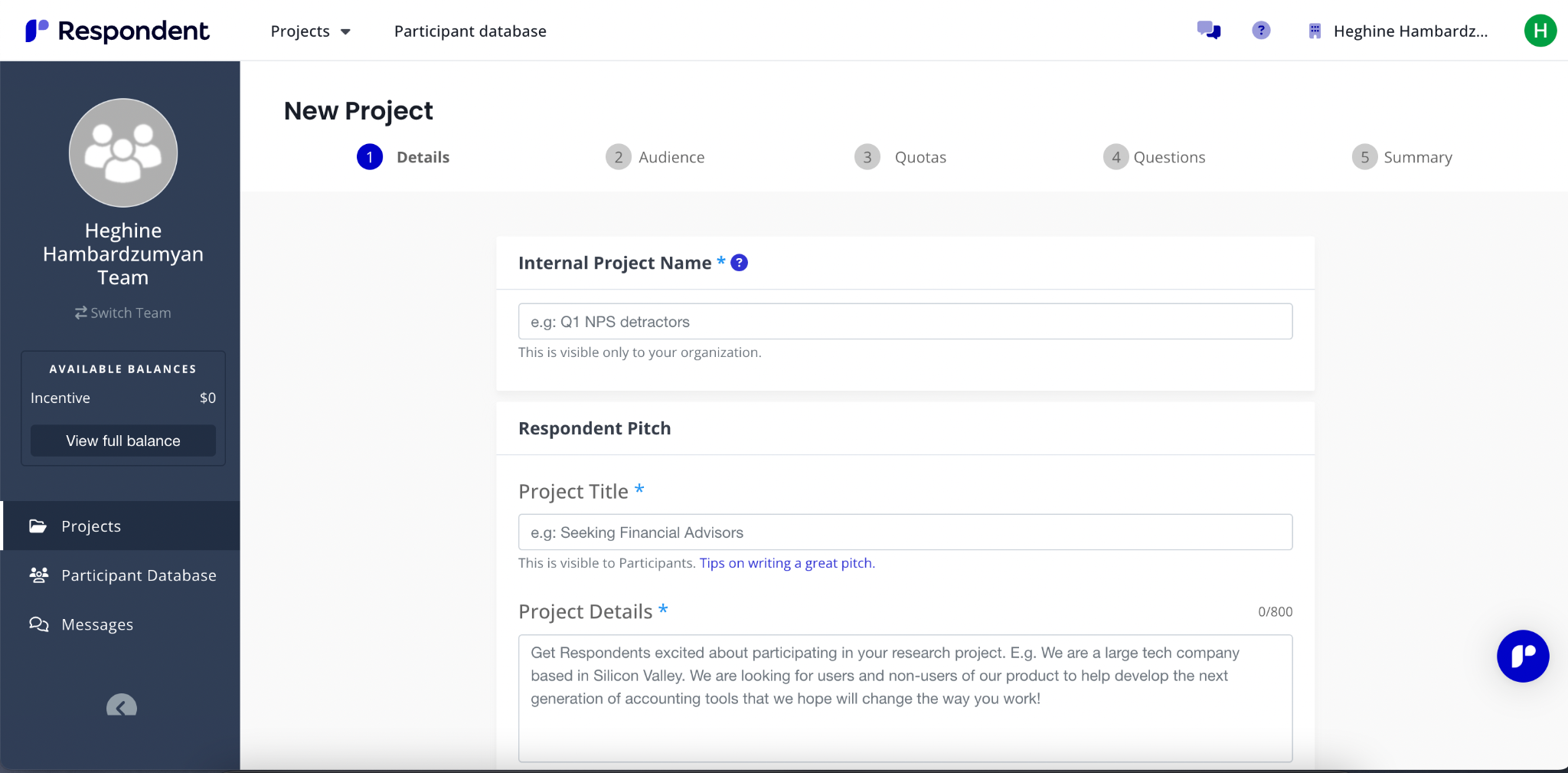
Respondent is a participant recruitment platform, not an interview tool, with a verified panel of 4M+ consumers and professionals across 150 countries. You tell it exactly who you need, it finds them, screens them, schedules them, and pays them. Whatever tool you use to run the actual interview: Zoom, Frank, anything, Respondent handles the people side.
What makes it different from just posting on LinkedIn or emailing your network is how the verification works. Participants are confirmed via work email, rated by previous researchers, and checked for screener inconsistency.
Pros:
- Verified professional panel with work email confirmation, people are who they say they are
- Built-in payments via Tremendous (gift cards, direct transfer, you set the incentive, Respondent handles the rest
- Pay-as-you-go; no monthly commitment, only pay for completed sessions
- Strong screener logic: filter by job title, company size, industry, behavior, location, tech stack
- Fast fill times; one researcher noted candidates arriving within three hours of posting on a Sunday afternoon
Cons:
- Recruitment only; you still need a separate tool to actually run and analyze interviews
- Niche senior B2B profiles cost more to recruit; budget accordingly
- No AI interview or analysis features
- Pay-as-you-go adds up fast without a volume plan
Why Respondent over Strella: Strella's panel works well for consumer research and broad professional segments, but niche B2B recruiting is genuinely hard, and general panels often fall short when you need a very specific job title, company size, or industry profile. Respondent's verified targeting gives you that surgical precision, and it handles participant payments natively, resolving two Strella gaps in one tool.
Pricing:
- Pay-as-you-go from ~$40/session for B2C
- ~$80/session for B2B
- No monthly fee
3. Maze
Best for: founders who need to validate a prototype or concept before writing a line of code
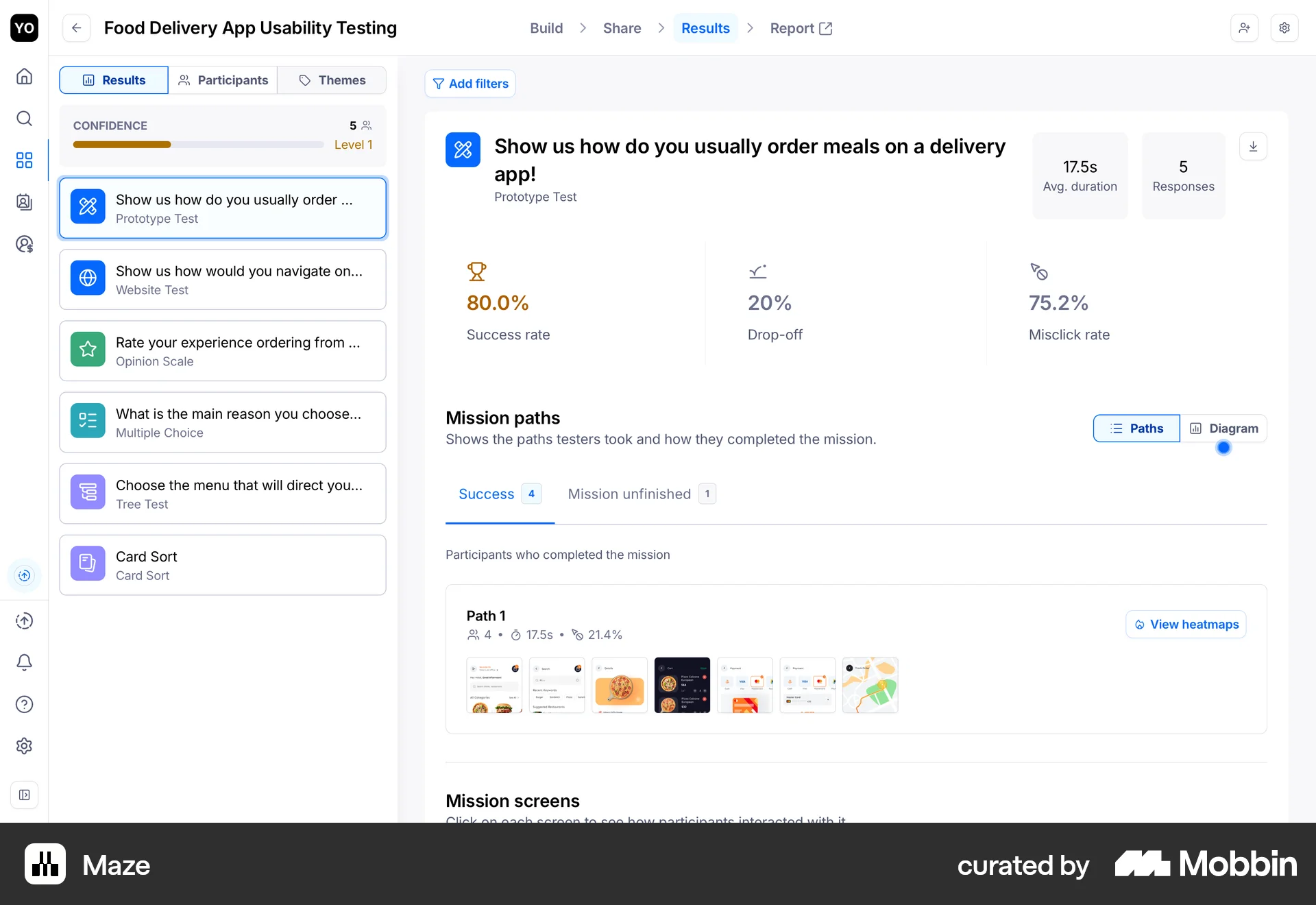
Maze is a product research platform built specifically for design and concept validation. Connect a Figma file, define a task, and Maze turns it into a testable flow, measuring completion rates, misclicks, time-on-task, and heatmaps. It also handles A/B concept comparison, copy tests, and card sorting. It's the closest thing to putting a design in front of a real user without actually being in the room.
What the output looks like in practice: after a study closes, Maze gives you a results dashboard per screen showing exactly where users clicked, where they dropped off, how long they spent, and what percentage completed the intended path. For a founder deciding between two landing page structures or two onboarding flows, that data lands in hours and answers the question without a single scheduled call.
Pros:
- Direct Figma (and Axure, Adobe XD) import; test prototypes in minutes, not hours
- Quantitative usability metrics out of the box: completion rate, misclick rate, path analysis, heatmaps
- A/B concept comparison: test two designs, landing pages, or feature flows side-by-side
- Free plan available, genuinely useful for low-frequency testing
- Built-in participant panel if you need one, or use your own audience
- Results back in hours
Cons:
- Behavioral data only; it tells you what users did, not why they did it
- Large Figma files cause instability. Prototype crashes are a commonly reported issue
- Mobile testing has known reliability problems
- Advanced features (interview studies, tree testing) are on the Organization plan only, which requires a custom quote
- The jump from the free plan (1 study/month) to Starter ($99/month) is steep if you only test occasionally
Why Maze over Strella: Strella captures why customers behave the way they do, but it cannot put a clickable prototype in front of them and measure what they actually do with it. If your question is "Does this onboarding flow make sense before we build it?" or "Which of these two concepts lands better?", Maze answers that in hours. Strella doesn't have that layer.
Pricing:
- Free: 1 study/month
- Starter: $99/month
- Organization: custom pricing
4. Lookback
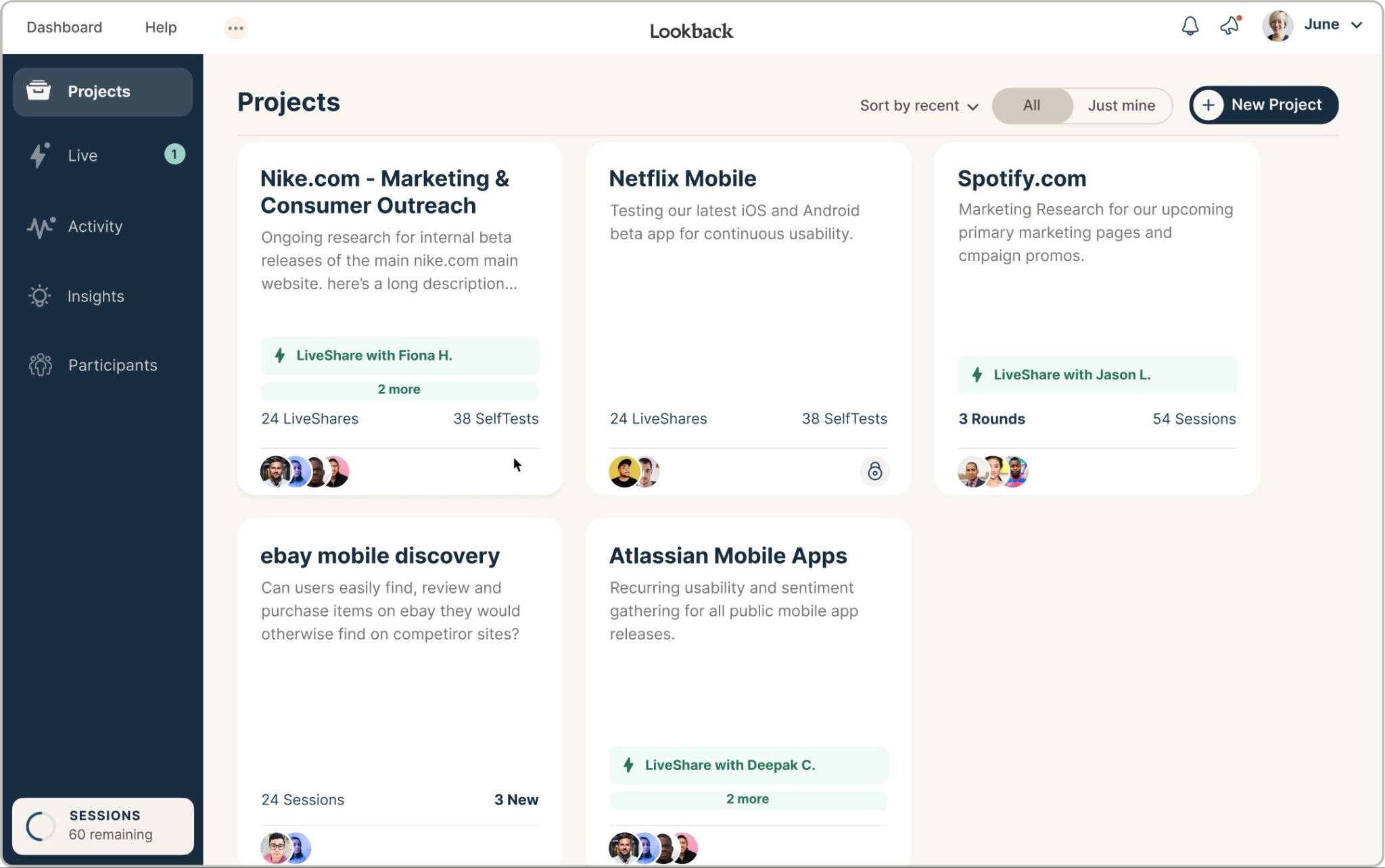
Lookback is a video-first UX research platform that records a participant's screen, face, and voice simultaneously during live or async sessions. It supports both moderated sessions (you run the call) and unmoderated ones (participants complete tasks on their own time). The whole point is observation: seeing what happens, not just being told.
The thing that makes Lookback genuinely useful beyond what a Zoom recording can do: team members can join a live session and watch in real time without the participant ever knowing they're there. A founder, a PM, and a designer can all be in the same observation room watching the same session, leaving timestamped notes as it happens.
Pros:
- Screen + face + voice captured at the same time you see the reaction, not just read the transcript
- Moderated and unmoderated sessions in one platform
- Team members can observe live sessions silently, without the participant knowing
- Collaborative tagging and session highlighting: useful for sharing findings with a team
- Affordable starting point: Freelance plan at $17/month
- 14-day free trial, no participant app download required for web sessions
Cons:
- No built-in panel, you recruit your own participants
- Chrome-only; iOS reliability issues reported repeatedly across reviews
- Exported clips use an unpopular file format that needs conversion before use elsewhere
- Analysis is basic: no AI synthesis, no automated theming across sessions
- Integrations might be limited
Why Lookback over Strella: Strella captures what customers say, but some insights only surface when you watch someone struggle. If your question is "where do users get confused in our onboarding?" or "what's their actual reaction when they hit the pricing page?", a session recording shows you something a text summary cannot. Lookback gets you that for $17/month.
Pricing:
- 14-day free trial
- Freelance: $17/month
- Team: $99/month
- Insights Hub: $229/month
- Enterprise: contact for pricing
5. Hotjar Engage
Best for: founders already using Hotjar who want to connect behavioral signals directly to interviews
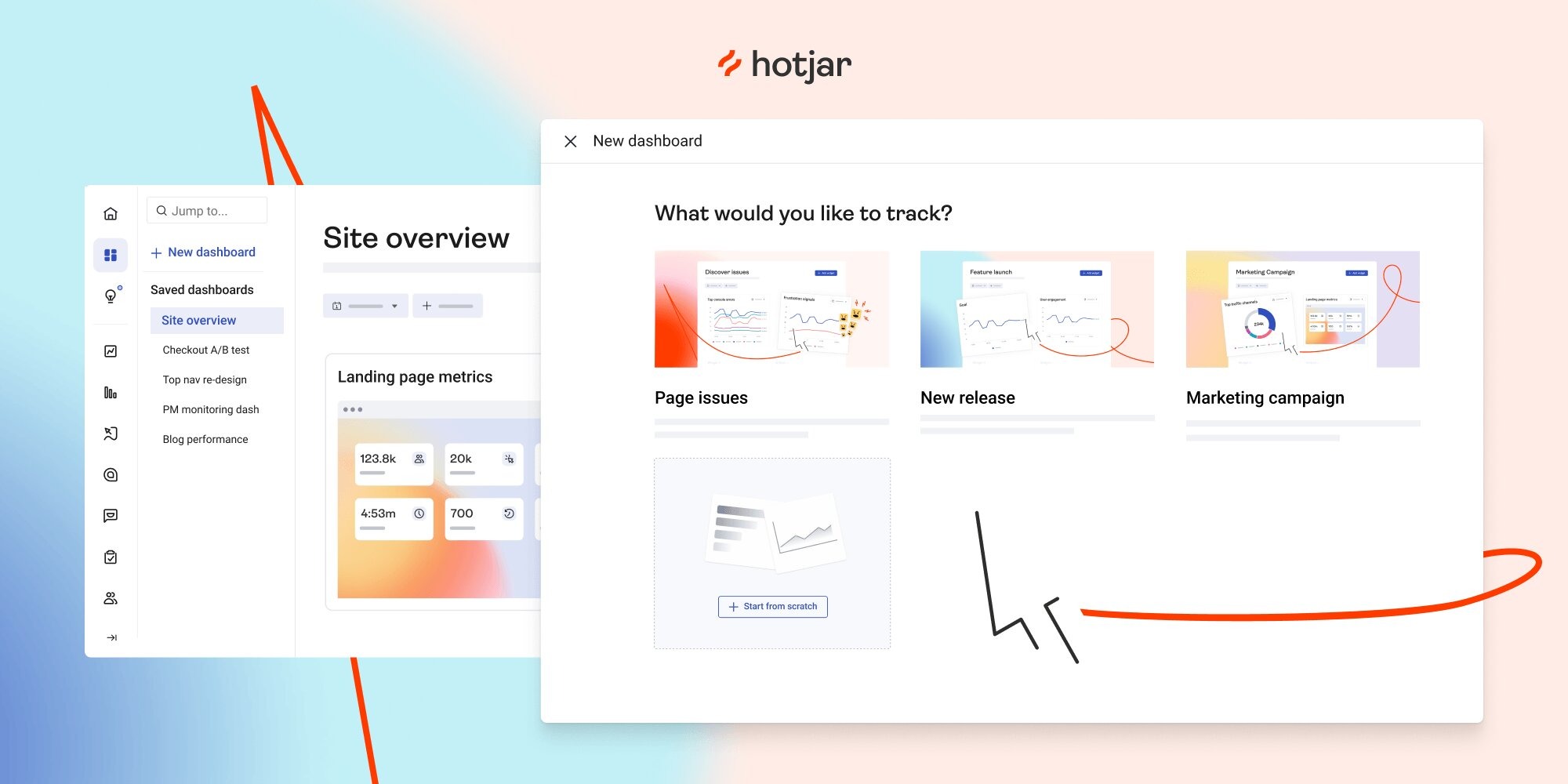
Hotjar built its reputation on heatmaps and session recordings. Engage is its interview layer, letting you recruit participants, schedule sessions, and run moderated video interviews inside the same platform where you're already watching user behavior. You see a confusing drop-off in a recording, and you interview the people behind it the same day.
Most customer interviews fail precisely because there's no behavioral context going in, you're asking people to explain actions they've already half-forgotten. That context changes what you ask and how deep you can go, which is something no standalone interview tool, including Strella, can replicate because they don't have the behavioral layer to begin with.
Pros:
- Behavior-to-interview loop: spot a drop-off in session recordings, interview those users the same day
- Handles scheduling, reminders, and recording automatically
- Built-in participant pool with compensation available at paid tiers
- Template-driven setup: no research expertise needed to get started
- For teams already paying for Hotjar Observe, Engage adds an interview capability without a new contract
Cons:
- No AI synthesis or automated thematic analysis, you get a recording and notes, not structured insight
- Participant pool only available on paid plans; free tier requires your own recruitment
- Pricing is split across three separate products (Observe, Ask, Engage), and bundling adds cost complexity
- High-paying interview slots are selective; not all participants get consistent access, which can affect recruitment consistency on the researcher side
Why Hotjar Engage over Strella: Strella is where you go when you've already decided to run a study. Hotjar Engage fits a different workflow: research triggered by something you already saw. You don't need to decide in advance. You notice something in a recording, you interview the people involved, and you understand what happened. That closed loop doesn't exist in Strella.
Pricing:
- Basic (Engage): free, up to 5 interviews/month.
- Plus: $280/month (annual).
- Business: $440/month (annual).
6. Koji
Best for: founders who want Strella-style AI interviews without Strella's pricing
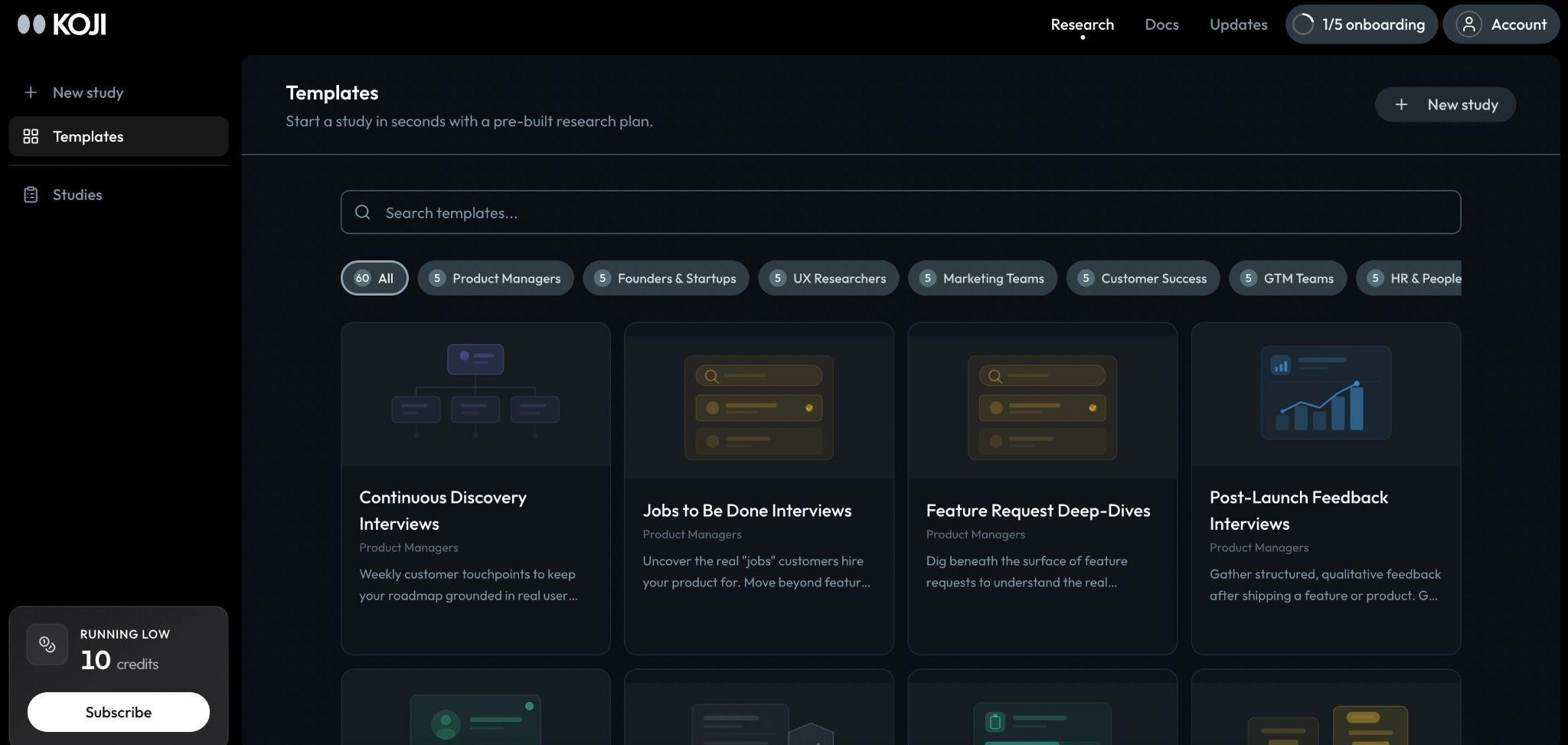
Koji is an AI-native research platform that conducts AI-moderated interviews end-to-end: voice or text, and automatically synthesizes findings into themes and reports. It's built specifically for founders, PMs, and small research teams, with transparent pricing and a customizable AI consultant that scaffolds the entire research process from setup to analysis.
You configure the study, define your audience, write your questions, customize the AI's persona and tone, and then Koji runs it autonomously. Participants complete interviews on their schedule, no calendars, no Zoom links, no no-shows. What comes back is a per-interview report as soon as each session closes, then a study-wide synthesis as more interviews accumulate.
Pros:
- Transparent pricing: no sales call, no procurement cycle, sign up and start
- AI conducts interviews end-to-end: voice or text, adaptive follow-up questions, no scheduling
- Automatic theme synthesis and insight reports after interviews are complete
- Six structured question types in one study, more flexibility than single-format tools
- Customizable AI consultant guides study design from scratch: useful if you've never set up research before
- Self-serve from day one, no IT involvement, no onboarding package required
Cons:
- No built-in participant panel, you bring your own audience
- Newer platform, fewer integrations, and a smaller community than more established tools
- No prototype testing or behavioral observation (Maze and Lookback cover those gaps)
- Interviews via phone/web, no native messaging channel delivery
Why Koji over Strella: Strella's pricing model is deliberately designed for large research organizations, built to eliminate per-project budget approvals inside enterprise teams, not to serve founders who need to run research without a procurement process. Koji solves the same core problem: AI-moderated interviews with automatic synthesis at a monthly price a single founder can justify without a budget conversation. If the use case fits but Strella's price doesn't, Koji is the closest structural alternative.
Pricing:
- Free starter credits available
- €29/month for text interviews (Insights plan)
- €79/month for voice (Interviews plan)
- €1 overage per additional response
So, Which One Is Actually for You?
The honest answer depends on where you're stuck.
If you don't have an audience yet and need to find the right people first, start with Respondent.
If you've got a Figma file and a gut feeling you want to validate before committing to a build, that's Maze.
If you need to watch someone use your product rather than just hear their summary of it, Lookback is the one.
If you're already in Hotjar and keep seeing patterns you can't explain, Hotjar Engage turns that curiosity into a conversation.
If the problem is simply that Strella's price doesn't work for where you are right now but the use case fits, Koji is the closest match.
And if you need everything: panel, AI interviews, synthesis in one integrated suite, and have the budget for it, Strella is worth a second look.
But if you already have customers and just want to understand them: why they churn, what's confusing, what they actually need without scheduling calls or hiring a researcher, that's what Frank was built for.
The best research is the kind that actually happens. Pick a tool, send it to five customers, and see what comes back.